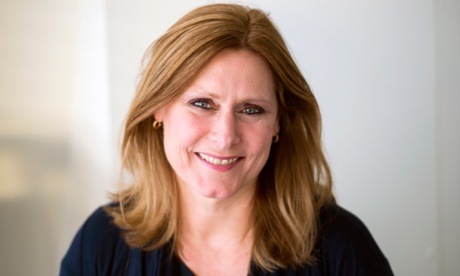
Sarah Brown – global campaigner for health and education, ex-prime minister’s wife, Twitter star – wants to talk about jewellery. Actually, what she really wants to talk about are the 57 million children worldwide who will never get a day in school. But a top-flight career in public relations and 13 years in residence at numbers 10 and 11 Downing Street have made Brown an expert on how to make people listen to and engage with a message, and these days she is convinced of the benefit of fashion as a campaigning partner. And so she is here to promote the bracelet she is wearing, made from sterling silver woven with sky-blue silk thread, sales of which will benefit Brown’s global education charity, A World at School.
The challenge of such a cause is that no one disagrees with it. There is no controversy with which to seize attention. “No one is going to say: ‘Oh no, I don’t think children should go to school,’” says Brown. We are 30 floors above Liverpool Street station, London, in the building where her charity works and Gordon’s non-parliamentary offices are based. Brown, smartly dressed in navy trousers and jacket and a scarf printed with abstract squiggles, is friendly and warm in person, although she positively bristles with efficiency. Several times, when a question starts to ramble, she dives in and crisply rewords it for me before answering. It is not done in a rude or domineering way, but as the instinct of someone who can’t imagine wasting time.
“We have to create something desirable, which motivates people to actively ally their own personal brand with this cause. And no one knows better how to create that desire than the fashion industry,” she says. Brown’s association with fashion and campaigning goes back to the 1980s, when her brother worked with Lynne Franks, whose firm represented Katharine Hamnett. Her years at No 10 coincided with a crunch time for London fashion week, which was in danger of being squeezed out of existence between New York and Milan. Brown proved herself a champion of the industry, negotiating with Diane von Furstenberg and reviving the lapsed tradition of Downing Street fashion week receptions, and played a key role in successfully seeing off the challenge.
Along the way, she made high-profile allies such as Naomi Campbell, who became a prominent supporter of Brown’s maternal mortality campaign. “I’ve worked with so many people in the fashion industry, and they’ve always been people who really get behind a campaign and come good on their promises. Historically, the campaigns that the fashion industry has attached itself to – I’m thinking of HIV/Aids, and breast cancer – these have tended to be campaigns with a strong identity, a vision that people can get hold of, and that has helped to make them very effective.”
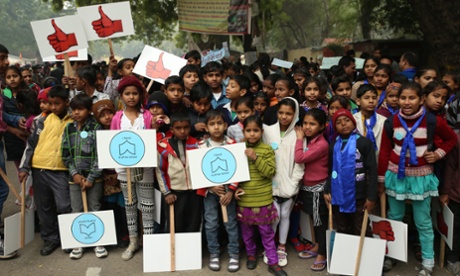
The bracelet is a collaboration that Brown initiated with jeweller Astley Clarke: 20% of the price tag will go to A World at School and online shoppers will be urged to join the three million signatories of the petition for a global right to education. Eight years ago, having noticed Brown’s name and Downing Street address attached to a jewellery order that had been placed online, founder Bec Astley Clarke slipped in a note introducing herself with the delivery, and the two became friends. “But I am realistic,” says Brown. “Fundamentally, I’m trying to implement change, and fashion does not exist primarily to do good in the world. Bec and her team can’t let the message stand in the way of their business, but there can still be a connection around creativity and branding and spreading a message online.”
From Brown’s vantage point in this glass and steel tower – so sleek that it stood in for a Shanghai skyscraper in the Bond film Skyfall – you can watch the weather fronts as they approach, rolling in across the city from the west. But then, Brown has always been savvy about knowing which way the wind is blowing. She joined Twitter early: “Because when we moved from No 11 to No 10 [in 2007] we needed to make ourselves more publicly available, and since Gordon and I wanted to keep the kids out of the public eye, I knew it was up to me to fill that space.” Twitter, on which she now has 1.2 million followers, allowed her to speak in her own voice, “rather than talking to journalists and leaving it up to them to translate what they decided I had meant to say. Also, 140 characters is perfect for my concentration span.”
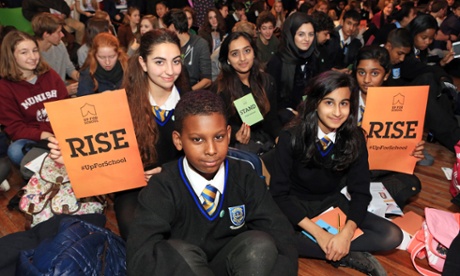
Last week, Brown piggybacked Twitter’s “throwback Thursday” meme, enlisting supporters such as Arianna Huffington and Miranda Hart to post photos of themselves as schoolgirls in support of the 31 million girls worldwide who are denied an education. “The fundamental change in the past few years is that everybody has their own brand, their own online identity, their own social media channels. If you want to be effective, you have to work with that. You have to create a unified call for action in a way that enables people to be their own brand,” she says. In other words: people are motivated to help others by the opportunity to post selfies. And if Brown finds anything negative in this development, she is too practical a campaigner to bemoan it publicly.
She is sanguine, too, about the pressures an association with fashion brings. “I enjoy fashion, but the reality of my schedule is that I have very limited time for hair and nails and makeup. To me, it’s a fairly straightforward tradeoff between results, and the amount of time I’m prepared to devote to it. I’m comfortable with that. Every once in a while I think: right, today I’m going to make an effort, and I’m going to enjoy it, but on the whole I’m not prepared to curate my life around my wardrobe.” The one fashion decision she regrets is the day she let the pressure get to her, she says. When Carla Bruni came on her infamous Dior-clad state visit in 2008: “I took advice from too many people, and ended up wearing something I wasn’t comfortable in. It was a perfectly nice outfit, but it wasn’t me. I got that one wrong.”
These days, the Browns live in Fife with sons John, 11, and Fraser, eight, juggling work trips to London between them. “The boys are used to us both having busy lives,” she shrugs. Gordon’s take on parenting has mellowed in the post-Downing Street years, she says. “You start off thinking you want your kids to be successful, but actually these days he’s much more of a view that you just want them to be happy. I think he’s a bit surprised by how strongly he feels that now.”
Both work diaries are still packed, “but it’s so much more manageable now, because we are more in control. The trouble with political life is all the things come out of nowhere and blindside you.” Her focus until the end of this year is those 57 million children “who all the UN countries signed up to promise they would have in school by the end of 2015 – which gives them months to deliver on that promise”. The thing is, she says, the goal is entirely achievable. “The costs are not actually very high, in global terms. There’s no rocket science involved. You don’t have to find a cure. This is a problem that can be solved. But you have to get the right people to listen and then to actually do something.”