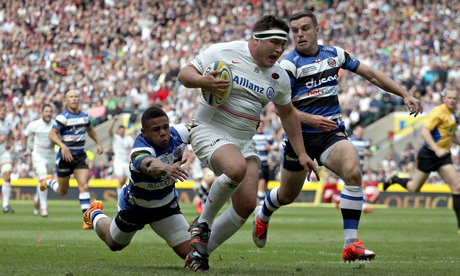
And so endeth a season that confounded from start to finish. The title has gone to a side who barely sneaked into the play-offs, at the expense of a team who played like millionaires the previous week only to crumple when it counted. If – and it is still a big if – the salary cap police have not been permanently muzzled, Saturday’s final may also be remembered with all kinds of mixed emotions. Alleged “financial doping” or not – any investigation of certain clubs has been put on hold by the Premiership hierarchy – no one can remotely question the resilience of Saracens’ players and coaches. This time last year they were pipped in extra-time in one of the crueller final denouements, with Owen Farrell among the most chastened participants. This year the England fly-half was both the man of the match and its principal villain. Dr Jekyll and Mr Hyde would seriously relate to modern professional rugby union.
Ultimately it was a triumph for organisation, planning and commitment over Bath’s hope, ambition and enthusiasm. Saracens’ defence coach, Paul Gustard, does not hog the limelight but the vice that clamped itself around Bath’s much-vaunted midfield was, in its brutal way, a masterpiece of stark modernist excellence. Around the corner, as always, came the screens of decoy runners with lurking ball-carriers behind; invariably waiting were a steely posse of defenders to snuff out the threat. Jacques Burger, Maro Itoje, George Kruis, Jamie George, Brad Barritt and the Vunipola brothers enhanced their reputations in the process.
It made it a chastening afternoon for George Ford, Kyle Eastmond and several of Bath’s other England World Cup hopefuls, none of whom found dancing with the “wolf-pack” much fun. Even had their full-back, Anthony Watson, not been forced off early by Farrell’s card-worthy high tackle, the travails of David Wilson and, later, Rob Webber in the set pieces were further evidence of Bath’s less-than-perfect day.
It was also the first time the play-offs have been won by a side from outside the top two in the regular season table, although as Saracens’ director of rugby, Mark McCall, rightly stressed, the north Londoners came top in the previous two seasons and gained absolutely nothing for it. Given the club, as a collective, have also scooped the LV Cup, the A league, the Under-18 academy and the women’s Premiership titles, they must be doing a fair amount right.
Lest we forget, they were also England’s leading side in Europe, increasingly the best place to draw form-lines for grand Twickenham days such as this. Whereas Bath were largely the architects of their own failure against Leinster in Dublin in the quarter-finals, Saracens fought their way to within a few points of reaching a second European final in successive years. Bath, for all their pretty patterns, still have something to learn about big game cussedness away from their intimate Recreation Ground home.
Mike Ford, their head coach, reckons they will come back stronger. As Saracens have just demonstrated, the sting of cup final defeat can be a powerful motivator. There are rarely any short cuts, though, as Sam Burgess is learning. The high-profile code-hopper had one of his more conspicuous games in union but it was his overambitious offload that led to Saracens’ third try for Chris Wyles after 31 minutes and effectively ended the game as a contest.
Farrell and George had already scored tries of their own to punish Bath’s glaring lack of first-quarter accuracy and may be reunited in England’s World Cup squad this year. The boy George may not look a natural Culture Club candidate but, in addition to his set-piece strengths, was quick enough to outpace Eastmond as he scurried to the line. It would be no surprise if he fills the place in the final 31 originally earmarked for Dylan Hartley until the Northampton hooker butted his Saracens opposite number in the semi-final.
Stick a few quid, too, on the 20-year-old Itoje emerging as a key England figure sooner rather than later. On Friday he was busy doing his final political theory paper as a second-year degree student at the London School of Oriental and African Studies. Twenty-four hours on he could be found graduating with honours as an influential forward in a Sarries back row who eclipsed their Bath counterparts, a sure sign of a young player unfazed by the size of the occasion.
If his future looks bright, so does English rugby’s. Aside from the United States international Wyles – born in Connecticut to English parents – all the points were scored by England squad members and the Aviva Premiership final nowadays is all but a Test match environment minus the anthems.
Next season will be even more achingly competitive, particularly if a few more big overseas names are lured over under the new second marquee player rule to replace the likes of the Clermont-bound David Strettle.
Those under investigation for alleged historic salary cap abuses, if they do face action, will argue they were just ahead of their time.
Bath Watson (Devoto, 9); Rokoduguni, Joseph, Eastmond, Banahan; Ford, Stringer (Cook, 67); James (Auterac, 47), Batty (Webber, 47), Wilson (Thomas, 49), Hooper (capt; Day, 55), Attwood (Garvey, 59), Burgess, Louw, Houston (Fearns, 61).
Try Joseph. Con Ford. Pens Ford 3.
Saracens Goode; Strettle (Ashton, 65), Taylor, Barritt (Hodgson, 69), Wyles; Farrell, Wigglesworth (De Kock, 56); M Vunipola (Barrington, 77), George (Brits, 53), Du Plessis (Figallo, 49), Kruis, Hargreaves (capt; Wray, 33), Itoje (Hamilton, 67), Burger, B Vunipola.
Tries Farrell, George, Wyles. Cons Farrell 2. Pens Farrell 3.
Referee W Barnes (RFU). Attendance 80,589.