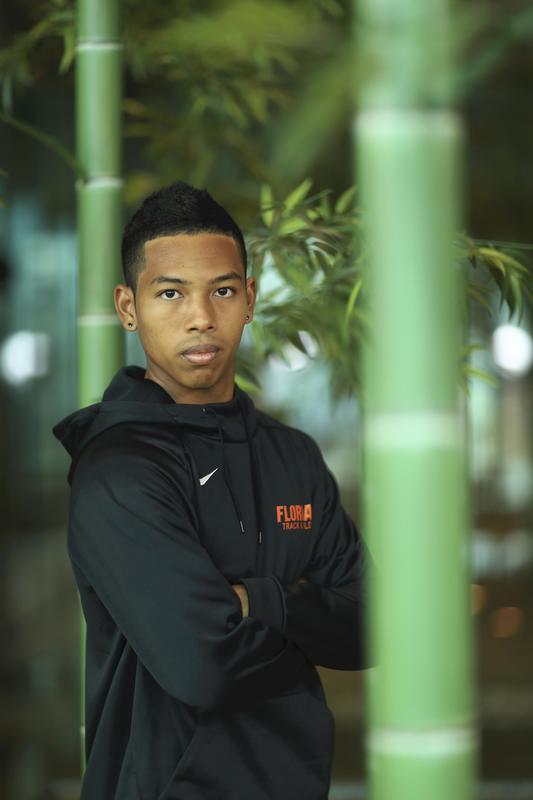
Abdul Hakim Sani Brown, who set a Japanese record of 9.97 seconds in the men's 100-meter race, discussed his dream of one day breaking the world record currently held by Usain Bolt in a recent interview with The Yomiuri Shimbun.
The 20-year-old spoke candidly regarding previously unknown details about his record-setting sprint, why he chose to enroll at the University of Florida in the United States, his life as a student and his future dreams.
Still room to improve
The Yomiuri Shimbun: You set the Japanese record of 9.97 seconds at the National Collegiate Athletic Association (NCAA) Outdoor Championships. Tell us about that moment.
Sani Brown: Before the preliminary, I was instructed by my coach Mike Holloway to keep my head low for two more steps at the start so that I could maintain my acceleration. I made a good start in the final and ran comfortably from the middle section to the end of the race. It was the best I could've raced at that time.
Q: In spite of that, you finished third. Does that reflect the training environment you were looking for?
A: Running with fast runners helps me run faster. It's more fun. Last year I missed the championships due to an injury, but this year I competed with top-level athletes. It was a really good experience for me.
Q: How have you improved during your time in the United States?
A: In terms of skills, I've improved my arm swings. Since last summer, I've always been conscious about firmly swinging my arms up to the front of my face and swinging my elbows to the back of my body. I also have better upper- and lower-body strength, so I can start more aggressively than before. The weight of the barbells I use is almost the same as before, but I've also been trained by a coach specializing in weight training on how to build muscle.
Q: You seem to perform well in big races. What do you focus on in races?
A: I visualize my running when I hear, "On your marks." Then when I hear "Set," I don't think of anything. If I concentrate on what I have to do, I can forget about the other runners and execute what I've accomplished during practice.
Q: You seem to have a lot more potential to grow. What percentage of your perfect form have you achieved?
A: It's still only 50 percent to 60 percent. I wonder if I could reach 100 percent someday. Recently, Coach Holloway told me that he'll definitely find things for me to improve on no matter how fast I run.
Motivation for studying in U.S.
Q: Why did you choose to study in the United States?
A: I started to think about that in 2015 as a second-year high school student when I ran in the World Youth Championships and World Championships. Very few go on to study in the United States, and it was something I didn't know anything about. I think curiosity was my biggest reason for going.
Q: Were you anxious about studying abroad?
A: I wondered how I'd do with English since I'd mostly forgotten it. My family spoke English at home when I was a child, but we switched to Japanese after my father, who's from Ghana, improved his Japanese skills. In the Netherlands [where Sani Brown was based for about half a year before entering university], I picked up English again and my anxiety mostly disappeared.
Q: The university is said to be academically challenging. Why did you choose such a difficult path?
A: When I was in high school, I realized that athletes never know how long they can compete. In the future, I want to do a sports-related job not only in Japan, but something with a more global scope. I hope I can get a job in that field if I get a sports-related degree.
Q: You now study sport management. Tell us about your studies.
A: My most interesting class was one in which active athletes like me explore careers after retirement together. We set goals to achieve five or 10 years down the road and presented our plans for achieving those goals. I presented a plan to become an agent and help athletes. I feel Japan is still separated from other parts of the world, so I hope to serve as a bridge that allows athletes to choose various future career paths.
Q: Do you want to serve as a model for other athletes?
A: I haven't really thought of myself like that, but I hope everyone takes on challenges. In America, people respond favorably if you show a desire to communicate with them. I felt that making efforts and expressing a desire to learn was more significant than the language barrier.
Inspiring future athletes
Q: How do you see next year's Olympics?
A: It's really hard for me to imagine. Even though I've been away from Japan for a while, Tokyo's my hometown. Though Tokyo might not feel like Tokyo during the Olympics, it'll still be fun. The Games are a big goal for me, and I want to put up some strong results this year in preparation for next year.
Q: What is your specific goal for the Tokyo Olympics?
A: I haven't set any goal yet. As an athlete, I set annual -- and even daily -- targets. It's important to set future goals, but I can't reach big goals unless I achieve smaller ones first. What I need to do first is to steadily accumulate smaller achievements. As my biggest target, however, I still want to break the world record [of 9.58 seconds set by Usain Bolt of Jamaica].
Q: The level of Japanese sprinters is improving.
A: It's good that we motivate each other to improve; we can run even faster times in relays. It's important that we aim to reach the finals or win medals as individuals. We can motivate high school students and other next-generation runners by raising our levels.
Q: How do you view your chances in the 100 and 200 races?
A: If I keep on doing what I need to do, I can definitely reach the finals [of the Olympics and World Championships]. I'm not that concerned with how much I can shorten my time, but rather with improving my form and brushing up my running. I accept that I'll need to keep on pushing and battling against myself.
Read more from The Japan News at https://japannews.yomiuri.co.jp/