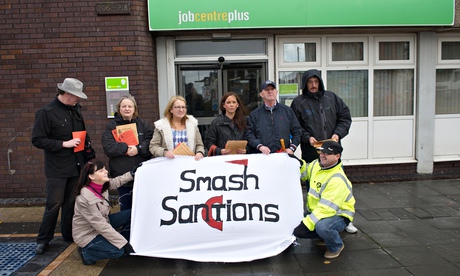
Statistics will take you only so far. Parts of the government’s welfare reform programme seem inscrutable to the casual observer. With this in mind, the theatre company Cardboard Citizens’ latest play, Benefit, illustrates the labyrinthine sanctions system through three interwoven tales of individuals having their jobseeker’s allowance or employment support allowance suddenly stopped. The play shows a young woman, a middle-aged man in a long-term relationship, and a man with severe mental health problems attempting to navigate the byzantine and often heartless benefit system.
Three of the four actors in the play have experienced homelessness at first hand, as have many members of the production team. Cardboard Citizens routinely tours hostels, day centres and prisons with its plays, giving performances inspired by the homeless people they meet, while also including people who have experienced homelessness in their casts. The play draws on testimonies from the company’s homeless members, media reports and charity research, and its director, Adrian Jackson (also the company’s founder), says he wanted to scrutinise “the punitive sanctions that are now liberally doled out by jobcentres for even minor infringements”.
The centre of the play involves the three protagonists, from disparate backgrounds, meeting in a queue at a food bank after being sanctioned. This is no coincidence – a cross-party report on food banks in December 2014 found that benefit sanctions were the single biggest reason for their use. Mental health charity Mind has expressed concern that the number of people with disabilities being sanctioned was so high, and said it was “unjustifiable that people with mental health problems are being disproportionately affected by this increasingly punitive system” – 60% of people sanctioned in the work-related activity group reported having disabilities.
A freedom of information request to the Department for Work and Pensions found that more than 900,000 people on jobseeker’s allowance had been sanctioned between April 2013 and March 2014. More than half of those sanctioned were under the age of 30, according to internal management statistics. The sanctions in the play are doled out for different reasons: one character fails his Atos fit-for-work assessment because he doesn’t understand the questions and the assessor clearly fails to grasp the extent of his problems; another is sanctioned for leaving a zero-hours contract that, true to its name, had offered no work for months on end; a young woman is sanctioned for attending a mandatory CV workshop at the same time as her usual signing-on slot. Throughout the play, interludes recount various real-life tales of sanctions, garnered from newspaper clippings and individuals in hostels and shelters.

The play is also timely because reports of homelessness have risen by 55% since the coalition came into power. Homelessness and benefit sanctions do not exist without overlap, as a recently launched report shows. The Homelessness Monitor 2015, the joint report by the Joseph Rowntree Foundation and Crisis, singled out the DWP’s sanctions regime for particular scrutiny, especially in its effect on homelessness.
One homelessness service provider in the north of England told researchers that dealing with sanctions now took up 50% of staff time. Another local authority respondent in the same region told Crisis: “JSA/ESA sanctions are increasingly viewed as one of the greatest causes of loss of accommodation for single people.”
The three stories in Benefit show that the journeys to being sanctioned are different, but the end result is the same: not the sudden ability to find and secure a job in places with still stagnant local economies, but hunger and great insecurity. Expecting people to rely on the kindness of friends and strangers when their subsistence benefits have been taken away carries an assumption that everyone has a safety net. Many people don’t, and relying on your family and friends can be tough when you’ve no money for rent, food and bills – sometimes for months on end. The benefit system should be the social safety net for every citizen: instead it’s increasingly treated as a prize to be earned.
Benefit’s UK tour runs from 18 March to 10 June. Details at cardboardcitizens.org.uk