This week’s best city stories from around the web explore counter-pollution measures in Beijing, extreme urban growth in Chongqing, a “rewilding” of New York City, and a simple – yet vital – change for pedestrians in Calgary.
We’d love to hear your responses to these stories and any others you’ve read recently, both at Guardian Cities and elsewhere: share your thoughts in the comments below.
Workaholic juice-fiend?
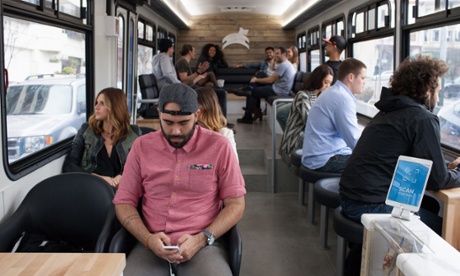
Last week, private transportation company Leap launched a new shuttle-bus service in San Francisco, designed to feel “more like a living room than a bus”. With free WiFi, USB ports and laptop stations for use – and not to mention the freshly-pressed organic juices and local snacks for sale – a trip aboard the Leap bus will set riders back $6 (juice not included) for a one-way journey from uptown to tech-town. For San Francisco’s smartphone users (of course, there’s an app for it), the service takes “the hassles out of getting to work”, ferrying commuters to a hub of tech and start-up offices in the city’s core. As the Washington Post points out, private services like this - and not just in San Francisco – raise some broader issues: “Transit needs a shakeup.”
Clearing the skies
In Beijing, a city made “almost uninhabitable” by pollution, there is light at the end of the foggy tunnel for residents, as the four remaining major coal-fired power plants in the city will be shut down next year, reports Bloomberg. For years, Beijing has been hit by heavy air pollution, caused by an enormous use of coal to generate electricity to fuel a booming economy. Shutting all the major plants in the city is estimated to cut carbon emissions by around 30m tons, and the four facilities to close will be replaced by four gas-fired stations, with the capacity to supply 2.6 times more electricity than their coal-powered predecessors.
A green injection for a concrete jungle
New York-based botanist Marielle Anzelone has a plan to give visitors to Times Square an immersive and natural experience by transforming a public plaza into a temporary nature installation to create an urban oasis in the heart of “Skyscraper National Park”. As Fast Co Exist explains, Times Square has already enjoyed a car-free makeover, and a pop-up forest – although only temporary – could make the neighbourhood much more appealing.
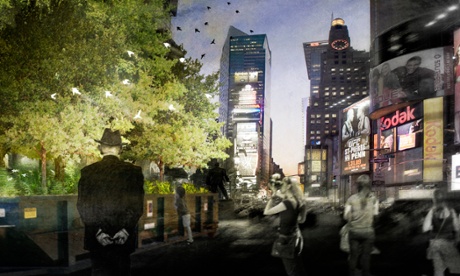
Launched earlier this month, the PopUp Forest: Times Square Kickstarter campaign is gaining steam, with almost $20,000 of the $25,000 goal already raised to fund a pop-up prototype for Brooklyn’s Gowanus neighbourhood. But, while the target has nearly been reached, it makes just a tiny dent in the $1.7m cost of planting the PopUp Forest in one of NYC’s busiest intersections.
First steps for pedestrians
In Calgary, citizens were asked for their input and ideas for the city’s new “pedestrian strategy”. But rather than glitzy infrastructure projects, several replied asking for one simple thing: sidewalks. Many areas across the city do not have sidewalks, but instead have paths worn into the ground on either side of a road from those who dare tread. Councillor Druh Farrell suggests that while it would be too costly to build a sidewalk on every street that is currently without one, the city should identify priority areas for pedestrian infrastructure to grow. “We’re a very young city,” she says. “As communities redevelop, we have an opportunity to fix some of our mistakes.” It’s one small step for Calgary ...
The city eats the country
As featured in ArchDaily, Tim Franco’s photographs reveal the impact of rapid urbanisation on the farmland surrounding Chongqing, China’s fastest growing city. “The changes I have witness in Chongqing are tremendous,” says the photographer. “I have seen entire districts disappearing in the centre of the city... with farmers continuing to plant vegetables between highways or on the side of construction sites.”
With 1,300 people moving to the south-western city every day, Franco’s images reveal the impact of a city actively seeking to urbanise a very rural population (in 2010, Chongqing vowed to raise its urbanisation rate from 28% to 70% by 2020). “I really felt that Chongqing was a representation of what was going on in the whole country, except in a rapid and city-scale simulation.”