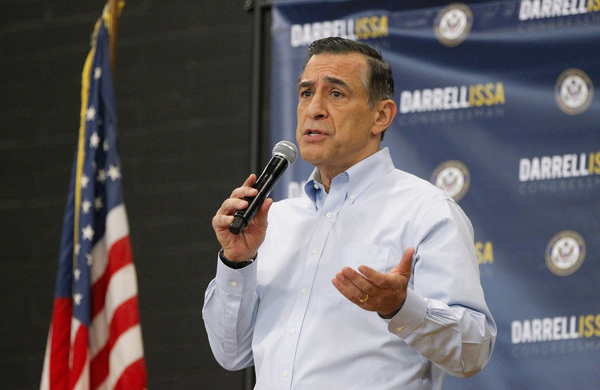
SAN DIEGEO _ A San Diego attorney has asked the Office of Congressional Ethics to investigate Rep. Darrell Issa for not reporting a business he owns in an ethics report.
Gil Cabrera said that Issa, R-Calif., violated the Ethics in Government Act by failing to report a real estate investment and property management company he owns with his wife to the Clerk of the House.
Issa's office, however, said he hasn't included the firm, DEI Investments, LLC, in his annual financial disclosures because the company never conducted any business and is consequently exempt from the annual reports.
"This was a name which was registered and never used. It had no income, no value and no business activity and therefore was not reportable," Issa's spokesman, Calvin Moore, said.
Cabrera, the former director of San Diego's ethics commission, said that the company needs to be included.
"It is critical that Mr. Issa make the disclosures necessary to comply with the requirements of the Act so that the public is granted a complete picture of Mr. Issa's finances as a U.S. representative and candidate for federal office," Cabrera said in his Dec. 11 letter.
Cabrera did not return follow-up messages requesting comment.
The Ethics Committee declined to comment, but its financial disclosure instruction manual says members must report ownership interests in privately held companies if they are valued at $1,000 or more or generate at least $200 in income.
San Diego County property records do not show any properties owned by DEI Investments, a real estate investment and property management company, since it was formed by Issa and his wife Katherine in 2008. But as a privately owned business, many of the company's financial transactions are usually not publicly available.
The business takes its name from the congressman's initials, and it lists a suite in the same building as the congressman's district office in Vista as its headquarters. California Secretary of State records show DEI Investments, at various points, was intended to be used for business in the commercial real estate investment and property management industries.
Records also show that the Franchise Tax Board suspended DEI Investments in 2014 for failing to file a tax return.
Representatives as well as candidates are required to provide the Clerk of the House financial reports that list their sources of income and their assets, investments, and businesses they own or work for. It's common to find that members of Congress have a home with a mortgage, a nest egg, and pensions from past elected positions they've held as well as other sources of income and investments.
These reports also list what properties a member of Congress owns, and, if relevant, any rent they receive.
These reports can also be used to calculate _ roughly _ a candidate or politician's net worth. Roll Call, a news publication that tracks members' wealth, estimates that Issa has at least $379.65 million in assets, but at least $125 million in liabilities, making him, by far, the richest member of Congress. Nearly all of his assets are in investments, but he does own $17 million in real estate, Roll Call said.
The Ethics Committee's financial disclosure manual says statements are reviewed for completeness, accuracy, and timeliness. If the committee finds an error or omission, it will notify the member. From there, the politician can accept the committee's review and submit an amended report. If the member disagrees, they can explain their position to the committee to reconsider. The process is not publicly disclosed, the committee said.
The committee's manual said that unintentional errors and omissions and amendments are "ordinary."
"Generally, unless there is some evidence that errors or omissions are knowing or willful, or appear to be significantly related to other potential violations, the Committee notifies the filer of the error and requires that he or she submit an amendment or provide an explanation or other information explaining why the filer believes an amendment is not necessary. Once an amendment is properly submitted, the Committee takes no further action," the manual says.
Under the Ethics in Government Act, a member who willfully and knowingly falsifies their statement, however, can be pursued by the attorney general and may be fined as much as $57,847 and a one-year prison sentence.