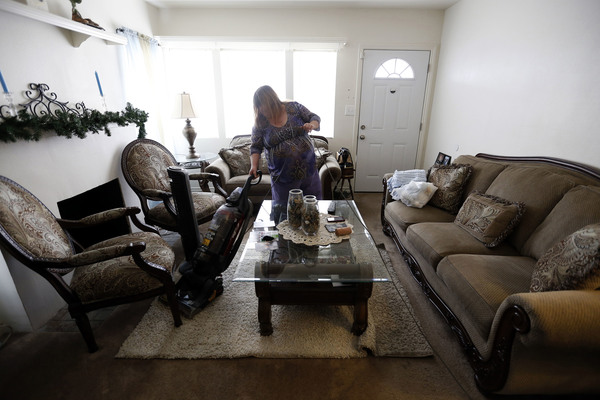
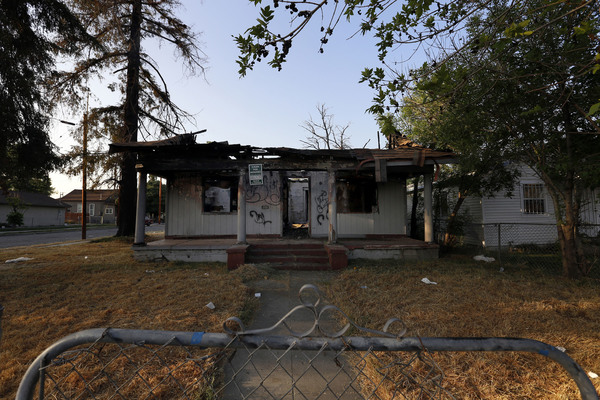
SAN BERNARDINO, Calif. �� Year after year the homes fell around her. Abandoned to squatters, stripped bare, gutted by fire.
On her side of the block, only two of five houses remained, side by side, uncharred. Diane Hayes wanted to sell and move out, but couldn't afford to. Her next-door neighbor died this year. Workers boarded the windows with big carriage bolts, but people managed to get into the crawl space and cut their way in through the floor.
Now Hayes waits behind her steel security screen for what comes next, her home a lone island whose fate sinks or stands with the city.
Her situation is neither the norm nor abnormal in San Bernardino.
A year after a terrorist attack put the city on an international stage, San Bernardino is stagnating and suffering and moving forward all at once.
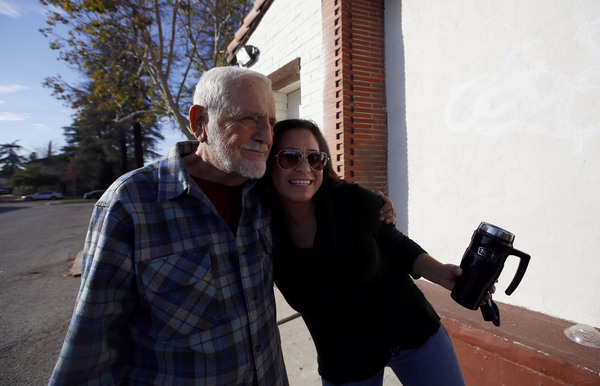
Five blocks away, Ernie Garcia opened an art center last year after retiring as dean of education at California State University, San Bernardino. The Depression-era Works Progress Administration building was a work of art in itself, a hacienda layout of 18-inch-thick adobe walls, wrapping around a courtyard.
When he moved in last year, it had been vacant for seven years. Mattresses filled the hallway and the wire had been stripped. On one of the walls, someone spray-painted, "I am the copper monster."
Now it is cleaned and renovated, alive with artists of all types _ painters, sculptors, poets, printmakers _ learning, teaching, and simply gathering and conspiring to bring the city back.
While every city has its divides and pockets, in San Bernardino, population 216,000, one island can feel strangely alien to another, a product of the economic forces that have battered the city for decades.
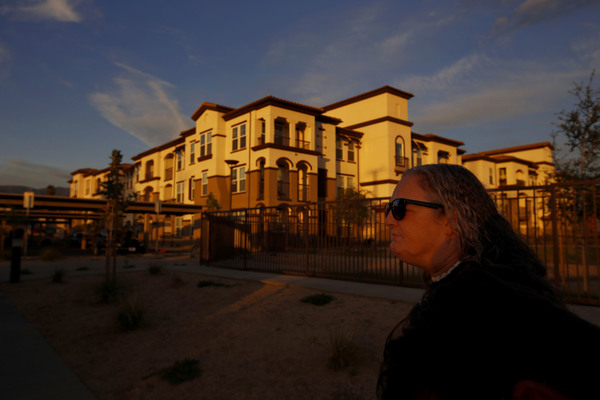
There are points of pride and hope _ Cal State San Bernardino, Garcia's art center, the downtown symphony, a new affordable housing complex, a soon-to-open transit center. And there are pockets of suburban quiet and even economic growth, with big distribution centers rising from dusty old ranch plots in the southeast.
When Syed Rizwan Farook and Tashfeen Malik opened fire in the Inland Regional Center and killed 14 county workers Dec. 2, 2015, the city grieved. But the attack, at a professional building on the south end of town, felt distant, removed from the everyday struggle and violence of many neighborhoods, where more than 60 people have been killed this year.
More than half the city is on public assistance, and only 46 percent of working-age people have jobs. The most populated parts of the city are desperately poor _ places where median family income is $15,000 a year.
But in the vacant lots and buildings, many see opportunity. Garcia's vision is to build an isthmus of art galleries and businesses between his center and a cultural landmark three blocks north _ the original McDonald's restaurant.
"We have people come from all over the world to see where McDonald's started," he said.
Visitors check the museum out and _ seeing the vacant lots and empty storefronts on Baseline Street, the prostitutes hustling the street in the middle of the day, the meth addicts and schizophrenics nodding, lurching, talking to themselves _ they get out of town.
The conundrum for a city in its fourth year of bankruptcy is how to build the isthmuses to the point there are more than just scattered bits of optimism, but signs of a collective recovery.
City Manager Mark Scott says the state government needs to help, because much of the collapse stemmed from a statewide shortage of housing. Prices soared in places like Los Angeles and Orange counties, and low-income residents moved inland, looking for low rent.
Scott, who has been city manager of Beverly Hills, Burbank, Culver City and Fresno, said it's unfair for the city alone to shoulder the burden.
"Poverty migrated here, just like it migrated to the Central Valley," Scott said. "And crime chases poverty."
Scott said the city is still righting itself, despite the surge in homicides. It's finally on track to leave bankruptcy, and voters passed a measure to streamline the structure of city government. And Scott expects San Bernardino will benefit and learn from improvements made in the school district.
Under a new superintendent, graduation rates rose from 73.5 percent to 79.9 percent between 2012 and 2014, closing in on the state average of 80.8 percent.
Last year, it surpassed it, climbing to 85 percent.
Miriam Nieto, a behavioral therapist, dreams of raising a family here, and opening a coffee shop downtown.
She is part of a movement called Generation Now, which works to engage young people politically and to volunteer for projects to improve the city. They walked precincts to get charter reform passed. They clean parks, paint murals, register voters.
But even she wonders if she'll see a transformation in her lifetime.
"Sometimes I think about do I even want to stay in this city," she said. "Why do I want people to come in, when I'm not even sure this is the right place where I would raise a family?"
Nieto lives on the west side of town with her parents, younger brother and sister.
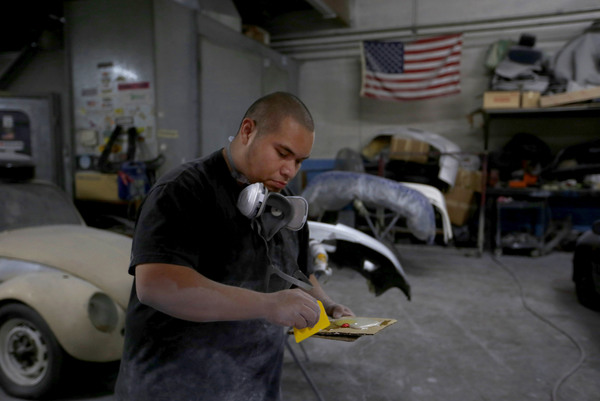
Her brother Jonathan, has his own dream in the city. He is trying to get a $20,000 loan to buy the body shop he works at on 9th Street. From that, he hopes to make enough to enroll at the ArtCenter College of Design in Pasadena and become a car designer.
He worries there are already too many body shops in San Bernardino, but he can't afford the rent anywhere else. "There's not much money to be spent around here," he said.
Like his sister, he wants the city to rise, but not by gentrifying and driving the poor people out. "I'd like to see the change happen with the people who are here," he said.
Dave Deardorff grew up in San Bernardino and fled the poverty and crime of his neighborhood in 1991.
He landed in another San Bernardino.
Deardorff 's Dover Drive neighborhood is quiet and landscaped _ cookie-cutter homes against the foothills, for a fraction of the cost they would be elsewhere. He bought his for $150,000 and figures it's worth $250,000 now.
"No loud parties, low crime," he said. "We kind of enjoy our isolation up here."
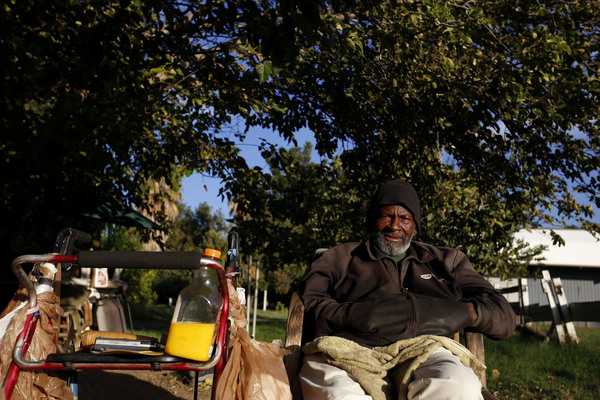
About as far as you can get from Dover Drive in San Bernardino, Herb Sims sat in the sun, reading the Bible and listening to Rush Limbaugh on a portable radio, even though he doesn't agree with him at all.
Sims has lived in San Bernardino here since 1959, on 1.25 acres his father first bought. Sims was a plumber who became a manager in the city's public works department.
After his retirement, his house caught fire. The city code enforcement said it was in danger of collapse and condemned it, but he wouldn't move. They cut off his water, electricity and gas, he said. He still wouldn't move. Finally, police came and handcuffed him, as work crews tore it down.
Now he lives in a trailer, with no power or water. He tends his orchard _ oranges, lemons, peaches, avocados, loquats, kumquats, tangerines, grapes. The city keeps telling him he can't live in a trailer there _ the property isn't zoned for it. But he refuses to sell and leave, even as the huge warehouses approach.
"I'm not angry," he said. "Everything's in God's hands. I'm living the life of Job."