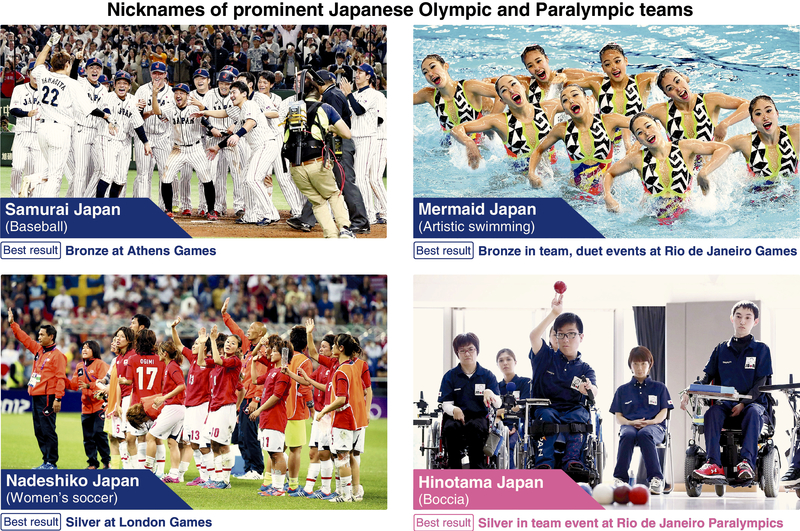
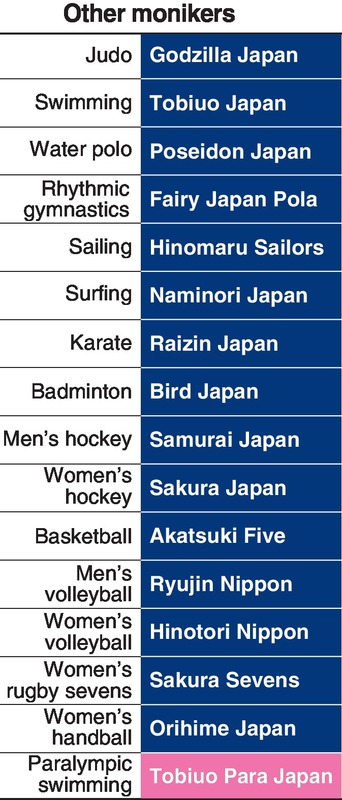
The national women's soccer team is Nadeshiko Japan, the baseball team is Samurai Japan and the artistic swimming squad is known as Mermaid Japan. While these monikers have become well known, other national teams have also adopted nicknames, such as sailing's Hinomaru Sailors and judo's Godzilla Japan, that they hope will capture the hearts of the public at the 2020 Tokyo Olympics and Paralympics.
Nadeshiko Japan, which was first used in 2004 ahead of the Athens Olympics, has been the main impetus behind the spread of Japanese sports associations adopting nicknames for their national teams.
The Japan Football Association invited suggestions from the public and chose Nadeshiko -- which is a flower that has come to suggest the idealized vision of Japanese womanhood -- because it "conjures up an image of purity, wholeheartedness and inner strength."
Nadeshiko won its first World Cup in 2011 and also took home the silver medal at the 2012 London Olympics. Although Nadeshiko failed to qualify for the 2016 Rio de Janeiro Olympics, the team reached the Round of 16 at this year's World Cup.
Samurai Japan also has become an established nickname in domestic sporting circles. Previously, the national baseball team had often been known as the All-Japan team or would simply affix the word "Japan" to the manager's surname -- it was "Nagashima Japan" when the skipper was Shigeo Nagashima, who is also the Yomiuri Giants lifetime honorary manager. The Samurai Japan nickname was introduced ahead of the 2009 World Baseball Classic, the second edition of that tournament.
Some sports have collaborated with other industries when coming up with a nickname. The men's volleyball team (Ryujin Nippon) and the women's volleyball team (Hinotori Nippon) jointly produced their mascot characters with Tezuka Productions Co., which manages the licensing for work by late manga legend Osamu Tezuka.
Japan's national judo team will go by the name Godzilla Japan at the world championships starting in August. The name emerged after film studio Toho Co. became interested in the fact that All Japan Judo Federation officials referred to their match video analysis system as "Godzilla." While judo and Godzilla both originated in Japan and have a powerful image, it is unclear whether the nickname will be used through the 2020 Tokyo Olympics.
Fairy Japan Pola, the national rhythmic gymnastics team, is unusual in that the name of major corporate sponsor Pola Inc. has been attached to the nickname. Major cosmetics maker Pola formed a partnership with the Japan Gymnastics Association in 2007. In addition to helping gymnasts improve their performance through support for their training, Pola beauty consultants also offer these athletes makeup and skincare advice.
However, not every sports organization has been able to widely boost recognition of their team's nickname outside their respective fields.
"Many sports organizations give me the impression they jumped the gun in making up a name before formulating a strategy that adds value to the national team," said Waseda University Prof. Munehiko Harada, an expert on sports management. "A thorough branding plan needs to be implemented to boost a team's recognition."
Nadeshiko led the way
Nadeshiko Japan blazed the trail for establishing a national team's nickname in Japan.
"It was easy for people to feel an affinity for the name 'Nadeshiko,' and our great results made people more aware of that name," said defender Azusa Iwashimizu, who played for the national team from the time Nadeshiko was adopted in 2004. Iwashimizu, 32, who plays for Nippon TV Beleza, was in the squad that triumphed at the 2011 World Cup and won the silver medal at the 2012 Olympics.
Looking toward the Olympics, she said she hopes to pass on to current Nadeshiko players that "defense against set pieces and others aspects will definitely change when players share awareness and the ability to concentrate."
The 2020 Games will be a golden opportunity for sports other than soccer and baseball to attract the limelight, and she expects this will inspire the Nadeshiko players to chalk up their best result since the 2012 Olympics.
"I'm sure everyone playing other sports will see this as a perfect chance to raise awareness of their team's nickname," she said, "so I want the Nadeshiko players to play hard as representatives of women's soccer."
Read more from The Japan News at https://japannews.yomiuri.co.jp/