SEOUL, South Korea �� Though the downfall of the man heading Samsung Group, South Korea's most powerful conglomerate, may seem ominous for the country's family-run business empires, the jailing of billionaire Jay Y. Lee could end up offering some relief to chaebol dynasties.
That's because Lee, who Friday received one of the harshest sentences ever handed to a chaebol leader, could fill the role of sacrificial lamb. Koreans in the past year have expressed outrage about the scandals that exposed the family-run groups, which dominate the nation's business landscape, and their cozy ties with the government. That anger helped Moon Jae-in, an outspoken critic of the conglomerates, win the presidency in May.
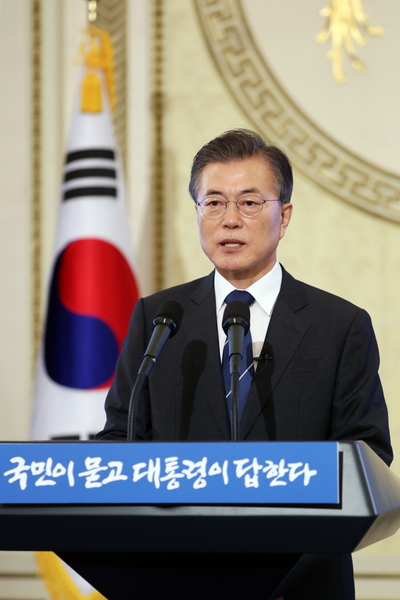
But Moon has yet to follow through on his anti-chaebol promises, focusing instead on more immediate concerns such as North Korea's weapons program and U.S. President Donald Trump's proclamations to renegotiate a 5-year-old trade deal between the two countries.
Moon isn't likely to make swift reform of the conglomerates a top priority, said Celeste Arrington, an assistant professor of political science and international affairs at the George Washington University, who described the issue as "off the front burner" following the conviction.
"It will certainly ease some of the pressure," she said. "Moon Jae-in seems focused on the broader set of ambitious political, economic and social reforms that need to happen."
Moon's office said it hopes the ruling will help bring an end to collusion between big business and the government. The Korea Chamber of Commerce and Industry and the Federation of Korean Industries �� the lobbying groups of the chaebol �� declined to comment on Lee's conviction.
Lee's five-year jail sentence threatens to prolong the vacuum atop one of the world's biggest companies because his father, who's been the group patriarch for three decades, remains incapacitated after a heart attack in 2014. Controlled by the Lee family through a web of cross shareholdings, Samsung is Korea's biggest conglomerate, comprising more than 60 units selling such varied products as smartphones, life insurance, cargo ships and clothes. Its listed units have a market capitalization of more than $390 billion.
Still, the Lee family's absence hasn't spooked investors as the group's most-prominent company, Samsung Electronics Co., posted record earnings and its share price climbed to a record high last month. The younger Lee is vice chairman but spent the past six months in custody awaiting trial.
The chaebol weren't always demonized. During the reign of President Park Chung-hee in the 1960s and 1970s, they were lionized for spearheading the rapid economic rise of a country that was poorer than North Korea. But as a decades-long, debt-fueled expansion caught up with the conglomerates, they started falling out of favor. The implosion of giants such as Daewoo Group prompted the International Monetary Fund to say family-run groups were largely responsible for the nation's 1997-1999 economic crisis.
Since then, the staunchest critics of the chaebol were shareholder activists, who argued that chaebol families were running their businesses, which account for the bulk of Korea's stock market, through an opaque maze of cross shareholdings and putting their interests ahead of those of minority shareholders.
Moon, a former human-rights lawyer, has shown a willingness to depart from conventional deference to the chaebol. On the Aug. 15 National Liberation Day holiday, the new left-leaning president skipped the custom of pardoning business executives convicted of white-collar crimes. In the past, many of those executives �� including the senior Lee �� were from the chaebol.
Moon wants the chaebol to pay more taxes, too, with the finance ministry announcing plans on Aug. 2 to raise the nominal tax rate on big corporations to 25 percent, compared with the current 22 percent. The government also wants to cut tax credits for spending on factories and research by the largest companies.
Special favors are what landed Jay Y. Lee in jail and got President Park Geun-hye, the daughter of former leader Park Chung-hee, impeached. Lee's conviction for graft, embezzlement and perjury was the latest development in an influence-peddling scandal that led to the ouster of Park, who's now standing trial for bribery �� charges both she and Lee denied. Lee will appeal.
Yet Moon may not have enough political capital to get his tax plan through parliament. His Democratic Party controls only 40 percent of seats in the National Assembly, though he did achieve a major victory last month when lawmakers approved a $9.9 billion) supplementary budget to stimulate economic growth and job creation.
Moon may also need the chaebol's cooperation fending off Trump, who denounced the U.S.-South Korean free trade agreement as a "horrible deal" and "a one-way street." A group of chaebol executives accompanied Moon when he traveled to Washington in June to meet the U.S. president.
And with Lee facing a long jail sentence, the new president doesn't have to worry about addressing popular outrage, said Clara Gillispie, senior director of trade, economic and energy affairs at the National Bureau of Asian Research, a think tank with offices in Washington and Seattle.
"This could alleviate pressure on President Moon to take additional action to satisfy popular opinion," she said.
If there had been an acquittal, Moon might have felt the need to show that he's tough on chaebol. "Now he doesn't have to," Gillispie said.
����
(Einhorn reported from Hong Kong. Jung Soo Maeng contributed to this report.)