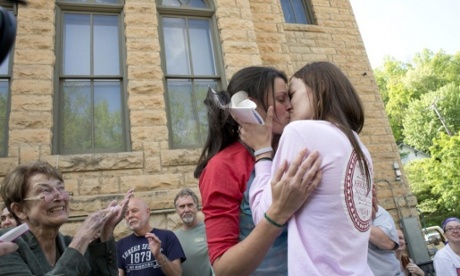
When Jennifer and Kristin Seaton-Rambo learned the other day that a county judge had forced the state of Arkansas to recognize more than 500 same-sex couples who were legally married there during a brief one-week window last year, they were ecstatic.
Granted, the couple already has two wedding anniversaries to remember each year: 10 May, when they became the first same-sex couple below the Mason-Dixon line to officially wed last year; and 4 October, the date of a long-planned commitment ceremony before friends and relatives.
Now 9 June makes three.
“Why not celebrate more anniversaries?” Jennifer asked with a laugh in an interview on Wednesday. “The more, the merrier.”
The Seaton-Rambos, like so many people in love in Arkansas and across the country, have been stuck in a weird – and weirdly American – kind of limbo over the past year.
Theirs is a microcosm of the insecure nuptial security that has been the wait for a US supreme court decision that could nationalize same-sex marriages within two weeks: until the judge ruled on Tuesday, equality was extended in Arkansas only to those couples who wed in that one-week, statewide love-in last May – and straight people, of course.
In the scrum of official uncertainty, the Seaton-Rambos were not just waiting for recognition by their state government and now the US legal system. Attempts to change their names were denied by the local clerk. Despite sweeping bureaucratic progress across the nation over the past year, they were not allowed to update their marital status with the federal social security administration, after same-sex weddings were halted after the one-week window.
At the same time, LGBT rights swung in a chaotic pendulum across Arkansas: three months after the Seaton-Rambos wed last year, the city of Fayetteville – a college town that thousands of employees from Walmart’s nearby headquarters call home – passed a local ordinance banning discrimination against LGBT people. After a massive effort launched by the Duggar family – then best-known for reality show 19 Kids and Counting, now embroiled in allegations of molestation against son Josh Duggar – used a robocall to allege the LGBT rights ordinance would “affect the safety of Northwest Arkansas women and children”, it was repealed.
In early 2015, the Arkansas legislature made it illegal for any locality to pass an LGBT non-discrimination ordinance. In May, residents of Eureka Springs, Arkansas, voted to uphold their ordinance, in defiance of state law.
This June – Pride month – will bring the looming decision by the US supreme court in cases from Kentucky, Michigan, Ohio and Tennessee, which could lead to blissed-out years ahead, or yet more chaos.
Many legal scholars say national marriage equality is all but certain to come down by the end of the supreme court’s term this month, with the justices expected to rule in line with public opinion. A Pew Research Center study released this week found a record majority in favor of same-sex marriage, with 72% of Republicans calling legal recognition “inevitable”.
But in Arkansas, this week’s recognition by that judge in Pulaski County came too late for other couples.
Thirteen months ago, when Arkansas made marriage legal for a week but not legally recognized forever, Allan Cox married Steve Thomas, his partner of nearly a decade. Their marriage was performed by the same judge, Wendell Griffen, who wrote this week that the state’s challenge to the legality of such marriage had a “shameless disrespect for fundamental fairness and equality”.
“It was a very happy day for us,” Allan said on Wednesday.
But the happiness didn’t last long. A few weeks later, his husband began to feel ill. By the end of the summer, Thomas was diagnosed with cancer.
He died in November.
Steve spent his final days in hospice with Allan by his side, his marriage to his husband in legal limbo.
During the weeks before his husband’s death, Allan was so busy with 40-hour weeks at work and rushing from hospital care to the hospice that he wasn’t free to fight the local clerk when it denied his legal name switch to Cox-Thomas.
All the technicalities are starting to change now – now that the legal approval has finally arrived, now that his husband has passed away: he can change his name, and apply for his husband’s social security benefit, to leave something for Steve’s grandchildren so they’ll have something to remember their grandfather by.
“I’m happy it happened,” Allan said of the state ruling before the national ruling. “I’m sorry Steve’s not here to see it – to know we’re actually married.”