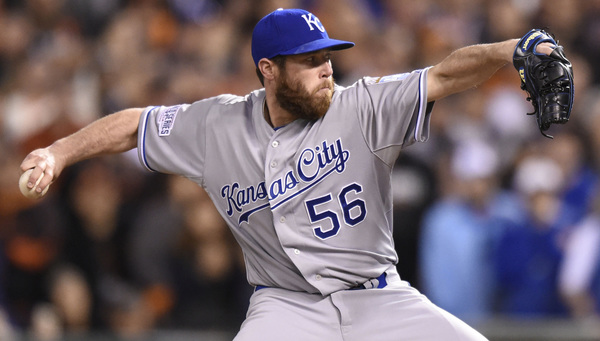
Two years after an overwhelming bullpen fueled their World Series championship and evolved modern bullpen usage, the Royals are now calling around the league for bullpen help before the July 31 trade deadline.
Ahem.
If you just rolled your eyes, you aren't the first.
"You know who'd be a good fit for your team?" a scout recently said. "Wade Davis and Greg Holland."
Rim shot!
No deals are believed to be in the works, but the Royals have told other organizations they are interested in trading for pitching help _ specifically one starter and at least one reliever. Particularly with the bullpen, this is a bit like seeking labor and materials after uninsured storm damage to your house.
The Royals' rise came from a harmonic conspiracy of preparation, guts, skill and luck, but there may not be a better singular illustration of how they conquered baseball than a bullpen that seemed to rob all uncertainty from a sport packed with unpredictability.
In 2014 and 2015, Royals relievers had a 2.99 ERA and the team was 26-15 when tied at the start of the seventh inning.
In 2016 and 2017, Royals relievers have a 3.67 ERA and the team is 12-15 when tied at the start of the seventh inning.
Even if the decline was inevitable, fixing it feels imperative for the Royals to have a chance at another postseason.
Let's get to the inevitable first, and the fix second.
In a world without consequence and a budget without limits, the Royals would still have Greg Holland and Wade Davis.
Holland was a homegrown star, and the first draft pick under general manager Dayton Moore to make the big leagues. Davis came in a trade with the Rays, but became a national star and a sorta robot in Kansas City.
Holland's elbow finally blew out late in the 2015 season. He rehabbed with the Royals until the following January, when it became clear he wouldn't sign a contract. The Royals tried, offering a two-year deal that would've covered his rehab and guaranteed about $8.5 million with up to $5 million more in performance bonuses.
Holland instead completed his rehab with guidance from agent Scott Boras. That decision will almost certainly prove to be better financially for him. His contract with the Rockies is complicated, but includes a $7 million guarantee this year with bonuses for another $8 million this year and a $15 million player option for 2018 if he pitches 50 games or completes 30. With bonuses, he could earn up to $35 million this year and next.
So, as it turned out, the Royals' deal offered $1.5 million more in guarantees but more than $20 million less in potential earnings. He leads the league in saves, pitched in the All-Star Game, and has already started to achieve many of those bonuses.
"We just didn't match up, the numbers weren't right," Holland said of the Royals. "I would've loved to have stayed there the next 15 years. It just doesn't work like that in baseball, especially for a relief pitcher."
The Royals traded Davis last offseason for outfielder Jorge Soler. When Moore told Davis of the trade, he admitted the 2017 Royals wouldn't be as good without him, particularly in the bullpen.
But they saved $7 million on 2017 payroll and got a player they control four years. Davis will be a free agent after this season. These are the decisions forced in baseball's third-smallest market, with one of the worst TV contracts in sports, and an owner unwilling to push payroll or embrace a full rebuild.
"I try to," Davis said when asked about blocking out the business side of baseball. "That's the thing, right? Just keeping getting better, worrying about the next day, all that cliche crap. But if you simplify it, it makes it easier to deal with whatever you're dealing with."
This is all hypothetical, and requires some guesswork, but let's assume Holland would've signed the same contract to stay in Kansas City. In that scenario, the Royals are spending about $15 million less in payroll this season without him and Davis.
Again, more hypothetical, and more guesswork, but using the 2014-15 late-inning success rate and adjusting for an inferior offense (they are last in the AL in runs this year compared to ninth and sixth) the Royals would have about three more wins this year.
At the moment, they are exactly three games behind the first-place Indians in the AL Central.
Awareness that keeping the HDH bullpen together for this season and beyond was financially unfeasible does not make improving the current bullpen easier.
And same as virtually everything the Royals have done over the years, they will count on minor moves and the guys already in house first.
Kelvin Herrera, for instance, is giving up more runs and base runners than any point in his career. But if you isolate his save situations, his 2.18 ERA and 1.016 WHIP are in line with his average from the past three years (2.30 and 1.072).
The Royals are encouraged by Neftali Feliz's performance since a recent waiver claim, and believe that Mike Minor, Scott Alexander and others _ one official mentioned Miguel Almonte's recent improvement _ provide the base for a good bullpen.
Relief pitchers are always available from some teams and desired by others at the deadline, and this year figures to be no different. The list is headed by the Phillies' Pat Neshek and the Padres' Brad Hand, but also includes the Reds' Drew Storen, the White Sox's Anthony Swarzak, the Braves' Jim Johnson, and others.
The challenge for the Royals won't be finding help, or a team willing to deal. The challenge will be the delicate balance between improving now and giving up too much for later.
This isn't like the 2015 deadline when the Royals traded for Ben Zobrist and Johnny Cueto, and not just because their farm system was deeper back then. The Royals were the best team in the American League that year, with good health profiles and undeniable momentum to go all-out for the first World Series championship in three decades.
All of that is different now. Depleting the farm system makes less sense with the playoffs less assured, particularly if it's for a one-game wild-card spot rather than division series with homefield advantage.
This is the Royals' place right now: trying to get back to where they were two years ago, in part by trying to get the bullpen closer to what it was, but fundamentally challenged to do it by their own limitations, the natural life cycle of relief pitchers, and a reluctance to bet too much of their future to help their uncertain present.




.jpg?w=600)