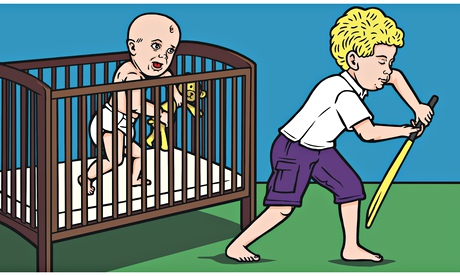
“It isn’t enough to succeed,” Gore Vidal once pointed out. “Others must also fail.” Vidal was talking about the competing fortunes of colleagues, rivals, professional acquaintances and, of course, close personal friends. But he might just as easily have been talking about brothers. In particular brothers and sport, and most particularly brothers and cricket, not that anyone really admits to any of this.
You will not find many sporting brothers out there prepared to offer up, or indeed feel, even under the deepest fraternal duress, anything other than unconditional brotherly support. But still it isn’t easy.
Brothers are strange objects generally, the one thing that’s just like you but isn’t you, with some parts turned up to 10 and others dialled back. No doubt it’s the same with sisters: they shadow you, an unsettling but somehow still horribly comforting reflection.
Cricket is, of course, crammed with brothers, perhaps more so than any other sport. This week at Lord’s Mitchell Marsh was recalled to the Australia Test team, from a squad also containing his brother Shaun. The Overton twins were in England’s one-day squad to face the McCullums this summer. And from the Bannermans of the late Victorian baggy-flannels era, to the Benauds, the Chappells, Husseys, Joyces (male and female) and Pakistan’s current triple‑Akmal (who between them add up to half a wicketkeeper), brothers are frankly everywhere.
This week there was a great brother moment in the County Championship, as Surrey’s gloriously youthful shooting star of an all-rounder Tom Curran was upstaged briefly by an even more gloriously youthful shooting star, his younger brother Sam.
Eldest sons of the late Gloucestershire and Northamptonshire all-rounder Kevin, the Currans are a hugely impressive pair. Tom already looks an international cricketer in the making. During the win against Kent in midweek Sam, who is three years younger at 17, became the youngest county player ever to take five wickets on his debut.
Perhaps the best part of all this was a brilliant post-play interview with both of them on Surrey’s website. First up was Sam, oozing super-cool younger brother sang-froid and talking about being yeah, pleased and, you know, pretty relaxed, while next to him Tom, the diligent elder sibling, smiled with tortured magnanimity and joked awkwardly about being upstaged, in a way that did not actually involve any real laughing.
Older brothers, even super-talented ones, often have this look, an air of tolerant confusion, consequence perhaps of always feeling that breath on your neck, of nourishing, unconditionally and without reservation, a success that will naturally intrude on your own.
When it comes to sport a younger brother is clearly the thing to be. Somehow those younger brothers, the ones who were always going to make it anyway, so often seem to be the dreamier, easier, more effortlessly alluring of the two. Mark Waugh, younger twin by four minutes, always seemed to have wandered out to bat by accident, some supernaturally talented passer-by detained, briefly on his way to the world flip-flop wearing championships.
Martin Crowe was the handsome bridegroom when New Zealand batted, Jeff a minor usher. For England the late Ben Hollioake was pure luminous, even-tempered athletic grace while Adam was the classic older bro, all gristle and know-how and grunt. It is not hard to see why this should be the case. Younger brothers have their pathway smoothed. They play up a year. They mimic and refine. They get to play in the slipstream. Having an older brother is a constant tease, a constant comfort, a constant source of drive.
It also is not hard to see why brothers succeed at cricket in particular, which is a skills game, a matter of tiny unforgiving margins, that must, above all, be learnt via endless competitive repetitions. Brothers drive each other on, brutally at times. I live with a pair of under-10 versions, both totally obsessed with cricket and football and prone, as usual to torturing each other with their own success and failures. And this is just at living room, garden, park, club, district and age-group level. Imagine how odd it must feel to be a Curran, to test constantly the outer limits of each other’s talent right up to professional level. And then, when you get there, to find this playmate, cheerleader, double agent, beloved object still there, still standing next to you, even as the rest of the world crowds in and offers its own brutally stratifying judgments.
It works though. There is an interesting development in modern coaching theory which states that the brother/sister/sibling model is the perfect learning system. The idea is that kids basically end up teaching each other, the ideal scenario a kind of model village green, where kids of different ages and levels are free to play, their own coaches, their own mediators, distantly supervised, but left to problem-solve, to fix, to learn from each other.
As an unplanned example Zlatan Ibrahimovic spent hour after hour playing, uncoached, in the playground on his childhood housing estate, occasionally going into the local library to look up Brazilian football clips before rushing out to try to copy them with his friends. And he turned out to be decent. Brothers in football is another story of course. There are far fewer for a start, perhaps because is less a formal, skills-based sport, more a matter of diverse and unforgiving fine physical margins. Plus of course it is brutally competitive at every level.
Cricket requires a family network now. Nobody makes it without an interested parent, part coach, part taxi driver, part kit-man. In football nobody makes it anyway. Even the unbelievably good do not make it. What is required is some perfect, impossible storm of preternatural drive, talent, obsessiveness and luck. What football, like all sports, does borrow a little from brother and sisterhood is the internal dynamic of its most engrossing teams. The same qualities are there: the drive, the love, the sacrifice, the galvanising sense of shared physicality.
Just as there is something touching about the way the closest players interact, from the joy of watching New Zealand this summer, or Burnley last season in the Premier League, or any functioning team, there is also the sense of something doggedly child-like, doggedly virtuous. Good luck Currans, Overtons, Marshes. Watching from the boundary edge, it is a journey through sport that feels, more than most, unusually intimate.