EASTERN MONTANA _ My hunting partners drop me off near a field of wheat stubble with the yellow dog. Their pickup accelerates up the road, leaving a plume of white dust behind.
They'll pick me up in two or three hours a mile and a half away as the sharptail flies. In other words, about a city block on Montana scale. This is vast, wide-open country, best at growing prairie grasses, tiny cactus, wheat and beef cattle.
Four of us have come west, as is our custom in September, to hunt sharp-tailed grouse. They're cousins to the ruffed grouse of the aspen woods back home, a touch larger than ruffs and not quite as tasty.
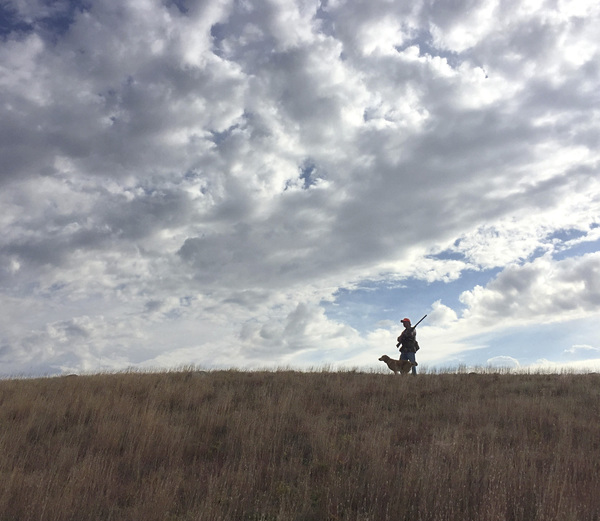
I begin hiking up a formidable rise in the light cover, the dog working close to me. Before I left the truck, we watched several sharptails flush from the wheat stubble to the prairie. I figure there's little chance they'll hold tight enough in ankle-high grass before flushing again, but against all odds, a couple take flight within range of the 20-gauge Dad used to shoot. Easy shots. I miss one, manage to catch up to the other, and the yellow dog knows what to do.
We can tell you how many other sharptail hunters we will see in six days out here. Zero.
"People probably think we're crazy, coming out here to hunt sharptails," one of my partners says to our farm friend, David, in whose hay yard we camp for a week each fall.
"Some do," he says with a grin.
The early part of pheasant season is hopping around here. Lots of hunters. Motels fill up. Bars are busy. Hunters flock to grassy sloughs on private land open to hunting during the season's first couple of weeks. Pheasants are good to eat, and you don't have to walk seven or eight miles a day to find them, as we do for sharptails.
It is in part the lack of other hunters that appeals to us about hunting sharptails. We ramble aimlessly across the grasslands, dropping into steep creases where the buffalo-berry thickets grow, ascending the next grassy knoll to see what lies beyond.
We hunt, but sometimes we just stop and look around.
Maybe it's because we come from country so densely forested that we appreciate the big empty of Montana. We love being loose on the land with our dogs, marveling at the forces that created such a rugged landscape. A couple of miles distant, the Missouri River meanders peacefully toward St. Louis. We see wild turkeys in the river's lowlands and imagine Lewis and Clark's men combing the countryside with muzzleloaders, hunting for their dinner.
The dog and I manage a couple more birds as the morning cool gives way to another warm midday. I stop at a stock pond to let the old girl swim in icy well water for a few minutes. Back at the truck, I toss my birds in with others my friends have shot. We exchange the stories of our walks.
Back at camp, we heat water to clean up, then feed dogs and wait for a full moon to rise. Crickets gossip in the grass. If you've never camped in a hay yard, you should try it. Hay yards smell good. Like hay.
The moon takes us by surprise, ascending like a spherical chunk of cheddar over the slough across the road. The dogs lie beside our camp chairs, expecting belly rubs.
We wonder whether the coyotes will sing again that night and if we'll hear the great gray owl hooting over a juicy vole. We know two things for sure. One is that a down sleeping bag will feel good. The other is that we'll awaken to rooster pheasants crowing from the slough across the road.
Yeah, we may be crazy. But it's a good crazy.