1 Burgess versus Slade
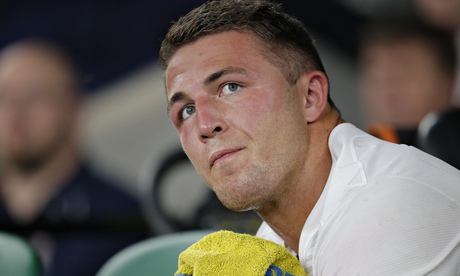
This was billed as that peculiar thing — a showdown between two people playing on the same team. Received wisdom is that England could choose only one of Sam Burgess and Henry Slade, England’s two centres. Two alternatives — one a big chunk of muscle and anger, the other what rugby’s lexicon likes to label a piano player. Burgess the shifter, Slade the player, which way will Stuart Lancaster go? After half an hour, the verdict of the bravo-ing audience was, take them both! Each was living up to his respective type, and what music they were making. By the end of the first quarter England were two tries to the good on the back of it.
Burgess’s physicality in defence was every bit what you’d expect from an 18st league forward and he showed a pair of hands too in the beautifully orchestrated buildup to England’s second try. Slade’s hands, though, are something else again. His initial touch was to lay on a perfect assist for England’s first, and some of his touches in the second half were sublime. Take them both indeed. If Lancaster does, it is likely Luther Burrell who must be sweating now.
But if there’s a quality lacking in the two it is speed, both of foot and thought. Burgess looked that 18st league forward again when he turned to chase the early chip ahead from which France so nearly scored. A few minutes shy of the break he was caught out again by a classic union sucker punch, falling for Morgan Parra’s tap and go and seeing yellow for it. Slade, too, was dull in taking out Morgan at a restart.
So what should Lancaster do? If he wants force of personality and physicality, then clearly it is Burgess. But let us not underestimate Slade’s appetite for the fray. He was solid too in defence and used his physique well to win one ball in the air in the second half. The trouble with both of them, other than that lack of pace is a lack of experience — Burgess in union, if not in sport. The feeling is still that Burgess plays like a back-row forward, even if two touches, one in each half reminded us of his handling skills. If the coach has to choose, Slade just looks a class apart, a pedigree union player, who seems made for the No12 shirt, England’s enduring problem. But Lancaster could yet take both. Burrell has pace over the pair of them, but otherwise Burgess is shaping up to be the tastier proposition.
2 Discipline
England lost the penalty count 10 to 6, but two yellow cards will resonate as the headline here. Burgess’s was eminently avoidable, even if there is always some sympathy for the big man expected to leave well alone the little one running straight at him. Calum Clark’s was more unfortunate still, mainly because of his previous form in that area and the fact that his was an otherwise-excellent performance of aggression and industry. England managed to score their best try of the lot while Burgess was gone. When Clark left, though, they conceded a pushover try, just as they did here in March when James Haskell saw yellow. That one cost them the Six Nations in the end. These are the margins in the big tournaments.
3 The breakdown
England’s lack of what is variously termed a No7, openside, fetcher and jackal is well documented. What is less often acknowledged is that these days work over the breakdown is a requirement of more than one person in the team. England do have plenty of jackals in their squad (including, incidentally, one Chris Robshaw), but there was a notable lack of it here. France dominated at the breakdown. Only three such turn-overs spring to mind as won by England — Clark took one in the first half; James Haskell two in the second. For all their handling and invention, England suffered here as much as they did at the set piece. Their first-choice team, though, has more in the way of breakdown thieves — and for good reason.
4 The hookers
Dylan Hartley’s absence has made the hooking question a live one. Tom Youngs remains the favourite to replace him in the first-choice line-up, but Rob Webber and Luke Cowan-Dickie had a precious chance to stake their claim for a squad place. Webber enjoyed a good first half, part of a scrum that waxed more than it waned, and he was a force around the field. But the second half did not go well for England’s set piece — and thus their hookers. It may yet be Jamie George, surprisingly omitted from the original squad but promoted when he took Hartley’s indiscretion on the nut, who ends up in the matchday 23.
5 Pace
Graham Rowntree was vocal over the summer about England’s ambition to run teams off their feet at this World Cup. This should be taken with a pinch of salt, but it is fair to say they were not afraid to move the ball, and they did so with imagination. You would think such a policy would favour George Ford over Owen Farrell in the fly-half debate that is set to run. Yet Farrell let it be known here that he can play a bit too, a fact that is too easily forgotten after his injury-hit recent season. The Six Nations before last he orchestrated England’s lively back division with aplomb. And he can kick (and jackal). He may yet end up at 12.
6 The back three
If anything raised the eyebrows about England’s early thank-you-and-goodbyes it was the unseemly number of wings discarded. But Jonny May and Anthony Watson, played blinders in a back three that looked masterful. Alex Goode at full-back is another playing for a place in the squad. His straight-line speed is far from devastating, but the way he manages to step his way out of trouble beggars belief. His all-round vision and composure, too, is unmatched. All of those qualities were on show for England’s superb third try, rounded off by May. Watson’s footwork was lethal as he left Brice Dulin bewildered for the first of his brace — and, boy, does he have straight-line speed. England’s squad does look thin out wide, their three wingers young and raw, but this was encouraging for May and Watson. The World Cup, though, will be another level.