A strange thing happened near the end of West Ham’s victory over Queens Park Rangers two weeks ago. The match was over as a contest, West Ham were heading for seventh place and the stadium was emptying out as supporters raced to beat the long queue at Upton Park tube station when a long clearance from a QPR defender sailed out of play and towards Sam Allardyce.
No one would have batted an eyelid if Allardyce had let the ball continue on its path but instead, nonchalant as you like, he hung out a leg, waited and then produced a backheeled volley that was admittedly not up to the standard of a Ronaldinho effort but was nonetheless a piece of showboating from Sam Allardyce.
That settled it: Allardyce really has changed. He did listen when West Ham’s board told him to introduce a more attacking style.
Watching West Ham trudge their way to 13th place last season was painful and although Allardyce managed to steer them clear of relegation, the sheer tedium of the football and his abrasiveness turned many against him. That supporters were bordering on open mutiny gave the board a free pass and Allardyce would have gone in the summer if West Ham had found a suitable replacement.
There would have been no outrage, no Save Our Sam placards – some supporters would have driven an open-top bus down Green Street: resentment was growing on both sides and it was hard to see what anyone was getting out of a marriage of convenience that was running its course. Even though the search proved fruitless, it still felt like Allardyce was on thin ice, that providing more entertainment would inevitably be beyond his capabilities. Yet the 59-year-old is confounding expectations. West Ham will be confident of beating Burnley on Saturday, they are playing robust, attacking football and Upton Park is a happy place again.
Allardyce is indeed a perplexing character at times and those Allardici comments will stick with him for ever, but he is undeniably accomplished in the Premier League and to dismiss him as a dinosaur is unfair. It should not be forgotten that West Ham were a mess when Allardyce picked up the pieces left by Avram Grant three years ago, but he won promotion at the first attempt and then kept them up, while his time at Bolton Wanderers proved that he could develop a team.
It would be pushing it to say that Allardyce had Bolton imitating Barcelona or that he did not place a huge emphasis on set-pieces, but no one could complain about watching Jay-Jay Okocha, Nicolas Anelka and Youri Djorkaeff. After scraping survival in 2002 and 2003, Allardyce led Bolton to four consecutive top-half finishes and European football.
That informed the thinking at West Ham once it became clear Allardyce was staying and it was acknowledged that it was unrealistic to ask for better football without first providing him with better footballers.
West Ham have improved in several positions, adding youth and pace to a squad that previously had very little of either. The full-backs, Aaron Cresswell and Carl Jenkinson, are quick and comfortable in possession, Cheikhou Kouyaté, excellent before he suffered a groin injury in the win over Liverpool, is an upgrade on Mohamed Diamé in midfield, Diafro Sakho has scored five goals in six games, Enner Valencia is growing in confidence and the arrival of Alex Song on loan from Barcelona means that it would be an affront to common sense not to keep the ball on the ground.
Part of the criticism of Allardyce was that he had one idea: cross to Andy Carroll, header down to Kevin Nolan, scrappy goal from six yards, repeat until opposition has succumbed. Unsurprisingly, West Ham were lost when Carroll was injured last season and there was alarm when he tore ankle ligaments in the summer, before Nolan injured his shoulder ahead of the trip to Crystal Palace in August.
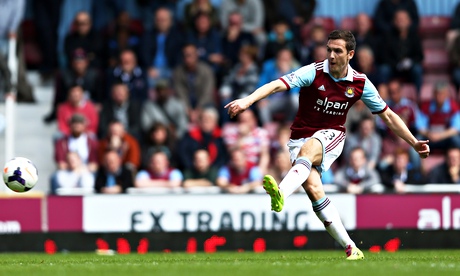
If that forced Allardyce out of his comfort zone, then he has adapted brilliantly, tweaking and modifying the side until he hit upon the golden formula against Liverpool last month. Song, Kouyaté and Noble formed an energetic and intelligent base in midfield, Valencia and Sakho were used as wide forwards with freedom to use their speed and skill to roam inside, and Stewart Downing moved from the flanks to an influential playmaking role in the hole, where he has been outstanding. Downing and Song, two refined players, are at the heart of West Ham’s evolution.
There was no target man or central striker in Allardyce’s thoroughly modern formation. Although Carroll and Nolan still have something to offer, now they face a fight for their places.
Allardyce also has much left to prove and his future remains uncertain given that his contract runs out at the end of the season, yet West Ham might finally be about to see eye to eye with their new backheeling entertainer.