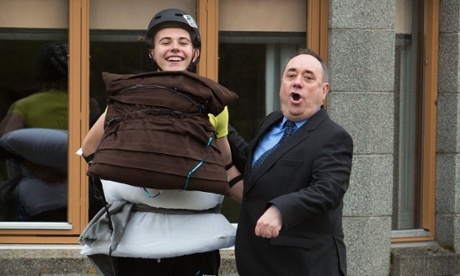
Alex Salmond is less than five minutes into his canvass of Port Elphinstone, an affluent village in the heart of Aberdeenshire, when he stops someone jumping out of a window.
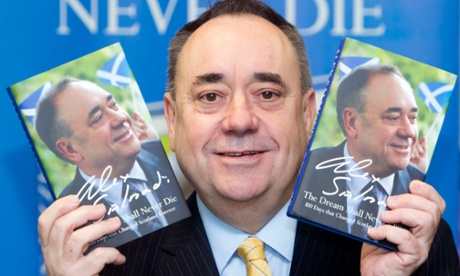
For the adoring crowds who have queued at packed signings of Salmond’s recently published memoir of last year’s independence referendum, The Dream Shall Never Die, the performance of such minor miracles is probably par for the course.
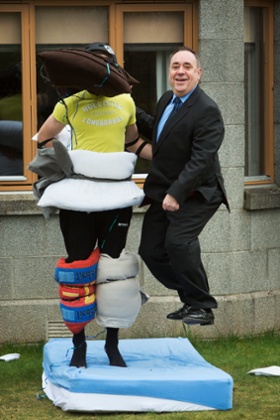
But for 16-year-old Lewis Wilson it is, momentarily, a great embarrassment. There you are, preparing to jump out of your high bedroom window wearing some inadequate padding while your wee brother and two pals wait to capture the moment on their camera phones. Then, coincidentally, the former first minister of Scotland arrives, accompanied by a team of canary-yellow Scottish National party activists, a journalist and a professional photographer.
Salmond immediately recognises the leg-breaking potential of the arrangement and proceeds to talk the lad down from his ledge. “Wouldn’t you prefer to get your photo taken with me?” he calls up. It is barely a question. Older and wiser men have found no reason to refuse the infamous Salmond photocall.
Safely back on the ground, Lewis explains that his mum did some leafleting for the yes campaign during the referendum, but that he was too young to support Salmond’s cause himself. “He’s just a lovely man,” he says, as the candidate for the Westminster seat of Gordon strides off to the next doorstep.
The former SNP leader confirmed widespread speculation last December that he wanted to return to the Commons after a five-year absence. The north-east is familiar territory for Salmond, and the sprawling constituency takes in his former Holyrood seat of East Aberdeenshire.
Currently held by the Liberal Democrats, the popular sitting MP Sir Malcolm Bruce is retiring after 32 years in the Commons, leaving new candidate Christine Jardine, a former journalist and party media adviser, to face what Lord Ashcroft’s polling predicts will be a 15.5% swing to the SNP.
The LibDems haven’t completely given up. But their message is unusual. Nick Clegg is visiting the seat, where he is expected appeal directly to Labour and Conservative supporters to vote tactically for his party. With the party fighting to hold more than one of its eleven seats in Scotland, Clegg will say: “In 11 Scottish seats, you face a simple choice: do you want an SNP MP or a Liberal Democrat MP?”
Salmond is undoubtedly a polarising figure, but this afternoon the magnetism is all flowing in one direction. “My son will be devastated he missed you,” esays one woman, so Salmond writes him a note on the back of an election leaflet. She admits regretfully that she voted against independence. “This area was rock solid no in the referendum,” says Salmond cheerfully later, “but I’ve always had a strong middle-class following.”
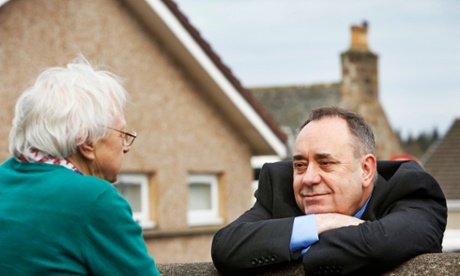
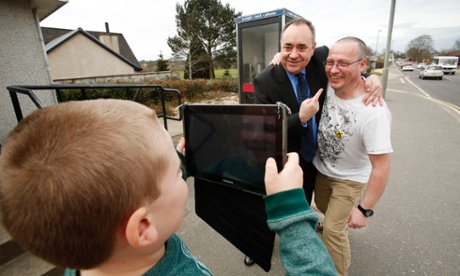
There are handshakes and car horn toots and photos galore as we make our slow progress up the street. The last time I interviewed someone with such a matinee-idol swagger, it was Richard Gere. Everyone wants to stop for a chat, Salmond most of all.
He is all charm, but no less the chancer. Jim and Jean, lifelong SNP supporters, invite him in to discuss the poor follow-up treatment she has received since her knee replacement operation. After assuring her that he will contact her doctor personally, Salmond surveys Jean’s elevated, swollen leg and makes a canny calculation. “Just on a wee self-interested point,” he asks her, “have you got a postal vote for the election? Not that I’m not confident you won’t be up and Highland dancing by then.”
Speaking later in his shared office in Inverurie, Salmond says he had anticipated the unprecedented surge in support for the SNP post referendum, but “not to the extent”.
It required, he says modestly, “me getting out the road”. “Otherwise the question gets compromised: ‘What are you doing still here? You lost.’ So you step to one side and renew, and it becomes a one-way street. You [David Cameron] promised, now deliver.
“We’re taking nothing for granted, etcetera, etcetera, etcetera,” he adds, perhaps mindful of SNP leader Nicola Sturgeon’s injunction to activists at the party’s spring conference to make humility a hallmark of the election campaign. “But we’re through the door and set fair for a very interesting performance from Scotland.”
Of course, what with the book tour and the policy interventions on BBC1’s Andrew Marr show, and the headline-grabbing champagne lunches with the Spectator magazine, and standing for Westminster, Salmond hasn’t exactly stepped aside. Only history will prove whether his particular version of “getting out the road” was political folly or masterstroke.
Does he feel responsible for putting Sturgeon in the position where she is now constantly asked who is really in change of her party? “Two things I would say: anyone who feels the need to ask that question doesn’t know Nicola Sturgeon. Secondly, if you are self-assured, as Nicola most certainly is, it’s not a question that bothers you. And thirdly – since I only said there were two – they’ll probably ask that less after last Thursday [Sturgeon’s much-admired performance in the UK leaders’ televised debate]. People carve out your own position. If you’re quality, you’re quality, and she’s quality.”
He is clearly aware of the need to haud his wheesht (hold his tongue) after the excesses of the past few weeks, and sticks to the script as closely as he is capable of doing, mentioning Sturgeon constantly and deferentially. One also gets the sense of a man with no intention of stepping off the carousel just yet. To be clear: this does not at all reek of desperation. It is evident that Salmond is absolutely delighted with the way things are shaping up.
As for the dangers posed to him by pro-union or anti-Salmond tactical voting: “I don’t think it’s statistically significant. One of the fundamental mistakes politicians make is that they think political chatter will cut it on the doorstep. Most people don’t think like political fixers.”
That said, tactical voting may be a more significant factor across Scotland than usual. (The country has a long history of voting against as much as for.) A YouGov poll for Channel 4 News last Friday found that almost half of all Conservative and Lib Dem supporters would switch to Labour to keep out the SNP. YouGov’s Peter Kellner projected that tactical voting could save up to nine Labour MPs as well as two Liberal Democrats.
Meanwhile, Salmond offered his potential constituents the last-minute concession of cancelling the North American leg of his book tour, which enables him to attend the Scottish Federation of Housing Association hustings at Inverurie town hall later that evening.
The fact that he even considered prioritising New York book sales over neighbourhood canvassing is something that Jardine is keen to emphasise, but, at the hustings, Salmond plucks his answers from a trove of historic local knowledge, fixes his closest rival with a beatific glare, and chuckles benignly at the gauche offerings of the 23-year-old Labour candidate, Braden Davy.
Jardine finds herself in a bind. She insists: “For me, it’s not about [Alex Salmond]. I’ve been the candidate here since January 2014. For me it was always about being the MP for Gordon and wanting to make a difference. The fact that he decided to throw his hat in the ring doesn’t change that.”
And yet, of course, it is a lot about Salmond, and, while there is no formal anti-Salmond bloc, she rams home on the doorstep the message that a vote for the SNP will mean it is all about Salmond, for the next five years.
“Completely polarising” is how the Scottish Conservative candidate Colin Clarke, a local businessman and farmer, describes Salmond’s presence in the campaign. Clarke argues that, with the average weekly wage £100 higher than elsewhere in the country and only 10% of the population employed by the public sector, the Gordon constituency “should be true-blue through and through”.
Out canvassing with Jardine in the quiet village of Udny Station, in Aberdeen’s commuter belt, retiring MP Bruce does not rate Clarke’s prospects. “Conservative voters are switching very overtly,” he tells me, adding he has heard that central office has been telling their candidate to stand back, and that “your time will come”. “The Tories are desperate to keep Alex Salmond out.”
Right on cue, one local promises Bruce and Jardine his vote after supporting the Tories previously: “I hope you manage to keep that man Salmond out!”
“We have a substantial game plan,” Bruce continues. “We’ve raised a lot of money and recruited a lot more help, especially since he announced his candidacy.” Labour activists campaigning for their candidate have been advised to concentrate their efforts in Aberdeen instead.
On Inverurie high street it is notable that, while everyone has heard that Salmond is standing (and occasionally the mere mention of his name elicits an involuntary lip curl), it is Jardine who is winning the leafleting ground war.
“The Liberal Democrats are the only ones who seem to be bothering campaigning,” says Eileen, a volunteer at the British Red Cross charity shop.
“The rest of them are just going on the telly,” interjects her colleague Rosaline. She explains her tactics carefully: “I won’t vote to get the party I want. I’ll vote not to get the party I don’t want.”
Tactical voting is a very private business, they explain. “A lot of people are thinking about this but they won’t like to say that they are.”
It may well be – as Jardine suggests – local concerns that ultimately make up voters’ minds in Gordon. But Salmond is no slouch at acting locally. The day after his enounter with Jean and her bad knee, I am passing her neat bungalow and pop in again for a longer chat. The telephone rings and it becomes evident that it is Jean’s elusive doctor. And the reason that he is calling now? “Oh yes,” she twinkles, “we had Him round yesterday.”