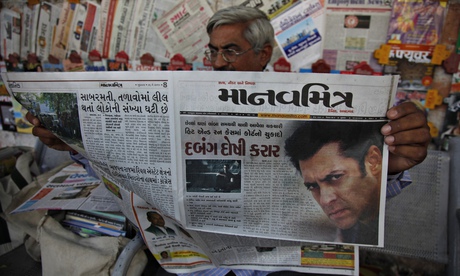
The Bollywood star Salman Khan has been sentenced to five years in prison after been convicted of all seven charges against him relating to a hit-and-run incident that happened in 2002. Khan, who has starred in many blockbusters since the 1980s, is among India’s most celebrated cultural figures. It was widely thought that Khan’s clout would prompt his acquittal. It did successfully stretch out the case for for more than a decade. But this week’s verdict sets a new precedent for drink-driving cases and more significantly for cases involving high-profile people.
In the early hours of 28 September 2002, Khan’s 4x4 mounted a pavement in Mumbai, killing a homeless person sleeping there and injuring four others. Khan, who was returning from a bar, was believed to have been behind the wheel and severely drunk. He is known to have fled from the scene despite struggling to stand up. Nevertheless, as the trial trudged along – with witnesses and documents going missing – Khan denied all charges.
After almost 13 years since the accident, there was a surprise twist this year. Khan’s driver, Ashok Singh, gave evidence on 31 March and told the court that it was him, not Khan, who was driving at the time of the incident. Singh’s statement was considered improbable by many. This week, the judge declared the driver’s version of events unbelievable and pronounced Khan guilty.
In a telling interview five days after Singh appeared in court, his wife Anita was asked why her husband had kept quiet for 13 years. To any discerning mind, her reply was partly nonsensical and partly tragic. It belied her family’s socio-economic status, at the opposite extreme to that of Khan. She claimed her husband saw the media and police hounding Khan and this scared him into silence. The remainder of her interview was filled with praise for Khan. “If he [her husband] is the culprit then he should be ready for the punishment also,” she said. “And we know Salman will never leave our side.”
Witnesses giving evidence on behalf of wealthy and powerful defendants in the course of the judicial process is commonplace in India. A high-profile example was the murder of Jessica Lal. She was a young model who was shot dead by a politician’s son at point-blank range while at a star-studded party in Delhi in 1999. As her murder trial progressed, witnesses unsurprisingly turned hostile and her killer was acquitted. Only after a fiercely courageous and protracted battle by Lal’s sister Sabrina, assisted by media attention, was there a retrial and justice for Jessica was finally won in 2006.
It was a watershed moment in terms of the message it sent out – of an India that was beginning to fight the status quo. Similar hit-and-run convictions involving rich and well-connected young men such as Sanjeev Nanda and Alistair Pereira were cited during Khan’s trial.
In Khan’s case the David and Goliath fight is even starker – a superstar against street-dwellers living in penury and without any identity in society. The victims’ families have been saying on Indian television that what happens to Khan is incidental to the process. They are concerned about how their lives have changed since the incident. Khan’s victim, who was killed instantly, was his family’s sole breadwinner. The four survivors have been left unable to work because of their injuries. For them, justice is economic. They have been reiterating their claim for compensation. So far, they have received a measly 1.5 lakhs each (£1,500), which has been exhausted in legal and medical bills.
For middle India, this verdict inspires hope. It is a surprising victory for the common man, challenging the definition of justice in India as a commodity for sale to the highest bidder.
Khan’s lawyers will appeal in the high court and his sentence could well be shortened. But whatever the outcome, the verdict is a clear message to India’s elite that they are not above the law any more.