An alleged terrorist accused of attempting to kill cyclists and police officers outside the Houses of Parliament seemed like a “very good man”, friends have said.
Salih Khater is well-known to the tightly knit Sudanese community in Birmingham, where locals said he lived after coming to the UK as a refugee during the ongoing civil war.
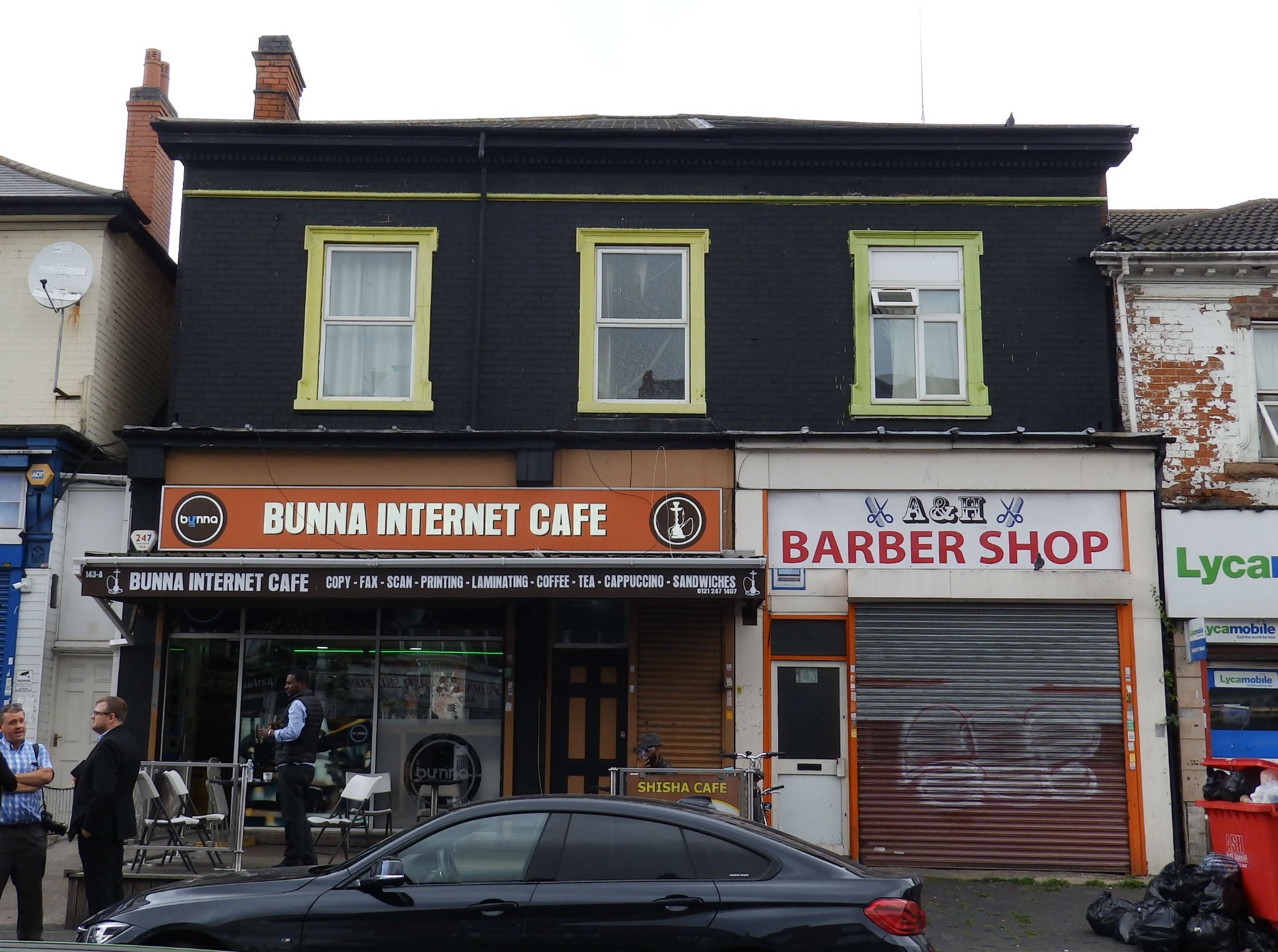
As journalists swarmed around the Sparkbrook flat where the 29-year-old British citizen lived until around four months ago, customers at the internet cafe below spoke of their shock.
“He seemed like a normal guy,” a member of staff told The Independent. “He seemed like everyone else, like the rest of our customers. He would come for a coffee and use the computers. You can't stop anyone coming in here, everyone comes.”
Police raided the flat hours after the attack on Tuesday morning and left later the same day. They are currently searching another property in Birmingham and have completed searches of another address in the city and one in Nottingham.
At a mobile phone shop down the road, there were rumours that Mr Khater had left the area because some of his relatives died in Sudan.
A friend of the terror suspect told The Independent he had been attempting to gain a visa to visit his family in the country, and believed he may have been trying to reach the Sudanese embassy in London.
“I'm shocked,” said the man, who did not want to be named. “He's a very good man, a very friendly man, everybody knows him.
“His father died six or seven months ago and that's why he was stressed.
“In my opinion he was going the wrong way and he didn't know what he was doing and when he saw the police he got scared - he's lucky they didn't shoot him.”
Mr Khater is believed to have lived in Birmingham for at least two years, and said on his Facebook page that he worked in a shop.
Sparkbrook residents did not know where it was, but said he was a “working man” who was not believed to be married or have children.
Mr Khater had also enrolled on an accountancy course at Coventry University that started in September, but was thrown out in May after failing his first year.
“Salih Khater studied accountancy at Coventry University between September 2017 and May 2018,” a spokesperson said. “He failed the first year of his course therefore his enrolment was terminated.”
“He's a normal Muslim, he's not radical - he prays five times a day and that's it, he doesn't wear religious clothing,” his friend said.
“He's a quiet person and he doesn't speak English very well...I think he would have been shocked after the crash, he would have needed a translator.”
The friend described Mr Khater as a “simple man”, while some acquaintances said he was “slow” and thought he may have mental difficulties.
Some locals in Sparkbrook, a district to the south-east of Birmingham city centre, had not heard about the incident in Westminster but expressed their dismay that he was linked to the area.
It has been the home of several terrorists, including the UK’s first suicide bomber, its first al-Qaeda plotter, one of one of the financiers of the 9/11 atrocity and extremists who went to fight for Isis.
Mr Khater describes himself as a shop manager on his Facebook page, where the “about” section reads: “In past I'm great but now I say I don't no [sic]”.
He said he studied at Sudan University of Science and Technology and went to school in Wad Madani, a city south-east of Khartoum.
A statement issued by Coventry University revealed he had started studying accountancy there last year but failed his first year and left in May
“As of May 2018 he is no longer enrolled at the university," a spokesperson said.
Mr Khater's page shows a mixture of connections based mainly in Sudan, Birmingham and Nottingham – the two cities that are now the focus of operations by counterterror police.
He remains in custody after being arrested on suspicion of attempted murder and the commission, preparation and instigation of acts of terrorism.
Investigators said the silver Ford Fiesta used in the alleged attack was driven from Birmingham to London late on Monday night and drove around the city centre for almost eight hours before the crash.
Footage showed the car sharply swerving through several cyclists and pedestrians, over central reservations and down the wrong side of the road at high speed before crashing into security barriers.
Police officers guarding the area had to leap out of the car’s path before armed colleagues rushed to detain the driver.
A man and a woman were taken to hospital with non-life threatening injuries after the crash early on Tuesday morning, and have now both been discharged. Another man was also treated at the scene.
It came during parliament’s summer recess and ahead of the daily rush of tourists to the area, leaving it relatively deserted.
Metropolitan Police Assistant Commissioner Neil Basu, the head of UK counterterror policing, said the suspect was not known to MI5 or counterterror police.
Investigators have still not established a possible motive, and will be looking for any evidence of political or religious affiliations.
“Given that it appears to have been a deliberate act, the method used and the iconic location, it is being treated as a terrorist incident and the investigation is being led by officers from the Met’s Counter Terrorism Command,” a spokesperson said.
“At the time of the arrest, there was nobody else in the vehicle, which has now been removed from the scene and searched. No weapons have been recovered at this stage.
“At this early stage, there is no intelligence of further danger to Londoners or the rest of the UK in connection with this incident.”
No other arrests have been made in connection with the ongoing investigation.
In the past 17 months, Westminster has been hit by two attacks and was the planned location of four disrupted plots, making it currently the biggest since terror target in Britain.
Isis has issued advice to its followers on how to carry out atrocities using vehicles, knives and other easily obtained items, which have made attack plans faster and harder to spot for authorities.
The prime minister’s spokesman said 13 Islamist and four far-right plots have been foiled since the first Westminster attack in March 2017 – an average of one a month.
A total of 676 terrorism investigations by MI5 and counterterrorism police were underway by the end of June this year, up from around 500 just four months before.