Sales of fuel cell vehicles, which have been considered the "ultimate eco-cars" as they emit no exhaust gases, remain stuck in low gear, mainly because of a slow rollout of hydrogen stations to supply fuel to these cars.
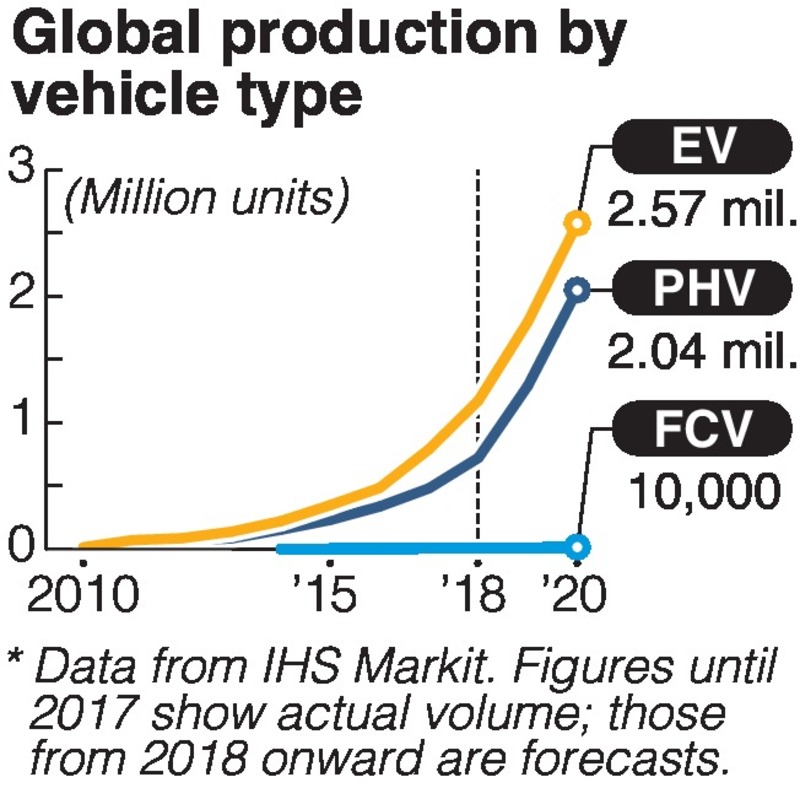
Fuel cell vehicles are trailing far behind electric vehicles, which can even be recharged at home, and plug-in hybrid vehicles, forcing Japanese automakers to rethink their strategies.
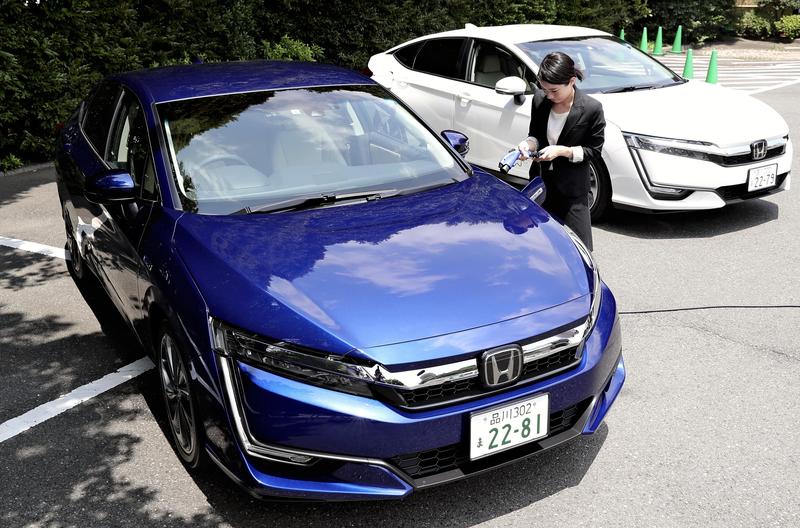
On Thursday, Honda Motor Co. announced it was adding a plug-in hybrid model to the Clarity cars it started marketing as fuel cell vehicles in 2016. The new model was expected to go on sale Friday.
At a press conference in Tokyo, Honda chief engineer Kiyoshi Shimizu indicated the automaker planned to shift its focus. "Our sales will center on plug-in hybrid vehicles," Shimizu said.
Plug-in hybrids have an electric motor and a gasoline engine, and can be recharged at home. If they run out of electric power, they can keep going on gasoline. The hybrid Clarity has a sales target of 1,000 units per year in Japan, whereas the fuel cell version has sold only about 200 units in more than two years on the market.
In addition, Nissan Motor Co., which has been jointly developing a fuel cell vehicle with Germany's Daimler AG and Ford Motor Co. of the United States, announced a plan to delay the mass production of these vehicles for the time being.
Only 2,300 units sold
Fuel cell vehicles are powered by electricity generated through the reaction between hydrogen stored as fuel in tanks and oxygen in the air, which turns the motor and makes the vehicle move. This process produces no exhaust gases.
Japanese companies have been at the forefront of this field, as indicated by Toyota Motor Corp. being the first automaker to introduce such a vehicle, the Mirai, to the market in 2014.
However, total domestic sales as of the end of 2017 had limped along to just 2,321 units. Sales in 2017 were just 849 units, down by 205 vehicles from the previous year. This pales in comparison to the 36,004 plug-in hybrid vehicles and 18,092 electric vehicles sold.
The biggest factor behind this situation is the delay in establishing hydrogen fueling stations. The government aimed to build 100 of these facilities in fiscal 2015, but achieving this target was pushed back until 2018.
"It's hard to come up with any reasons to choose a fuel cell vehicle that make it worth putting up with the inconvenience of the lack of hydrogen stations," said Toru Hatano, a principal analyst at British data and information services company IHS Markit.
Glimmer of hope
Despite this, there is still a path to survival for fuel cell vehicles. Commercial vehicles, such as buses and trucks, are one potential market. If hydrogen stations were established at hubs where many such vehicles assemble, hydrogen could be efficiently supplied to them.
Although Toyota has turned some of its management resources toward the development of electric and plug-in hybrid vehicles, it has not abandoned the idea of making fuel cell vehicles more popular.
In March, Toyota launched sales of a production model of a fuel cell bus. The automaker aims to sell about 100 units by 2020.
It also plans to start a project using small fuel cell trucks for delivering goods in cooperation with Seven-Eleven Japan Co. in 2019.
Read more from The Japan News at https://japannews.yomiuri.co.jp/