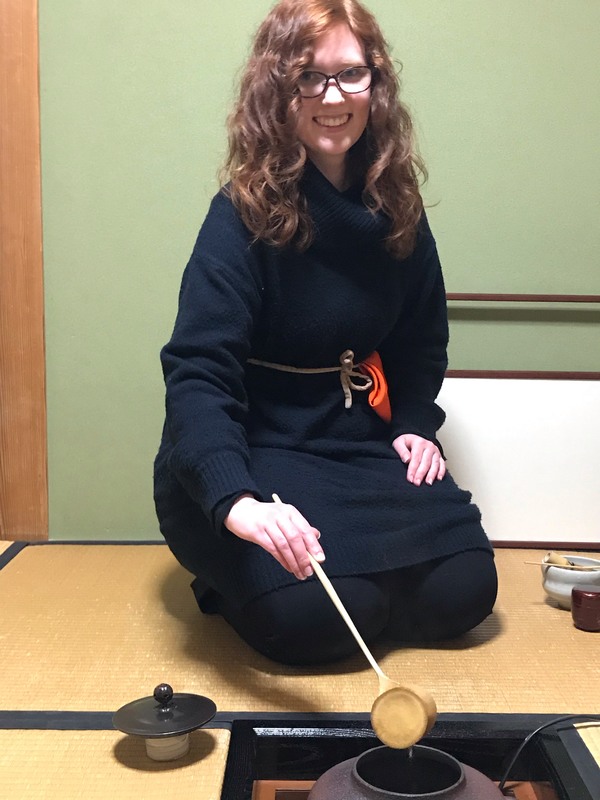
Tasha Mooney shares her experiences as participant of the Japan Exchange and Teaching (JET) Programme, which is administered through the collaboration of Japan's local and national government authorities and promotes grass-roots internationalisation at the local level.
* * *
Living in rural Japan opens you up to a lot of experiences that you wouldn't normally get to do. These experiences can start you on a long road you never would have seen for yourself. So here in rural Fukuoka when I was asked one day, "Do you want to try sado?" I thought, "why not?" I didn't think I would be here over two years later still doing it.
Sado, or tea ceremony, literally translates as "The Way of Tea" and is an important part of Japanese culture. It's a ceremony that consists of preparing and serving tea. The tea used is matcha, or powdered green tea. Small Japanese sweets known as wagashi are also served. The sweetness of the wagashi is there to offset the bitterness of the tea, creating a wonderful harmony of flavors.
In sado, there is a particular order in which you do everything, from entering the room to adding tea to the teacup. Each step has meaning and leads into the next step. These steps are in place for both the person making and drinking the tea.
Sado is very graceful, but for me that gracefulness is a facade, because I am always frantic when doing it. This franticness comes from the stress of remembering the steps and doing seiza, a traditional form of sitting where you kneel on the floor and fold your legs under your thighs.
As a foreign person, seiza was the most difficult for me because it can be painful to do, especially when you didn't grow up doing it. I've spent all my years sitting in chairs and never on the floor, so getting my Irish legs used to sitting this way was not easy. It is something I still struggle with now, more than two years later.
So trying to look graceful while your legs are screeching at you in pain and you're frantically thinking, "What comes next?" can be almost impossible.
But at the end of the day even if you make a mistake, sado is enjoyable for everyone. When the person takes the tea, which you've poured so much of yourself into, and drinks it, all that stress washes away. On the reverse side, drinking the tea that someone has poured so much of themselves into gives you nothing but a feeling of joy.
Doing sado may be difficult but as time goes by the sense of accomplishment alone is enough to make you look forward to the next time you get to put your legs through all that pain again. Personally, I'm patiently waiting for the day that that calm and confident facade becomes real.
-- Tasha Mooney is from Wicklow, Ireland. She is a third-year Assistant Language Teacher (ALT) on the JET Programme, working in Tagawa, Fukuoka.
Read more from The Japan News at https://japannews.yomiuri.co.jp/