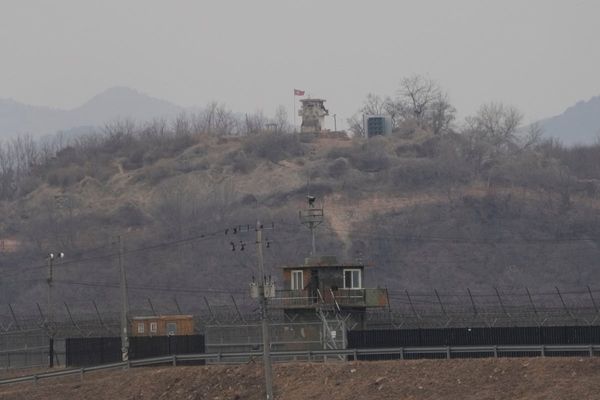
South Korea on Monday shut the propaganda broadcasts across the border with North Korea ahead of this week’s anticipated summit between the neighboring countries’ two leaders.
North Korean leader Kim Jong Un and South Korean President Moon Jae-In are scheduled to meet at the border truce village of Panmunjom on Friday.
Seoul had been blasting propaganda messages and K-pop songs from border loudspeakers since the North's fourth nuclear test in early 2016. The North quickly matched the South's action with its own border broadcasts and launches of balloons carrying anti-South Korea leaflets across the border.
South Korea turned off its broadcasts on Monday to ease military tensions and establish an environment for peaceful talks, Seoul's Defense Ministry said in a statement.
It said Seoul hopes the decision will lead to both sides stopping slander and propaganda activities. Yonhap news agency reported that some North Korean broadcasts were sporadically heard in the South on Monday morning. South Korean defense officials said they could not immediately confirm the status of the North's broadcasts.
Ahead of the summit, Pyongyang announced it would halt nuclear and missile tests and said it was scrapping its nuclear test site to instead pursue economic growth and peace.
“North Korea’s decision to freeze its nuclear program is a significant decision for the complete denuclearization of the Korean peninsula,” Moon Jae-in said in a regular meeting at the presidential Blue House on Monday.
“It is a green light that raises the chances of positive outcomes at the North’s summits with South Korea and the United States. If North Korea goes the path of complete denuclearization starting from this, then a bright future for North Korea can be guaranteed.”
Pyongyang agreed to a live broadcast by South Korean media of part of Friday’s summit, as well as summit coverage by the South’s reporters in the North’s part of the Joint Security Area at the border, the Blue House revealed on Monday.
The two sides held working-level talks at the Peace House on the South Korean side of Panmunjom to discuss matters of protocol, security and press coverage ahead of the summit.
After initially welcoming Pyongyang’s statement on halting nuclear and missile tests, US President Donald Trump sounded a more cautious note on Sunday.
“We are a long way from conclusion on North Korea, maybe things will work out, and maybe they won’t - only time will tell,” he said on Twitter.
China, North Korea’s main ally, also welcomed the North Korean announcement, but editorials in state-run media on Monday were tempered with notes of caution.
The China Daily, the official English-languages newspaper of the Chinese government, said the pledges conveyed the message that Kim will sit down for talks as the leader of a legitimate nuclear power.
“Negotiations about actual nuclear disarmament will likely prove arduous given such weapons are critical to Pyongyang’s sense of security. It will require ironclad security guarantees if it is to relinquish them.”
Elsewhere on the peninsula, thousands of riot police moved in to disperse protesters who tried to keep supplies from reaching the site of the Terminal High Altitude Area Defense (THAAD) system in the southern city of Seongju.
Construction trucks moved into the South Korean base housing the system, infuriating villagers opposed to its deployment.
“A peace treaty is being discussed... There is no more North Korea (nuclear threat) as an excuse (for deployment of THAAD). We can neither understand nor accept construction plans to operate the THAAD,” the THAAD residents’ committee said in a statement.
The system is aimed at defending against an attack by North Korea which has been pursuing nuclear and missile programs in defiance of UN Security Council resolutions, prompting threats of war from both the North and the US.
Residents have been blocking the only road to the site since mid-2017, forcing the US military to use helicopters to shuttle in fuel, food and other supplies.
“It is imperative to improve living conditions of troops based in Seongju city. We can no longer delay this so the ministry started deploying workers, materials and equipment needed for the construction today,” a Defense Ministry official said.
THAAD, designed to shoot down short- to medium-range missiles, has also angered China which believes the system’s radar could be used to penetrate its territory.