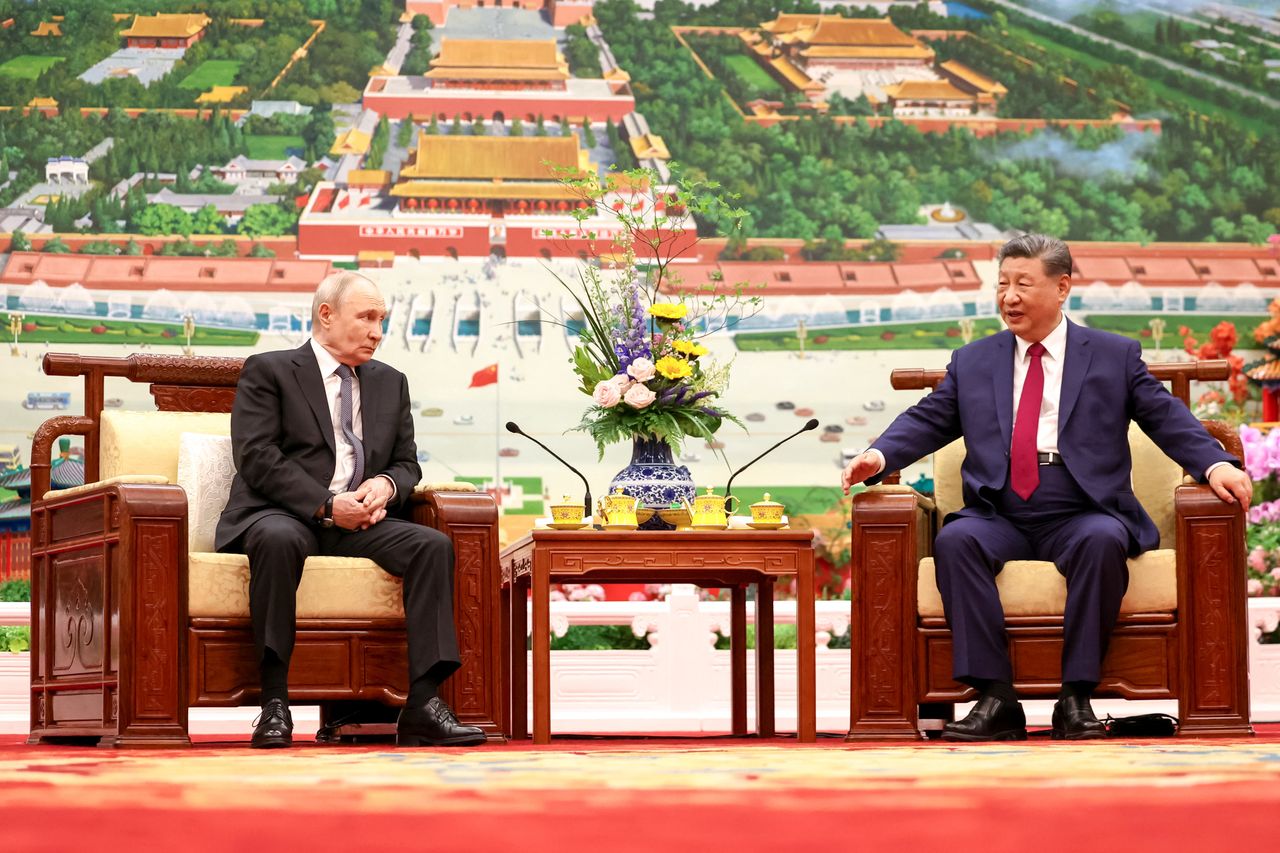
Sberbank CEO German Gref said on Wednesday that Russia's largest bank hopes to use Chinese-made processors to run GigaChat, the country's flagship AI model, according to Reuters. Gref made the remarks on Russian state broadcaster Channel One during President Vladimir Putin's two-day visit to Beijing, while sanctions continue to prevent Russia from procuring advanced Western AI hardware.
Gref didn’t specify which Chinese chips Sberbank is interested in, but the most likely candidate is Huawei's Ascend 950 family, which is also a target of intense buying competition among China's own tech giants.
Sberbank’s timing is doubtless problematic for Huawei, which has huge orders to fulfil from ByteDance, Alibaba, and Tencent. ByteDance alone committed $5.6 billion in orders for the Ascend 950PR earlier this year. Huawei is targeting 750,000 units of the 950PR in 2026, but production at SMIC is constrained by weak yields on the foundry’s 7nm-class DUV process and an estimated eight-month cycle time from wafer start to finished processor.
The 950PR sits between Nvidia's H100 and H200 in inference performance and outperforms the restricted H20 by a claimed factor of 2.8 times, though that figure is unverifiable because Hopper-era hardware lacks native FP4 support. Even so, every chip Huawei can produce faces overwhelming domestic demand, so a sanctioned Russian buyer would be competing for allocation against companies that collectively represent the backbone of China's internet economy.
Sberbank launched GigaChat Ultra in March with a new reasoning mode, and the underlying model family has grown through GigaChat 2.0 and GigaChat Max over the past year. Running those models at scale requires both inference and training hardware, and the Ascend 950PR is optimized for the former, specifically the prefill stage of serving LLMs.
Huawei's training-focused counterpart, the 950DT, isn’t expected to ship until Q4 2026 and carries 144 GB of Huawei's proprietary HiZQ 2.0 memory with 4 TB/s bandwidth. Sber's existing infrastructure relies on a combination of stockpiled Western GPUs, Chinese alternatives, and domestic Russian production that hasn’t yet reached competitive capability for frontier AI workloads. If Sberbank wants a fully Chinese-supplied AI compute stack for GigaChat, it’s going to need both chips at volume.
Sberbank acquired a 41.9% stake in Element, Russia's largest electronics producer, in January for 27 billion rubles ($356 million). Element manufactures integrated circuits and semiconductor devices that account for roughly half of Russia's microelectronics output, but its production focuses on defense and industrial applications, not data-center AI accelerators. Russia's most advanced domestic chipmaking targets 65nm lithography by 2030, which is roughly 25 years behind the leading edge.
The Putin-Xi joint declaration signed on Wednesday called for closer bilateral cooperation in AI and backed China's proposal for a global AI governance body. Whether that translates into actual chip allocation for a sanctioned buyer vying for space on Huawei's already oversubscribed order book remains to be seen.