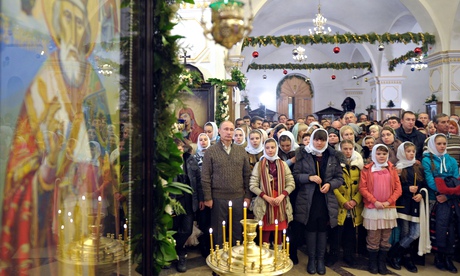
Russians celebrated Orthodox Christmas on Wednesday with fears about the weak rouble still at the forefront of many people’s minds.
On Wednesday morning, the rouble was trading at over 63 to the dollar, compared with a rate of 33 on Orthodox Christmas last year. The rouble briefly fell to a low of nearly 80 to the dollar in December before rallying in the second half of the month. However, the new year has seen another slide as the price of oil continues to slump.
President Vladimir Putin, who last month told Russians they should not panic about the difficult economic conditions, made his first public appearance of the year at a midnight mass in the city of Voronezh. He attended a service at a church which has provided shelter for children fleeing the conflict in east Ukraine. The president, wearing a brown jumper, stood surrounded by children during the service.
In Moscow, the prime minister, Dmitry Medvedev, attended a service at the main Christ the Saviour Cathedral with his wife.
Russians, along with other Orthodox Christians, celebrate Christmas on 7 January in accordance with the Julian calendar, which was replaced in most of the world with the Gregorian calendar 500 years ago. The new year in Russia starts with over a week of public holidays, meaning many Russians travel abroad or go to their dacha (country house) as the country shuts down for nearly a fortnight. This year, however, the number of Russians travelling abroad fell dramatically as many decided the weak rouble made foreign breaks hard to afford.
Analysts say the oil price is the key indicator of the Russian economy, but the western sanctions imposed on Russian banks in the wake of the war in Ukraine have also played a part, as well as underlying concerns about the lack of diversification and reform in the Russian economy.
The situation is still far from an all-out crisis, with the country still possessing a healthy, albeit lower, amount of foreign currency reserves. Reserves have dropped to $388bn (£257bn), down from $500bn a year ago, and are now at their lowest level since the collapse of Lehman Brothers – and the burn rate is accelerating as the central bank intervenes to prop up the rouble.
One of the main concerns is the size and structure of external debt, with 74% of the total of $730bn external debt denominated in foreign currency. Around 60% of the $106bn due in 2015 is owed by companies currently under sanctions, and so they cannot easily roll the debt over, while many banks have dollar debt but not the same level of dollar assets.