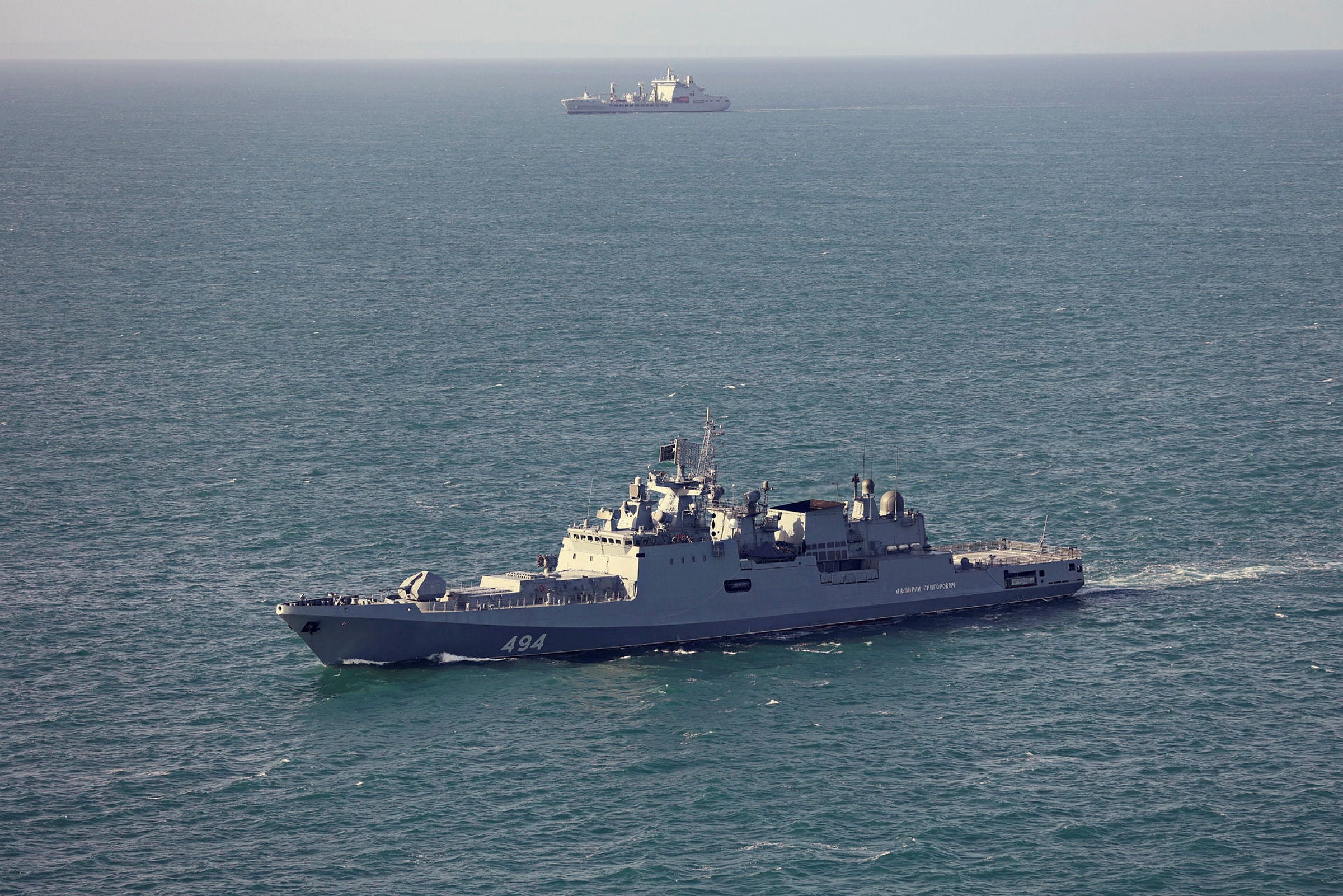
A Russian warship fired warning shots at a UK-registered yacht being sailed by a retired couple in the English Channel on Tuesday to prevent a possible collision, authorities said.
The Kremlin frigate Admiral Grigorovich fired several shots while sailing near the 40ft yacht, Bright Future, as it sailed around 20 nautical miles south of the Isle of Wight. There were no injuries or damage caused during the incident.
Jane Kelvey, 68, and her husband Alan, 70, who were travelling on the Bright Future, described the incident as “a bit scary” on Tuesday night.
“I crouched down. I didn’t think our safety was in danger. But it was certainly unusual. As we sailed away, we said to each other, what the hell just happened?” they told The i.

Speaking to BBC Newsnight in a separate interview, Mrs Kelvey said the incident was “just surreal” and branded the Kremlin’s claim their ship was on a collision course as “just normal lies”.
“It’s just not true. They’re blaming us, and as far as we’re concerned, we were blameless.”
A spokesperson for the Ministry of Defence said the shots were not aimed at the vessel and were “an attempt to prevent a possible collision”.
Authorities were alerted when the Bright Future alleged that the warship fired warning shots nearby at a distance of approximately 500 yards (457 metres).
As Russian warships are routinely shadowed by the Royal Navy when they pass through the English Channel, the offshore patrol vessel HMS Mersey was monitoring the frigate.
A seaboat from HMS Tyne, another patrol vessel, was sent to the yacht to gather information and check on the safety of the crew.
The Conservatives said the incident was “hugely concerning” and showed “yet again, that Russia poses a direct threat to our nation”.
James Cartlidge, the shadow defence secretary, said: "In the last three days we have seen a Russian shadow fleet tanker seized, Russian agents exposed at the heart of an attack on the prime minister and now we have reports of shots fired by a Russian frigate at a civilian yacht in the Channel.

"This shows, yet again, that Russia poses a direct threat to our nation, and underlines why it is critical for Labour to get a grip on defence after the chaos of their ministerial resignations last week. Above all, this news shows why reports of Labour planning to make further cuts to defence are so shocking.”
The Russian ministry of defence said the yacht had been on a “dangerous approach” and the ship fired warning shots after attempting to draw the attention of the yacht’s crew through signal flares and sound signals.
It said its sailors had acted “in strict accordance” with international shipping regulations.
It comes just two days after Royal Marine commandos and officers from the National Crime Agency boarded the sanctioned Russian shadow fleet tanker Smyrtos in the Channel.
But Martin Kelly, of crisis-management firm EOS Risk, said people should be careful not to link the incident with the seizing of the Russian tanker by the UK.
He said: “Warships, it doesn’t matter who you are or where you’re from, are entitled to self-defence.
“If a ship, yacht, etc is approaching, the rules of force escalation will start with a VHF (very high frequency radio) warning, and if there is no response the next escalation is a more intense warning, and then up to warning shots, which is where we got to here.”
He added: “This kind of thing does happen everywhere all of the time, I honestly don’t think there’s a link here. If Russia was going to respond then they would do against probably a commercial ship.”
The shots were fired on the same day as the captain of the seized shadow tanker Smyrtos appeared in court charged with breaching sanctions. The Russian shadow fleet vessel was carrying 98,000 tonnes of crude oil when it was intercepted by British troops.
Ajay Pant, an Indian national, has been charged with directly or indirectly supplying or delivering by ship prohibited oil or oil products from Russia to a third country, in contravention of strict sanctions. He has been remanded in custody.
The court heard that the oil tanker was part of Russia’s “clandestine fleet of 700 ships”, which acted as its “lifeline” by transporting 75 per cent of its oil and helping fund the war against Ukraine.
The move to seize the tanker was the first UK-led operation to capture a sanctioned vessel, and it has since been formally prevented from leaving the UK.
Ministers also announced new laws last month designed to crack down on Russian interference, warning saboteurs that if they deliberately damage vital undersea internet cables around Britain, they will face jail.
The penalty for interfering with communications cables currently carries fines of just £1,000, unless prosecutors can prove the action was on behalf of a foreign power, which can be punished with a prison sentence.

But Liz Lloyd, the digital economy minister, said in a speech in central London that ministers would “make the law clearer, tougher, and much harder to evade, sending a clear message that if you act recklessly or if you deliberately target our cables, there will be serious consequences”.
The move is designed to act as a deterrent to protect the undersea fibre-optic cables, which are responsible for 99 per cent of the world’s digital communications and perform an essential role in commercial, government and military operations by securely transmitting information.
At the time, Baroness Lloyd said the UK’s message to Putin was simple: “We can see what you are doing and any interference will have serious consequences.”
The three-and-a-half-thousand tonne Admiral Grigorovich, a Black Sea fleet frigate, has been shadowed by the Royal Navy on a few occasions as it passes through the English Channel.
In April, it was reported that it accompanied two shadow fleet vessels along England’s southern coast, while British tanker RFA Tideforce followed behind.
Admiral Grigorovich has eight vertical launch cells for cruise missiles, which can be used against ships or ground targets. It also has an A-190 Arsenal naval gun and a hangar and helipad for a military helicopter.