Closing summary
We are now closing the blog.
Here is your summary of the day so far:
-
At least 21 people were killed and dozens injured overnight in Kyiv, local authorities said, in what the city’s mayor Vitali Klitschko claimed was the worst Russian attack on the Ukrainian capital during more than four year’s of Russia’s air assault on Ukraine (9:25).
-
Ukraine’s Volodymyr Zelenskyy has vowed to “definitely” retaliate against Russia as he visited one of the sites of the attack (16:48).
-
EU’s foreign policy chief Kaja Kallas said she would propose further sanctions on Russia, saying “the more Moscow attacks civilians, the more sanctions must be imposed” (9:31).
In other news,
-
Over in Germany, chancellor Friedrich Merz has laid out his plans for wide-ranging reforms in a bid to revive the country’s struggling economy and counter the rise of the far-right ahead of key land elections this autumn (10:09).
-
German prosecutors have accused Ukrainian “state authorities” of ordering the 2022 explosives attack on the Nord Stream gas pipelines linking Russia with Europe, a charge likely to ignite tensions between Kyiv and Berlin, its biggest military backer (11:44).
-
France, Portugal (15:50) and Spain are bracing for another possible heatwave that could bring temperatures of 44C over the coming days, as figures show that June’s extreme heat was responsible for more than 2,000 excess deaths in the two countries.
-
If you have any tips, comments or suggestions, email me at jakub.krupa@theguardian.com.
I am also on Bluesky at @jakubkrupa.bsky.social and on X at @jakubkrupa.
Ukraine will 'definitely' retaliate for Russia's attack on Kyiv, Zelenskyy says
Ukrainian president Volodymyr Zelenskyy vowed to retaliate for Russia’s strikes on Kyiv that killed at least 21 people and wounded dozens, as he visited an apartment block partially destroyed in the attack.
Asked by reporters whether Ukraine would retaliate, Zelensky replied: “Definitely”.
21 killed, 85 injured in last night's Russian attack on Kyiv, authorities say
The death toll from last night’s Russian attacks on Kyiv has risen to 21, and 85 people are confirmed injured, including two children, Ukraine’s State Emergency Service said in an update.
US negotiators have been in touch with Ukraine over past two days, Zelenskyy says
Back to Ukraine, a senior Ukrainian defence official, Rustem Umerov, and US president Donald Trump’s son-in-law Jared Kushner have held talks in the past two days, president Volodymyr Zelenskyy said.
Speaking at one of the sites targeted in a devastating Russian attack on Kyiv as rescuers sifted through rubble, Zelenskyy said he still hoped Kushner and envoy Steve Witkoff would visit Ukraine even though US-backed peace efforts to end the war have stalled for months, Reuters reported.
Zelenskyy added that he hoped to have a meeting with Trump on the sidelines of a Nato summit in the Turkish capital Ankara next week.
Vatican excommunicates all members of ultra-conservative rebel group SSPX
The Vatican has excommunicated a rebel group of ultra-conservative Catholics who defied Pope Leo by ordaining bishops without his consent, creating a schism in the Roman Catholic church.
In a statement on Thursday, Cardinal Víctor Manuel Fernández, who heads the Holy See’s Dicastery for the Doctrine of the Faith, said the group from the Society of Saint Pius X (SSPX), founded in the Swiss village of Ecône in 1970, had “committed an act of a schismatic nature” which, under canon law, is punishable with automatic excommunication.
The Vatican went further than expected and said that all priests of the SSPX and all Catholics who “adhere formally” to the group were in schism and excommunicated.
A schism is a term to indicate a severe, formal rupture within the church.
Andrea Vreede, Vatican correspondent for NOS, the Dutch public radio and TV network, said:
“The Vatican hopes that by being harsh on the bishops, the priests and faithful, maybe some of them will repent and turn back to mother church. Because it’s not nice to be excommunicated.”
Ryanair warns of 'queue chaos' because of new UE entry/exit system
Ryanair has warned of “queue chaos” this summer at EU airports because of new fingerprint checks, as the European Commission invited the air industry to an urgent meeting next Tuesday to discuss concerns over the new entry and exit system.
The airline, Europe’s largest, said passengers going on well-deserved breaks this summer should not be used as “guinea pigs” for a “half-baked” system.
Airlines for Europe and Airports Council International have asked the commission to suspend the new border controls “at least throughout July and August” but potentially for a full year until next summer.
They are concerned that airports are not ready to cope with the influx of passengers over the peak summer season, that staff are being subjected to abuse as queues build for fingerprinting and that the whole travel industry will be hit hard.
On Thursday, Ryanair said it had already urged suspension until September in the “most exposed countries”, claiming the current infrastructure is “not ready to manage the high passenger volumes expected” from mid July.
It listed seven airports that were already “experiencing major disruptions” with “further congestion expected” as the holiday season gets busier.
The airports are: Tenerife South, Palma, Alicante and Málaga in Spain, Milan Bergamo in Italy, Kraków in Poland and Paris Beauvais in France.
Neal McMahon, Ryanair’s chief operating officer, said:
“It is clear that the entry/exit system (EES) is still not ready for peak summer volumes. Passengers and families should not be used as guinea pigs for a half-baked passport control system that risks creating long queues, missed flights and unnecessary stress at airports this summer.”
Portugal raises alert level over extreme temperatures expected this weekend
The Portugese government has declared a state of alert over extreme temperatures expected in the country over the weekend.
“Each one of us has the responsibility to prevent and do our part. I ask everyone to respect the authorities’ instructions. We are all necessary to protect our community,” prime minister Luís Montenegro said on X.
The alert will last until 11.59pm on Monday and includes the ban on use of some machinery in agricultural settings as the government hopes to reduce the risk of wildfires.
Residents were also told to drink at least 1.5 litres of water, avoid alcohol, and stay cool with windows, blinds and shutters closed during the hottest periods.
Interior minister Luís Neves warned the country faced an unprecedented fire risk, as temperatures could reach up to 47C locally, which combined with low humidity levels effectively posed the risk of “a real powder keg,” Publico reported.
Let me quickly bring you up to date on other news from across Europe.
Romanian president Dan condemns Russia's 'reckless and irresponsible' attack on Kyiv
Romanian president Nicușor Dan has condemned the Russian “reckless and irresponsible” attack on Kyiv overnight.
In a post on X, he said:
“Our condolences and deepest thoughts of compassion go out to the Ukrainian people and all the affected families. We also wish a swift recovery to the wounded.
Russia has demonstrated once again that it does not want peace and is not engaging in reasonable behaviour to advance toward a comprehensive security situation.
Romania will support Ukraine for as long as it takes to defend its freedom.”
Reporters in Kyiv spoke to some local residents about last night’s Russian attack on the city.
When 17-year-old Karolina Shevchuk’s phone warned a Russian missile was headed towards her district of Kyiv, she decided against seeking shelter, choosing instead to stay in her apartment.
It was only when she went outside to look for her cat and a young man shouted for her to take cover that she realised the danger.
“I thought he was joking, but then I could hear whistling. I ran back into the building, covered my ears, and then – boom. Debris came crashing down on us,” she told AFP.
Updated
Russia’s military chief, Gen Valery Gerasimov, reported the results of the “massive retaliatory strike” to Vladimir Putin, Kremlin spokesperson Dmitry Peskov said, according to the state-run Tass news agency.
The Russian president has not publicly commented on the overnight attack on Kyiv.
Starmer: 'I am utterly appalled by Russia’s latest barbaric assault on Kyiv'
UK prime minister Keir Starmer has issued a statement condemning Russia’s attacks on Kyiv.
He said:
I am utterly appalled by Russia’s latest barbaric assault on Kyiv, which has killed and injured innocent civilians.
These attacks are a stark reminder that while Ukraine continues to pursue peace, (Vladimir) Putin continues to inflict suffering and violence on the Ukrainian people.
The UK will continue working with allies to increase pressure on Russia and support Ukraine in securing a just and lasting peace. We stand with Ukraine for as long as it takes.
Death toll rises to 20 following Russia's overnight assault
The number of people killed in Kyiv after Russia’s overnight attack has risen to 20, according to a local official.
More than 56 others were injured after a barrage of Russian drones and missiles struck the Ukrainian capital.
Updated
Record number of people sought shelter in city's underground stations - Kyiv Metro
A record number of people took shelter in underground stations in Kyiv last night, with 52,500 people, including nearly 4,500 children, finding refuge in the city’s metro system.
It was the highest number of people to shelter in underground stations during a night-time air raid in recent years, according to the Kyiv Metro.
There are 46 underground stations that operate as shelters in the city, the Kyiv Metro said.
Aftermath of Russian overnight attack on Kyiv - in pictures
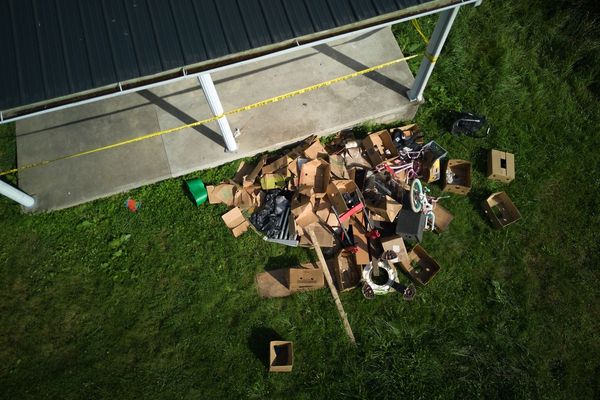
Following the overnight attack, damage was recorded in 30 locations across Kyiv, mainly residential buildings and civilian infrastructure, according to Tymur Tkachenko, head of the Kyiv city military administration, AP reported.
Some 20 residential buildings were damaged, interior minister Ihor Klymenko said.
Updated
Germany condemns Russian strikes on Kyiv, vows to continue supporting Ukraine
Separately, Germany’s foreign ministry condemned Russia’s major strike on Kyiv in the strongest possible terms and vowed to continue supporting Ukraine against Russian aggression.
In a statement, it said:
“We condemn in the strongest possible terms the massive Russian airstrikes on Kyiv and other parts of Ukraine last night.
Once again, Putin’s Russia has subjected the Ukrainian capital and large swathes of the country to massive drone and missile attacks.
People were killed or injured in their sleep, homes were destroyed, and civilian infrastructure, such as a medical facility, was severely damaged. Our thoughts are with the victims and their families.
The shocking images of destruction from last night demonstrate once again that Russia is continuing its illegal war of aggression against Ukraine with unabated brutality.
Putin shows no willingness to negotiate. He continues to rely on missile and drone terror against the population, while Russia suffers enormous losses on the front lines in its aggression against Ukraine.
Therefore, Germany, together with its partners, is further increasing the pressure on Russia. We will continue to support Ukraine in its fight to defend itself. This support will also be a key topic at next week’s NATO summit in Ankara.
Germany alleges Nord Stream sabotage was carried 'on the orders of state authorities in Ukraine'
Meanwhile, German prosecutors alleged that Ukrainian state authorities were behind the 2022 sabotage of the Nord Stream gas pipeline linking Russia with Europe in a move which AFP said could complicate close relations between Kyiv and its key military backer Berlin.
In a statement detailing the charges brought against one suspect, German prosecutors said that he and other members of the Ukrainian military had acted “on the orders of state authorities in Ukraine”.
The suspect in question was arrested in summer 2025 in Italy and extradited to Germany the following November, and was named at the time as Serhii K., AFP said. He has denied involvement, Reuters noted.
Zelenskyy says he hopes for swift results of Irish probe into alumina exports to Russia
in Dublin
Volodymyr Zelenskyy has said he hopes not to wait too long for the results of an Irish government investigation into alumina exports to Russia thought to be feeding the Kremlin’s war machine.
Speaking in Dublin on Wednesday he said he was grateful that the Irish government was conducting an investigation into the issue. “We very much hope for a positive result and we do hope that we will not have to wait for it for months,” he told reporters.
Investigative journalists, including at the Guardian, revealed that the Aughinish Alumina refinery on the west coast of Ireland is part of an international supply chain that appears to be feeding the Russian war machine.
The smelter, which is owned by the Russian aluminium group Rusal, is at the heart of a booming, and legal, trade in alumina, which is derived from bauxite and serves as the base ingredient for aluminium. Ireland exported $376m alumina to Russia in 2024, a 50% increase on 2022.
Speaking alongside Zelenskyy, Ireland’s prime minister, Micheál Martin, said the two leaders had a “good discussion on that specific issue” and that Ireland was “coming to the completion of an investigation so we get the full facts”. He continued: “We do not want to be in a position where material emanating from a plant in Ireland goes to support the Russian war machine.”
At a ceremony to mark the start of Ireland’s six-month EU presidency, Zelenskyy was more blunt about unnamed European companies.
“Unfortunately there are companies in Europe that are owned or effectively controlled by Russia and its sanctioned oligarchs. They keep supplying the aggressor with essential materials even now.”
The Ukrainian president also warned he had “very unpleasant information” about Russian preparations for another massive attack. Hours later Russia launched a large-scale bombardment of Kyiv that killed at least 17 people and injured dozens more.
Zelenskyy also reiterated calls for a speedy journey for Ukraine to join the EU, calling on the union to open talks on the five remaining groups of EU rules, known as clusters. Ukraine embarked on the first phase of membership talks (cluster one on the rule of law) last month, but now wants to open talks on all remaining chapters of the EU rulebook, including the single market, environment, economic and social policy.
Martin, who earlier stressed the transformative effect of European membership for Ireland, said he intended to work to secure the opening of all the remaining clusters by the end of our term.
Russia will 'continue to increase pressure on Kyiv' to achieve its goals, Kremlin spokesperson says
Responding to the EU foreign policy chief’s comments that the bloc would increase pressure on Russia for its strikes on civilian targets in Ukraine, the Kremlin’s spokesperson Dmitry Peskov said that Russia will equally “continue to increase pressure on the Kyiv regime in order to achieve our set goals.”
Death toll after overnight attack on Kyiv rises to 17
Meanwhile, the death toll following a Russian drone and missile attack on Kyiv has risen to 17, Ukraine’s emergency services said.
Russia ‘mounted drone surveillance of European nuclear sites over 18 months’
Defence and security editor
The Kremlin orchestrated a concerted surveillance campaign using drones launched from shadow fleet vessels over an 18-month period which targeted nuclear sites in the UK, France, Belgium and the Netherlands, researchers have said.
Analysis by the International Institute for Strategic Studies (IISS) of 144 incidents in more than a dozen countries beginning in late 2024 concluded Russian intelligence had operated with “substantial impunity”, leaving authorities across Europe flat-footed and confused.
Drones were repeatedly spotted over airbases and airports, yet none were captured or shot down by western militaries, exposing a strategic failure in Nato air defences that the thinktank said had been quietly acknowledged across Europe.
RAF Lakenheath in Suffolk, a UK base that was being prepared to house US nuclear weapons, and France’s nuclear submarine base at Île Longue in Brittany were among the sites targeted by unarmed drones believed to have been launched at sea.
European governments have been reluctant to accuse Russia of being behind the incidents, but Charlie Edwards, a senior IISS fellow, said “every government we spoke to said they would welcome the report being published”.
Back to Ukraine, the Russian Defence Ministry said its “massive attack” on Kyiv using long-range, high-precision air-, land-, sea-launched weapons and drones hit military and energy facilities, as well as airports and other locations, Reuters reported.
It said it was a retaliation for Ukrainian attacks on Russia.
Russia launched 74 missiles and 496 drones during the attack, the Ukrainian air force said. Air defence units downed most of those but 25 ballistic missiles and 12 drones struck 33 locations.
Merz presents coalition reform package in bid to revive economy amid AfD challenge
Over in Germany, chancellor Friedrich Merz has laid out his plans for wide-ranging reforms in a bid to revive the country’s struggling economy and counter the rise of the far-right ahead of key land elections this autumn.
The package of reforms includes income tax cuts of a volume of €10bn to be financed by increased taxes on the wealthy, as well as changes to the pension system that will eventually see the retirement age rise to 67, AFP said.
The tax relief will be mainly funded by raising the top rate of tax to 47% from 45% for the highest earners with an annual income of €280,000 or more, Reuters said.
The reforms also include an action plan against benefit fraud and abolishing workers’ ability to obtain sicknotes by phone, as well as a goal to cut staffing by 8% in federal ministries through digitisation, Reuters said.
Merz’s CDU/CSU trails nationally in all polls behind the far-right Alternative für Deutschland by three to five percentage points, with junior coalition partner SPD in fourth place, behind the Greens.
In September, closely watched local elections will be held in Saxony-Anhalt, which could see AfD come to power for the first time, with the party consistently polling at above 40%.
At least 13 killed in Russian drone and missile attacks on Kyiv - full story
in Kyiv
At least 13 people were killed and dozens injured overnight in Kyiv, local authorities said, as Russia launched its latest massive drone and missile attack on the Ukrainian capital in the early hours of Thursday.
Fires were burning at sites across the capital as dawn broke, with strikes or debris hitting residential buildings in several districts and a hotel on one of Kyiv’s central boulevards. The death toll of 13 may rise, as local emergency services said 86 people were injured, 70 of whom had been hospitalised.
Loud explosions shook the capital for several hours as waves of drones as well as cruise and ballistic missiles came towards the capital and Ukrainian air defence attempted to shoot them down.
Kyiv’s mayor, Vitali Klitschko, writing on Telegram, said that at one site the first to sixth floors of an apartment building had collapsed after a direct hit. At another location, people were pulled out from under rubble after part of a block of flats collapsed.
Russia regularly launches combined missile and drone attacks on the Ukrainian capital and there had been speculation for some days that another massive attack was in the works. President Volodymyr Zelenskyy warned Ukrainians on Wednesday that it could come that night. “I am asking all our people to be extra careful, take care of yourselves and your children, and use shelters, this is very important,” he said, speaking on a visit to Dublin.
Kyiv mayor Vitali Klitschko said the city will mark a day of mourning on Friday to commemorate the victims of the overnight strikes on the city.
At least 13 people were killed in the attack, with almost 90 injured.
Flags will be lowered on all municipal buildings in the city, with a recommendation to all other landlords to also raise their flags, if applicable.
All entertainment events in the city will be cancelled.
'The more Moscow attacks civilians, the more sanctions must be imposed,' EU foreign policy chief says
EU’s foreign policy chief Kaja Kallas responded to the overnight attacks on Kyiv, saying she will propose further sanctions on Russia.
“Words of condemnation alone will not stop attacks on Kyiv. Only sustained military support for Ukraine and increased pressure on Moscow can do that,” she said.
“Today, I will propose to sanction more entities supporting Russia’s military-industrial complex in response to the strikes. The more Moscow attacks civilians, the more sanctions must be imposed. We keep raising the cost until Russia understands it cannot win.”
Kallas added that all EU staff in Kyiv are accounted for, as she thanked them for their service in these difficult circumstances.
Morning opening: At least 13 killed in overnight Russian attacks on Kyiv
At least 13 people were killed in overnight Russian attacks on Kyiv and Ukraine, hours after president Volodymyr Zelenskyy cut his visit to Ireland short as he warned that Moscow was preparing a “massive attack”.
At least 86 people were injured during the strikes.
Zelenskyy said that at least 20 sites were attacked overnight, “most of them ordinary residential buildings,” with damage also reported “to an ambulance station, a research institute, a hotel, and [local] businesses.”
“Air defence supplies for Ukraine are an absolute and critical priority,” he stressed, repeating his request for a US licence to produce Patriot missiles locally in Ukraine.
Ukrainian foreign minister Andrii Sybiha urged Ukraine’s allies to help Kyiv strengthen its air defence.
“Do not delay decisions on air defence for Ukraine! This is our main request to our partners after Kyiv suffered a night of horror,” he said.
I will bring you all the updates from Kyiv.
Separately, German chancellor Friedrich Merz is presenting his government’s new reform agenda this morning, hoping to send to gain new momentum after criticism of his lacklustre performance so far. I will bring you the key lines on that too.
It’s Thursday, 2 July 2026, it’s Jakub Krupa here, and this is Europe Live.
Good morning.