A police officer who was poisoned by a nerve agent in the attack on a former Russian spy and his daughter is talking in hospital as the hunt continues for the culprits.
Security sources told The Independent several people are believed to be behind the assassination attempt in Salisbury, and are likely to be “either present or past state-sponsored actors”.
Sergei Skripal and his daughter Yulia remain in intensive care in hospital and authorities have not said whether they can recover.
Amber Rudd, the Home Secretary, said: “The two targets are still in very serious condition, the policeman is talking and is engaging so I’m more optimistic for him, but it’s too early to say.
“This is a nerve agent, we are still treating it as very serious.”
Asked if she was hopeful for the police officer, she told ITV’s Good Morning Britain: “Indeed, hopeful, but it’s still very serious.”
Ms Rudd said the nerve agent used was “very rare” but declined to name the precise chemical and emphasised that the risk to the public was low.
Suspicion has turned to the Russian government, which jailed Mr Skripal for “treason” in 2006, or former spies he betrayed while working for MI6 during his time a colonel in the GRU military intelligence service.
He was given refuge in Britain after being exchanged in 2010 for Russian agents caught in the West as part of a Cold War-style swap in Vienna.
Mr Skripal appears to have lived a quiet life in a semi-detached home in Salisbury, but a former associate, Valery Morozov, believes he had not completely retired from espionage.
“Every month [he was] going to the Russian embassy to meet military intelligence officers,” he told Channel 4 News, claiming that that the former double agent was keeping “dangerous” company.
The Russian Embassy said they were not aware of any meetings and denied any involvement by its security services.
Ms Rudd declined to say whether she regarded Russia as responsible for the attack but said the Government will put a plan in place to respond when the culprit is identified, adding: “When we have all the evidence of what took place, we will, if it is appropriate, attribute it to somebody.
“If that is the case then we will have a plan in place. We need to be very methodical, keep a cool head and be based on the facts, not rumour.
“Let me be clear, we are absolutely robust about any crimes committed on these streets of the UK. There is nothing soft about the UK’s response to any sort of state activity in this country.
“You may not hear about it all, but when we do see that there is action to be taken, we will take it.”
The attack in Salisbury may prompt further action following on from the Government's Criminal Finances Act, which was inspired by the US's Magnitsky Act.

In measures introduced last year, it allowed the assets of international human rights violators to be frozen, and powers could be strengthened by the Sanctions Bill, which is currently going through committees in the Houses of Parliament.
Gavin Williamson, the Defence Secretary, said Russia was becoming an “ever-greater threat”, citing its “aggressive stance” in Eastern Europe and alleged support for separatists in Ukraine.
“Russia's changing the way they actually fight and raise the level of conflict,” he added. “We are seeing this in the north Atlantic as well, the amount of submarines that are operating, there's a 10-fold increase in the last seven years.
”Russia's being assertive, Russia's being more aggressive, and we have to change the way that we deal with it because we can't be in a situation in these areas of conflict where we are being pushed around by another nation.“
Mr Williamson also declined to say whether he held Russia responsible for the attack in Salisbury, saying only: ”What's happened is absolutely disgusting and it is so important we give the police the space and opportunity to do a proper and thorough investigation.“
Hundreds of detectives, forensic specialists, analysts and intelligence officers working around the clock on the case, police said.
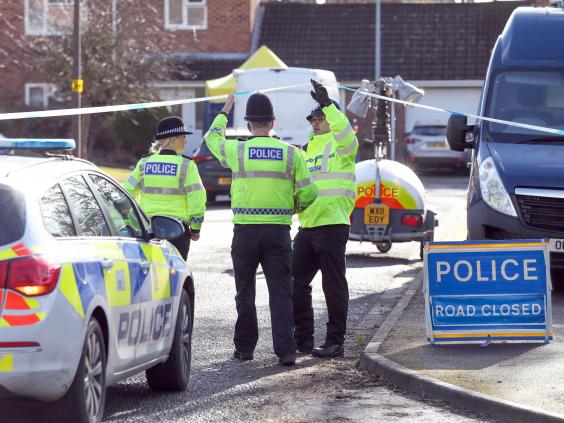
They are examining CCTV and building a detailed timeline of events, while specialist officers in protective clothing continue investigations at cordoned off areas in Salisbury.
The work is expected to take several days, while police appeal for witnesses who were in and around the city centre on Sunday afternoon to come forward.
Mr Skripal, 66, and his 33-year-old daughter, Yulia, were found unconscious on a bench in The Maltings shopping centre at around 4.15pm.
They had eaten at a nearby Zizzi restaurant and gone for a drink at The Mill pub, with both establishments still cordoned off.
Chemical weapons experts told The Independent that the nerve agent could have been administered in a variety of ways, including in their food or drink, and in the form of a spray or liquid.
Sarin has been used globally in both liquid and gas forms, while the even stronger nerve agent VX – developed in the British military’s secretive Porton Down facility – was used to assassinate Kim Jong-un’s brother last year.
Dr Jennifer Cole, an associate fellow at the Royal United Services Institute for Defence and Security Studies, said anyone manufacturing nerve agents needs advanced chemical knowledge and some form of laboratory.
“With something that dangerous you need to know exactly what you're doing, particularly so that you don't get it on yourself,” she told The Independent.
“It wouldn't be difficult to manufacture in the UK - it wouldn't have to be imported.”
Dr Cole said that when nerve agents are absorbed through the skin or inhaled, they are very fast-acting.
“The fact that there doesn't seem to have been anyone with them when they collapsed could point to it being ingested - the need to digest would slow the reaction and give whoever administered it chance to get away,” she added.
Antidotes do exist to several nerve agents but their effectiveness relies on them being administered immediately to counteract their rapid effect on the nervous system.