Around 100 military personnel are being deployed to Salisbury to aid the ongoing investigation into the poisoning of a Russian spy, police say.
The national counter-terror policing network, which is leading the probe, said it had requested help to remove “a number of vehicles and objects from the scene in Salisbury town centre as they have the necessary capability and expertise”.
"The public should not be alarmed and the public health advice remains the same,” a spokesperson added. “The military has the expertise and capability to respond to a range of contingencies.
"The Ministry of Defence regularly assists the emergency services and local authorities in the UK. Military assistance will continue as necessary during this investigation."
The Independent understands that units from the Army, RAF and Navy are being deployed alongside experts in chemical, biological, radiological and nuclear (CBRN) warfare.
They will be visiting numerous scenes cordoned off around Salisbury, including the bench where Sergei and Julia Skripal were found unconscious on Sunday, the former double agent’s home, and an ambulance station housing the vehicle that took them to hospital.
A witness said he saw police searching a car at a vehicle recovery centre close to Mr Skripal’s home on Thursday, describing seeing around 10 people in hazmat suits looking at the Mercedes people carrier.
Samples from the victims have already been tested by experts at the Defence Science and Technology Laboratory at Porton Down, a secretive military facility where nerve agents have been developed and tested over decades of controversial research.
Gavin Williamson, the Defence Secretary, said Friday’s intervention built on the “vital expertise and information already provided” by scientists at Porton Down.
“We have the right people with the right skills to assist with this crucial inquiry,” he added. “This is a dreadful incident and my thoughts remain with the victims and their families.”
Amber Rudd described the nerve agent used, which also made a police officer seriously ill and affected 18 other people, as “very rare” but investigators have not named the precise chemical used.
Investigators are working on the possibility that Mr Skripal was targeted at his Salisbury home, where sources told The Independent a package containing the nerve agent may have been delivered and opened in the presence of his daughter.
As the race to find out how the pair were poisoned – and who by – the Home Secretary has visited the scene where they were found.
Ms Rudd said Mr Skripal, 66, and his 33-year-old daughter remain intensive care, after visiting Detective Sergeant Nick Bailey in Salisbury District Hospital.
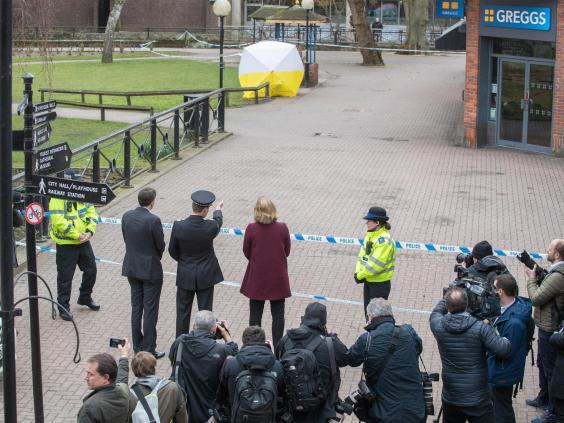
"It is very serious for the two people who were indeed the subject of this outrageous attack and for the police officer, I understand it's still serious, although he's still conversing and engaging,” she added.
"I understand people wanting to have answers [about the nerve agent and culprit], and there will be a time to have those answers.
"But the best way to get to them is to give the police the space they need to really go through the area carefully, to do their investigation and to make sure that they have all the support that they need.
"At the moment our priority is going to be the incident, which is why I'm here in Salisbury today, making sure that everybody's protected around the incident, making sure the emergency services have had the support that they need and will continue to get it.”
Suspicion has turned to the Russian government, which jailed Mr Skripal for “treason” in 2006, or former spies he betrayed while working for MI6 during his time as a colonel in the GRU military intelligence service.
Ministers have declined to say who is believed to be responsible in the wake of high-level Cobra and National Security Council meetings, but threatened further sanctions against Russia if state involvement is found.
"In terms of further options, that will have to wait until we're absolutely clear what the consequences could be and what the actual source of this nerve agent has been,” Ms Rudd said.
On Thursday, new police cordons were erected around the gravestone of Mr Skripal’s wife Liudmila, who was buried in 2012, and the memorial stone of his son, Alexander, who was cremated last year.
They are located at separate sites in the London Road Cemetery with each guarded by a police officer.
Counter-terror police are believed to be looking into the deaths, as well as that of Mr Skripal’s elder brother Valeri, a former paratrooper in Russian forces who died two years ago after sudden weight loss.
The cause of 59-year-old Ms Skripal’s death was recorded as endometrial cancer and Alexander, 44, was said to have suffered liver failure while on holiday.
Mr Skripal’s wife passed away in the UK but Alexander and Valeri died in Russia and any fresh probe into the circumstances will need the cooperation of the authorities in Moscow.
Forensic tests are focusing on his house, a branch of the Zizzi restaurant chain and The Mill pub in Salisbury, where witnesses say Mr Skripal began to behave in an agitated manner following lunch with his daughter.
The former double agent may have become a target after using his contacts in the intelligence community to work for private security firms, investigators believe.
Sergei Skripal could have come to the attention of certain people in Russia by attempting to “freelance” for companies run by former MI5, MI6 and GCHQ spies, security sources say.
Security officials told The Independent that 66-year-old Mr Skripal was no longer an active MI6 asset and was not regarded as being under threat, meaning he lived openly under his own name.
Investigators are looking at the possibility that the attackers flew into Britain to carry out their mission and then left, possibly individually, afterwards.