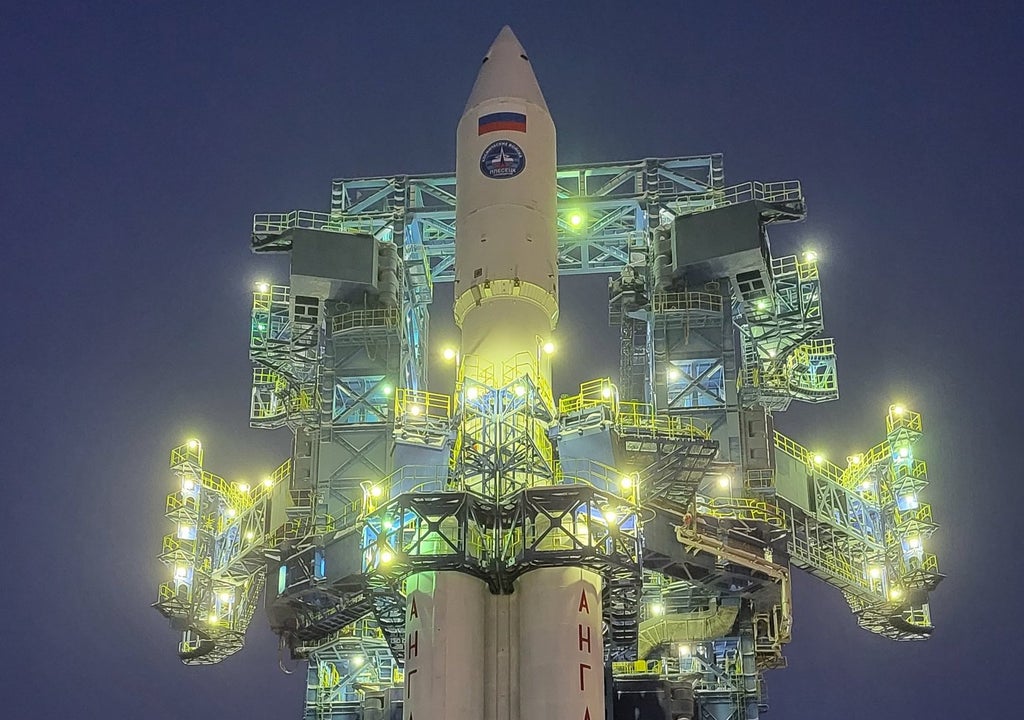
A chunk of Russian spacecraft that went out of control and plunged back down to Earth has re-entered the atmosphere.
It brings an end to the difficult journey of the upper stage of the Angara A5 rocket. It departed Earth on 27 December, in a test flight that initially appeared to be successful, but a second burn to move the spacecraft into a higher orbit failed.
Since then, the upper stage known as Persei has been in an uncontrolled fall back down to Earth. The speed and size of the object made it difficult to predict when and where it would finally plunge back down to Earth.
It did so late on Wednesday evening UK time, however, hurtling into the atmosphere over the South Pacific. That is according to data from the Space Force, which tracked the debris, shared online by satellite tracker Jonathan McDowell from the Harvard-Smithsonian Center for Astrophysics.
Data shows that the rocket made its entry east of French Polynesia, into an empty patch of sea. While the debris from the re-entry could have spread much further the surrounding area does not contain land and little material is expected to have survived the descent anyway.
Persei was a significant piece of space debris, weighing about 20 tonnes when it departed. But much of that mass was made up of fuel, which likely was lost as it fell back down to Earth or destroyed during the re-entry.
The much-watched re-entry recalls that of China’s Long March 5B booster, which spent 10 days in orbit before plunging back down to Earth last summer. That was particularly controversial because such rockets are usually intended to fall safely into the ocean, but it instead headed into orbit before plunging back down again at speed, leading to international condemnation.
As with the piece of Russian Angara A5, China’s rocket led to fear and fascination as people tracked it as it fell back down to Earth. But it ended in similarly safe fashion, dropping into an empty patch of the Indian Ocean.