ISTANBUL _ Turkey and Russia staged a determined show of solidarity Tuesday, a day after an off-duty Turkish police officer gunned down Russia's ambassador in a shocking public assassination that added another layer of complexity to the Syrian conflict.
While foreign ministers from the two countries, plus Iran, pressed ahead with an already-planned meeting in Moscow to weigh Syrian strategy, a team of 18 Russian investigators arrived in Turkey seeking clarity on the motives of the shooter, who was shot dead by Turkish special forces.
Turkish authorities raided homes of relatives of the 22-year-old assailant, Mevlut Mert Altintas, and searched for links to a movement that stands accused of being behind a coup attempt in Turkey five months ago.
The gunman, a riot policeman since 2014, shouted jihadist slogans during his attack, and specifically cited carnage in the northern Syrian city of Aleppo, where Russia and its Syrian government allies carried out weeks of devastating bombardment, killing hundreds of civilians.
It was not yet known whether Altintas was acting in sympathy with a Syrian opposition faction, especially a jihadist one, or if the killing was intended as an expression of outrage over Russia's role in civilian bloodletting in Aleppo.
As the humanitarian crisis in Aleppo deepened in recent weeks, Turks by the thousands staged rallies and protests outside diplomatic missions of Russia and Iran. Iranian-backed Shiite Muslim armed factions helped Syrian government forces drive rebels out of their Aleppo strongholds.
Both Turkish President Recep Tayyip Erdogan and Russian President Vladimir Putin described the assassination as a bid to drive a wedge between the two countries. The attack came amid a rapprochement of recent months that followed years of tensions over Russia's and Turkey's opposing interests in Syria.
Russia supports Syrian President Bashar Assad and Turkey has aided rebels seeking to oust him, but the two have been cooperating in recent months, freezing out the United States in their consultations.
"We know that this is a provocation ... to hamper the normalization process between Turkey and Russia," Erdogan said in a televised address Monday evening, hours after the killing. "But both the Russian government and the Turkish government refuse to submit to this provocation."
At Tuesday's meeting in Moscow, the Russian, Turkish and Iranian foreign ministers agreed to work toward an accord between Assad and the rebels, Russian officials said.
At home in Turkey, though, Erdogan's domestic political preoccupations quickly overshadowed the investigation into the killing of Ambassador Andrei Karlov. The Turkish leader has been carrying out a sweeping purge of suspected supporters of Fethullah Gulen, an elderly cleric living in exile in the United States whom Erdogan considers the mastermind behind the coup attempt in July.
Gulen has denied involvement in the failed coup, and through a spokesman condemned Monday's fatal attack. But pro-government newspapers Tuesday trumpeted suspicions that Altintas had Gulenist links.
Several news accounts that blamed Gulen's organization also hinted darkly at a CIA connection to the assassination, under headlines such as "Massive Sabotage."
"The incident is being examined meticulously," Deputy Prime Minister Numan Kurtulmus said.
At least five members of Altintas' family _ his parents, a sister and two uncles _ were arrested in raids on their homes in western Turkey, officials said. Detention of criminal suspects' relatives is a common judicial practice in Turkey.
The gunman's parents and sister run a clothing store in the Aegean district of Aydin, and the father, Esrafil Altintas, was quoted in local media reports as expressing bewilderment over the attack. "I cannot understand how he did something like this. I am very surprised," he said.
One of the detained uncles had worked at a school said to have ties to the Gulen movement, one of thousands of institutions nationwide shut down after the coup attempt. Police also reportedly found books by Gulen at Altintas' home in Ankara.
The brazen killing, which came as the ambassador was delivering a speech at an art gallery in the capital, prompted a tightening of security at diplomatic installations in Ankara, the capital, and Istanbul, the commercial capital and Turkey's largest city.
Iran temporarily shut both its Ankara Embassy and its Consulate in Istanbul. Dozens of police were deployed outside the Russian Consulate in Istanbul.
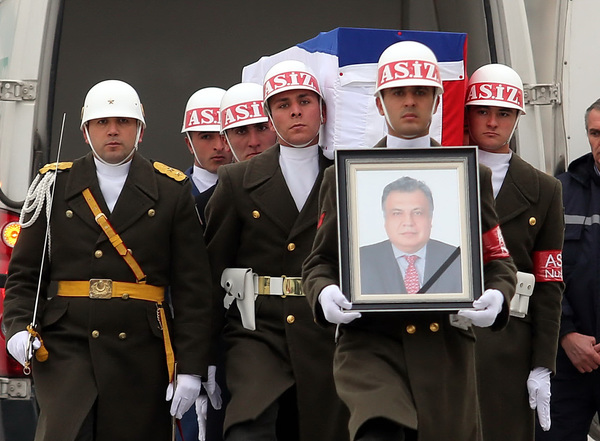
The security jitters coincided with expressions of sympathy. Some Turks laid flowers and wreaths outside Russian diplomatic missions. Karlov's body was flown back to Moscow on Tuesday.
Investigators began putting together a timeline of Altintas' movements in the days and hours leading up to the attack. Municipal officials in Ankara said he had visited the art gallery three days prior to the shooting, using his police identification. On Monday, shortly before the ambassador's appearance, he returned, again flashing his badge when he was asked to submit to security screening.
As the ambassador spoke, the gunman, wearing a dark suit and tie, took up a position a few feet behind the envoy, opening fire about two minutes into Karlov's speech. Onlookers described his calm demeanor and said they thought he was part of a security detail.
He shot the ambassador 11 times at close range, officials said. "Don't forget Syria, don't forget Aleppo!" Altintas shouted in Turkish during the attack.
Turkey's post-coup purge has been enormous in scale. More than 40,000 people have been arrested, with most held without trial, and more than 125,000 government workers were suspended, accused of ties to Gulen or the outlawed Kurdistan Workers Party. The detained include more than 168 military generals or admirals, and more than 7,500 police officers.
Authorities routinely base accusations of Gulen links on sparse or circumstantial evidence, such as use of a particular messaging app, or holding an account in a bank associated with Gulen's business empire, or some connection to one of the thousands of schools operated by the movement. Altintas attended one such tutoring organization, investigators said.
Some Western governments and human rights groups have likened the purge to a witch hunt, and expressed strong concerns about due process for the accused. Erdogan has furiously brushed aside such criticism.
Investigators said Altintas took two days of leave following the coup even though all police officers were ordered to report for duty. Altintas' then-supervisor was detained on allegations he was a Gulen supporter.