It is a quiet day on the bourses in continental Europe with markets barely moving. France’s main market dropped after the government revealed that unemployment had hit a record high.
- FTSE Eurofirst 300 -0.05% 1,374 points
- France’s CAC40 -0.42% at 4,296 points
- Stoxx Europe 600 index -0.35% at 343.7
That is all from the business live blog. We will be back next week.
Merry Christmas to all our readers.
News flash from Reuters:
Russia is holding talks with international ratings agencies about the situation in the Russian economy.
FTSE gains 11 points
The FTSE100 has closed. On a day of thin trading, when many traders were out the office, the UK index of leading shares finished up 0.18%.
Updated
Christmas Day used to be the only time of year when no one could buy anything.
Not any more.
This year 8 million people are expected to be distracted from turkey and TV by bargain-hunting on their smartphones and tablets, writes Guardian retail reporter Sarah Butler.
As an increasing number of retailers begin their end of year sales online on Christmas Eve, shoppers are expected to spend 25% more than last year on Christmas Day with most logging on at midday according to online retailing body imrg and research firm Experian.
Christmas Day shopping has become increasingly popular over the past few years with more than half of consumers expected to log on to at least browse, according to card provider Barclaycard.
Growth is being driven by a rise in the popularity of tablet computers, which make shopping from the sofa an attractive pastime, while the likes of Marks & Spencer, Boots and Currys all start their sales online on Christmas Eve and Amazon launches its post-Christmas discounts just after the Queen’s speech at 4pm.
Here is the full story.

Unemployment in France has hit a record high, according to the latest official data published today.
The number of job seekers reached record levels in November, with 3.488m people claiming out-of-work benefits.
The figures showed a rise of 27,400 people on the jobless queue compared to the previous month, up 0.8% from October. Unemployment has risen 5.8% over the last year, despite promises by the government to get more people into work.
In an interview last month, François Hollande said he would not stand again for the French presidency in 2017 if he had not managed to cut unemployment.
BP shares fuelled by Russia deal
Shares in BP have edged up 0.5% today, after reports that the oil company is close to a deal with its Russian partner Rosneft to develop oil fields in eastern Siberia.
BP has a 20% stake in Rosneft and has continued to make plans with the Kremlin- controlled firm despite western sanctions.
The latest deal was reported by the Russian daily Kommersant, which says that Rosneft has signed a “strategic partnership” with BP to explore oil fields in eastern Siberia.
BP will pay around $700-$800m to get a 20% stake in the Tass Yuriakh field in eastern Siberia, estimated to contain 1 bn barrels of reserves. So far, the two sides have only initialled a preliminary deal, but plan to seal the deal in 2015.
BP and Rosneft have declined to comment.
BP has insisted it will still do business in Russia, despite warning investors it could be damaged by the fallout from western sanctions.
Holger Zschaepitz, a senior editor at Die Welt, points out that many investors already see Russian bonds as junk.
#Russia bond market unchg despite S&P junk warning. 10yr yield stays at 13.17% as markets have treated Russia as junk for several weeks.
— Holger Zschaepitz (@Schuldensuehner) December 24, 2014
Low productivity risks cramping the outlook for UK economy - IHS
Howard Archer, chief UK and European economist at IHS, is not slackening his output when it comes to analysing the latest batch of UK productivity figures.
Productivity is rising, but the glass looks half-empty.
Some modest festive cheer for the UK economy, with labour productivity showing some welcome and much-needed improvement in the third quarter. Nevertheless, productivity currently remains limited compared to pre-crisis levels and there is still considerable uncertainty as to how much of this is due to structural factors. How much productivity improves going forward will be a critical factor in how soon and how far the Bank of England raises interest rates.
The extent to which the weakness in the UK’s productivity has been structural rather than cyclical has vital implications for the economy’s growth potential and for policy. If productivity fails to pick up appreciably over the coming quarters, it indicates that the economy has less potential to grow without generating inflationary pressures and that interest rates will likely need to rise at a faster rate than currently envisaged.
My emphasis
He identifies four factors about the recession and recovery that could do lasting damage to UK productivity.
- Many of the new jobs that have been created are in less skilled, low paid sectors where productivity is limited.
- Business investment declined sharply during the recession and the early stages of recovery. This may have significantly damaged UK productivity as a number of companies failed to invest to upgrade dated capacity or adapt latest technology and production techniques.
- The prolonged crisis and problems in the finance sector may have led to impediments in the movement of capital and labour to their most productive uses.
- The impact of “zombie” companies that have essentially been kept alive by low interest rates and banks’ reluctance to write off loans.
The jolly number crunchers at the Office for National Statistics have released data showing who will spend Christmas Day at work.
Here are the stats courtesy of this excellent blog from Guardian’s data team.
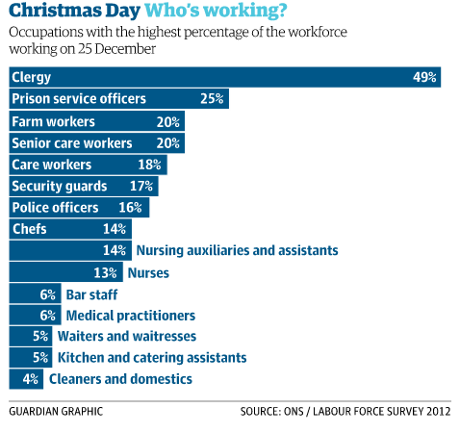
Most of the people working at Christmas are carers and nurses, with over a quarter of a million people in these professions working on 25 December.
The big unanswered question: why do 51% of the clergy get a day off on Christmas?
Here is the UK’s productivity story in graphs.
Productivity has improved but not made up ground lost during the economic crisis.
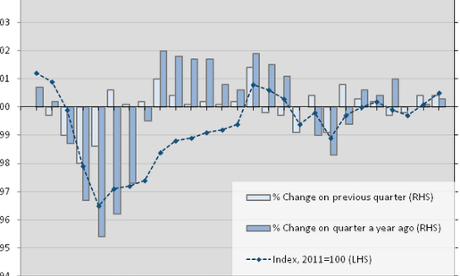
London and the south east has its own economy, operating in a very different way from the rest of the country.
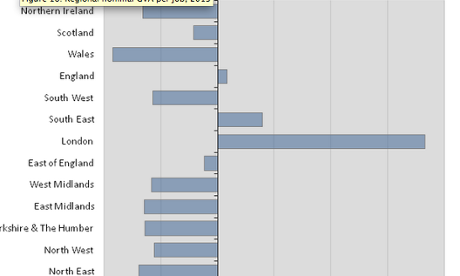
UK productivity edges up
UK labour productivity has improved, but remains below its pre-crisis peak.
Worker productivity increased by 0.6% in the third quarter of 2014 compared with the previous quarter, according to data released by the Office for National Statistics. It was 0.3% higher than 2013, but 2% below where it was before the 2008 economic crash.
Here are the headlines from the ONS release:
- Output per hour increased in all of the main industrial groupings in the third quarter, by 0.5% in the production industries and 0.6% in the service industries.
- Unit labour costs increased across the whole economy by 0.5% in the third quarter, reflecting a sharp increase in labour costs per hour worked.
- Productivity is above average in London and the south east, but well below average in Wales and Northern Ireland.
Updated
Get your Christmas priorities sorted...
Russia ready to demand refund on Mistrals
Give us the warships or our money back.
Russia’s defence ministry has today issued a blunt warning to France over two €1.2bn Mistral helicopter carriers.
French president François Hollande called off the sale indefinitely, after the EU imposed sanctions on Russia over Ukraine.
Deputy defence minister Anatoly Antonov said this morning:
Regarding the Mistrals, here a contract is in place. All the terms are spelt out in the contract: terms of delivery, penalties, procedures. We can demand a refund.”
Russia's central bank throws credit lifeline to companies
Hot on the heels of news that its credit rating could be downgraded to junk, Russia’s central bank has said it is willing to help Russian companies refinance foreign loans.
Russian companies have to repay more than $100bn in foreign debts next year, but have no access to western credit to refinance the loans because of EU and US sanctions.
Reuters has the details:
Russia has around $414 billion in foreign exchange and gold reserves, down from around $510 billion at the start of the year, as it was forced to spend heavily to prop the rouble in the past months after oil prices almost halved from this year’s peaks in June.
“The measure is aimed... at helping to refinance foreign credits by Russian exporters in foreign currencies maturing in the near future at a time of their restricted abilities to access international capital markets,” the central bank said in a statement.
It said such lending operations will also help bring the rouble exchange rate closer to fundamentals and reduce volatility. Loans are to be provided for up to one year at auctions at a minimal rate of Libor plus 0.75 percent.
Updated
What is the only thing you can’t buy for a pound at Poundland?
A share in the company.
A Poundland share is worth 326 pence this morning, up 2%, just as shoppers scramble for last-minute stocking fillers.
Updated
easyHotel's CFO checks out
easyHotel will bid bon voyage to its chief financial officer.
The budget hotel group founded by Sir Stelios Haji-Ioannou announced that Darren Mee, chief financial officer, had resigned “in order to pursue another opportunity”.
Mee oversaw easyHotel’s entry onto the London the stock market earlier this year, where it raised £30m, around half what it hoped for.
He will stand down on 29 January and the company said it plans to start the search for his successor shortly.
Simon Champion, chief executive officer, said:
The Board would like to thank Darren for his substantial contribution to the Company this year and helping us achieve our successful listing on AIM.
Updated
In case you missed it...
A former Royal Bank of Scotland office in the heart of London has been taken over by squatters who want to serve a free Christmas lunch to homeless people to protest against the housing crisis.
Here is a flavour of Diane Taylor’s story
Previously leased by the RBS group and housing a branch of National Westminster Bank, the squatters say that the building has “been taken by the people” in a statement posted on their Facebook page. The current ownership of the corner site is unclear: Land Registry records show that the owner is Greencap Ltd, a Jersey company that appears to have been dissolved.
According to one of the activists, Danny Freeman, 22, the fact that the building was previously used by RBS, which was bailed out by the taxpayer during the financial crisis and today remains 79% owned by the state, has made their message of “homes not banks” all the more resonant.
You can watch a video about the action here.
Abe to press ahead with stimulus plan
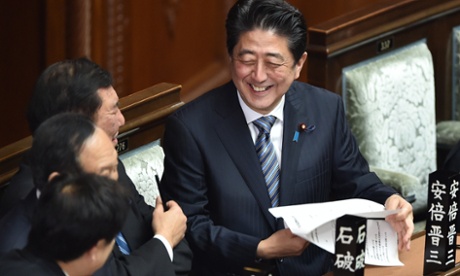
Abenomics is here to stay.
Shinzo Abe vowed to press ahead with his economic stimulus programme today, after being voted in as Japan’s prime minister by deputies in the lower house of Parliament.
Abe was re-elected by Japanese voters 10 days ago in an election with record low turnout.
Updated
Smith & Nephew shares soar on takeover talk
It is not just the spirit of Christmas that is boosting one FTSE-listed company.
Shares in the British medical device manufacturer Smith & Nephew are up by more than 7% this morning, after reports of a takeover by US firm Stryker.
The Michigan-based producer of surgical implants could offer shareholders a premium of up to 30% on Smith & Nephew’s current share price, according to Bloomberg. Shares in London-based Smith & Nephew have been rising throughout the year on talk of the deal.
So is this just more fancy footwork from a US company that wants to cut its tax bill by getting a UK headquarters?
Apparently not.
According to company insiders, Stryker is not planning a tax inversion “because of the limited tax benefits and political risk”.
Rough translation of “political risk” - being labelled an unpatriotic corporate deserter by US president Barack Obama.
Updated
Knockdown price on MySale shares for CEO
One business executive has got a bargain in the Christmas sales.
Carl Jackson, the chief executive of troubled online retailer MySale, has snapped up 3.7m shares in the company, according to a statement issued to investors.
Jackson paid 79.92 pence a share, a hefty discount on the 91.75 price that shares were trading at earlier this month. The share price tumbled last week after the company, which runs clearance sales for fashion brands, issued a major profit warning. Retail tycoons Sir Philip Green and Mike Ashley made huge losses, after £140m was wiped off the company overnight.
Jackson now owns 2.5% of the company.
Updated
Russia risks junk credit rating
Good morning, and welcome to our rolling coverage of the world economy, the financial markets, the eurozone and the business world.
Russia could see its credit status reduced to junk for the first time in more than a decade, after the Standard & Poor’s rating agency said it was considering a cut.
There is at least a 5o% chance that Russia will be lowered to junk status within 90 days, S&P has said.
We are reviewing our assessment of Russia’s monetary flexibility and the impact of the weakening economy on its financial system.
Following the announcement, the rouble fell in early trade this morning, losing 0.7% against the dollar to 54.88.
Russia has been put on the S&P’s “creditwatch” list because of “the rapid deterioration of Russia’s monetary flexibility”.
Last week the Russian central bank yanked up interest rates to a 17.5% in a desperate bid to defend the rouble, a move that poses serious risks to an economy falling into recession.
S&P currently rates Russia as BBB-, its lowest grade for credit worthiness, although rival agencies Fitch and Moody’s rank the country a little higher.
Aside from that we are not expecting big news on European financial markets.
The London Stock Exchange closes early at 12.30; Paris and Madrid close around 2pm local time (1pm GMT) and Frankfurt is closed. Hat tip to CMC Markets for this round-up.
New York is also on Christmas time and will close at 1pm local time. With so many traders taking a break from their Bloomberg screens, trading is likely to be thin.
We will see what other news we can magic up.
Updated