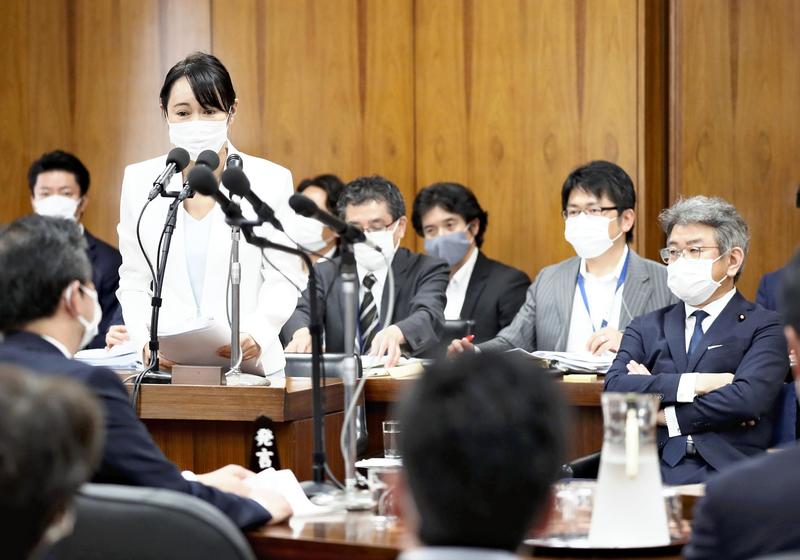
The vote on a bill to revise the Public Prosecutors Office Law and thus allow the retirement age of senior prosecutors to be raised was delayed at a House of Representative committee on Friday after opposition parties submitted a no-confidence motion against the minister in charge of such legislation.
The Constitutional Democratic Party of Japan and three other opposition parties submitted a no-confidence motion to the lower house the same day against Ryota Takeda, minister for administrative reform, who is in charge of legislation regarding public servants, including the revision bill, for his insufficient explanation of the bill.
As a result, the vote at the lower house Cabinet Committee was delayed until Monday or later.
The focal point of the revision bill is an exceptional stipulation that allows the retirement age of senior prosecutors to be extended based on the judgement of the Cabinet or the justice minister.
Opposition parties and former prosecutors have urged the government to withdraw the stipulation as they insist that prosecutorial independence could be threatened. The government has refuted this, saying that there cannot be arbitrary judgment on personnel affairs, and aiming to pass the revision bill in the current Diet session.
At the Cabinet Committee, Justice Minister Masako Mori emphasized the importance of the revision bill, saying, "It's necessary to secure capable talent continuously and make the best use of these officials as they get older."
The bill to revise the Public Prosecutors Office Law is part of a package of legislation that the ruling parties have presented, including a bill to raise the retirement age of national civil servants to 65.
The prosecutor law revision seeks to raise the retirement age of prosecutors from 63 to 65, in line with that of other national civil servants; leave unchanged the retirement age of the public prosecutor general at 65; and introduce an "executive age limit system" under which senior prosecutors, such as the deputy public prosecutor general and superintending prosecutors at high public prosecutors offices, are not allowed to hold managerial posts once they turn 63.
The opposition parties have shown understanding of these points. However, they see as problematic the exceptional stipulation that allows the extension of senior prosecutors' terms for up to three years if the Cabinet or the justice minister deems it necessary. The opposition camp said that prosecution needs to be strictly neutral and the exceptional stipulation leaves room for arbitrary intervention by the government into personnel affairs.
Another point of contention is the relationship between the revision bill and Hiromu Kurokawa, 63, the superintending prosecutor at the Tokyo High Public Prosecutors Office, whose retirement age was extended by the government in late January this year.
As there is no stipulation on the extension of retirement age in the current Public Prosecutors Office Law, the government extended his retirement age based on the National Civil Service Law.
A senior CDPJ member said that Kurokawa is close to the Prime Minister's Office.
As there was no exceptional stipulation allowing the extension of the retirement age of senior prosecutors in a bill to revise the Public Prosecutors Office Law that was compiled by the Justice Ministry in October last year, the opposition parties say that this revision bill is an attempt to justify Kurokawa's case retrospectively.
Mori said at the committee that she examined the bill again when she had time before the bill was presented to the Diet.
As celebrities protested the revision bill on Twitter, the opposition parties strengthened their offensive and worked together to compile their own bill without the exceptional stipulation.
At the plenary session of the House of Councillors on Friday, Prime Minister Shinzo Abe said that he would refrain from commenting on opinions on the internet.
In an online program the same day, Abe stressed that he had not met Kurokawa in person nor spoken to him at a personal level.
The government and ruling parties aim to pass the revision bill in the lower house during the week starting Monday. Nippon Ishin no Kai intends to agree to the revision bill conditionally.
A senior ruling Liberal Democratic Party member said that the government and ruling parties would not delay the passage of the bill to the next Diet session.
Read more from The Japan News at https://japannews.yomiuri.co.jp/