Facial recognition technology is becoming more and more sophisticated thanks to artificial intelligence (AI). Although there are high expectations for the technology to help realize a safe, convenient society, there is also the risk that its use will open the door to a surveillance society.
In the United States and Europe, there have been moves in recent years to regulate the use of the technology by law enforcement agencies. Japan also needs to address this issue sooner or later.
-- Problems with privacy
Facial recognition has various different applications, which have different levels of inherent problems.
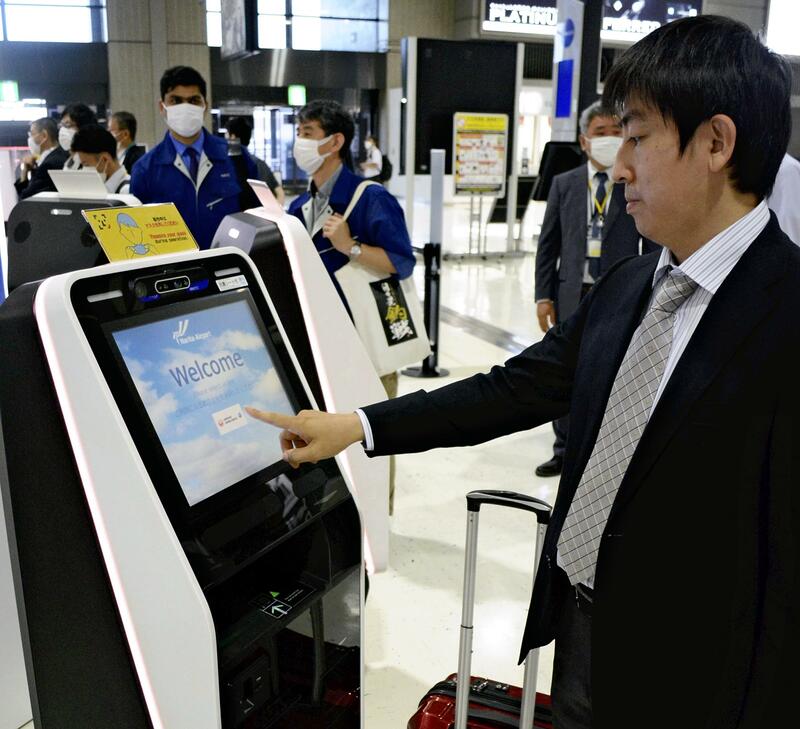
For example, a face authentication system for passengers, which began full-scale operation at Narita Airport in July, seems less likely to lead to problems because its use is based on the consent of the passengers themselves.
When passengers have their faces registered at check-in, they are allowed to pass through security checks and boarding gates due to the registration. The recognition system is used only for those who have clearly agreed to its use.
The face data is discarded within a certain period of time after boarding, as one of the thorough security management measures. But passengers who don't want to use the system can still use the airport in the conventional way.
"This is a good example of achieving both convenience and privacy protection," said Aimi Ozaki, a lecturer at Kyorin University who is knowledgeable about facial recognition systems.
Ozaki also acknowledged that there are many problems with using these systems without people's agreement, particularly those applied to the general public.
The foundation of facial recognition systems is built on surveillance cameras, which capture images of people and objects like vehicles from a distance. So it is usually difficult for anyone to notice that their data is being acquired.
Regarding public spaces used by many people, it is virtually impossible to clearly obtain the consent of each person being photographed.
Nowadays, images of faces are widely circulated on the internet through social media. Thus, the spread of face recognition cameras in every corner of society has led to the loss of anonymity in public spaces and makes it possible to track people's behavior.
"If people feel like they are being watched, they will restrict their behaviors. So society may lose vitality as a result," Ozaki said.
The United States and Europe are beginning to take a hard look at the use of this technology in police investigations.
For example, in August last year, the Court of Appeal in Britain ruled that the use of facial recognition technology by the South Wales Police was illegal.
Since 2017, police in Britain have collated the facial images of about 500,000 suspects and other people on watch lists in and around the venues of soccer matches. The ruling stated problems on the practice, such as "it is unclear where the photos were taken and who [in the photos] are on the watch list."
In April, the European Commission attracted much more public attention by announcing a proposal to regulate the use of AI. The commission proposed, with some exceptions including the search for missing children, a ban on real-time facial recognition in public spaces by law enforcement agencies, in principle.
The United States, which has been actively using AI in investigations, is also facing a headwind. A major incident that enhanced the trend was the death of George Floyd, an African American man, in May last year.
There was severe public criticism against some measures taken by the police after the incident, such as police in some states connecting their equipment to security cameras in the private sector to monitor protesters rallying to criticize the unfortunate incident. Body cameras carried by police officers were also criticized on the grounds that they have facial recognition functions.
IBM, Amazon, and Microsoft have stopped providing facial recognition technology to the police. States and cities around the U.S. are moving to restrict its use.
-- Use by police in Japan
In Japan, the use of facial recognition technology by the police is not clear in detail, although the National Police Agency claims that it does not perform real-time facial recognition in public spaces.
To prevent the police from conducting problematic investigations as they did in the past using GPS devices, "the police need to increase the transparency of the use of facial recognition technology," said Prof. Makoto Ibusuki at Seijo University, a specialist of the criminal procedure law.
Ibusuki is referring to warrantless criminal investigations conducted by police using GPS devices, which resulted in a Supreme Court ruling in 2017 stating that the practice is illegal.
In the court case, it was revealed that the people involved had been ordered to keep the illegal use of GPS a secret for many years. The practice gradually came to light through a series of coincidences, including a complaint by a person who happened to find a GPS device during a vehicle inspection.
The use of GPS devices for police investigations realized with advanced technology was a new form of "the tailing of suspects," which is conducted with no warrants without exercising lawful powers. The use was intended to conduct tailing on behalf of humans, but the accuracy and continuity levels were much higher.
The same holds for facial recognition. It may be an extension of investigators "spotting a suspect with the eyes," but is very different in terms of accuracy and the range of surveillance. If the use of facial recognition technology spreads to public spaces, issuing a warrant may be required in some cases to conduct an investigation using forced powers.
-- Transparency in private sector
It is possible for the police to use cameras owned by the private sector installed in various public places, in addition to their own cameras.
For example, 94,000 cameras were installed nationwide by railroad operators as of March 2019. Seventeen of the operators have dedicated lines to send images in real time to the police in emergencies.
This is an important system to protect public safety, but some of the operators do not disclose the fact that they cooperate with the police through the measure.
In July, East Japan Railway Co. started using cameras with facial recognition functions at train stations. The company said the system registers the face images of suspects and parolees of serious crimes and people who act suspiciously, and collates them with people in the stations. However, the company refuses to disclose the locations and numbers of these cameras, the criteria for registration, and where and how to obtain the face images.
Recently, Google surprised the world by announcing that it had received more than 10,000 geofence warrants from the U.S. government over a year's time. Geofence warrants are search warrants to identify people who were near the site of a crime when it took place and disclose such information. They are intended to comprehensively collect data of persons who match certain criteria, not collecting information from targeted persons alone.
The system greatly contributes to efficiently conducting investigations. But at the same time, it violates the privacy of countless individuals who are not criminals. It is essential that people are informed by companies of the fact that their information has been provided to police. It is also necessary that their data is discarded when they become clear of suspicion.
It's possible that data from facial recognition and other systems will be used more in investigations.
"So it's necessary to create a regulation regarding conducting investigations making full use of such data," said Ibusuki.
Read more from The Japan News at https://japannews.yomiuri.co.jp/