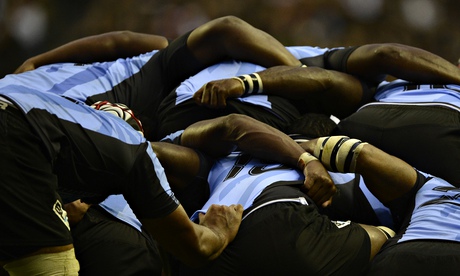
The opening match of the World Cup pitches the richest union in the world against one that holds fundraising events to help pay its players. The top-priced ticket for the game between England and Fiji is £315, more than the average monthly wage on the islands in the south seas where the profit from a Test match played at Suva is less than the Rugby Football Union makes from programme sales for a single match.
If resources were a barometer, next week’s opener would be a blow-out, a means for England to ease their way into the tournament. Fiji, though, are used to making their way in an unequal world, World Cup quarter-finalists in 2007 after defeating Wales in Nantes, and with a team largely assembled from the three major leagues in Europe and the Super 15, they are expected to make the hosts start at a gallop rather than a jog.
“Fiji, Tonga and Samoa bring colour to the World Cup,” says Adam Perrin, whose film Pacific Warriors, a documentary on rugby in the three countries, premieres in London on Thursday. “They have to battle against the system, lacking the resources of the major nations and always worrying whether clubs will prevent the release of their best players, but they always play with a smile on their face and consistently produce the most naturally talented players in the game. I have worked out that 30% of the players in the World Cup are of island extraction, spread among 12 countries.”
If Fiji have it all to do to repeat their success of eight years ago, locked in a group with Wales and Australia as well as the hosts, Samoa and Tonga have a reasonable chance of making the last eight, vying on paper with Scotland and Argentina respectively for a place in the knockout stages. They also have a core of players with considerable experience in the professional game, although they are both without three men who have opted to remain with their clubs. No one wants to confirm the identities of the players to avoid compromising their relationship with those clubs, but new tactics are being used by those seeking to fight the practice.
“The rules governing the release of players are clear but they are not being enforced,” says the former second row Daniel Leo, who played in the 2007 and 2011 World Cups for Samoa. “Clubs are waving euros in the faces of players to stop them playing for their country, but nothing is being done about it.”
Leo, the London Welsh second-row who is playing his last season of rugby, intends to change that. He made himself unavailable for the World Cup after being the shop steward for the players last year in a dispute with the union that led to a strike threat before the match against England at Twickenham. The Pacific Islands Rugby Players’ Association has been set up and from next year Leo will be its representative in Europe.
“Islands players are big respecters of authority and they do not like to speak out against it or challenge clubs,” he says. “That is why there is a big need for the players’ association. The boys will have proper representation and will not have to deal with clubs or unions directly. Clubs have been putting pressure on island players not to play for Fiji, Tonga or Samoa and I will be the middle man ensuring that everyone isreleased.”
Fiji have a full complement of players after their head coach, the New Zealander John McKee, spent a month in Europe this year speaking to coaches, team managers and owners. His appointment marked a turning point for the team who had been beset by division in 2011 and suffered three heavy defeats in the pool stage. World Rugby, which uses the profits it makes from the World Cup to invest in countries at tier two level and below, stepped in to sort out an administration that was failing.
“We may not have the facilities but we have talented athletes,” says McKee, who is contracted until 2017 but hopes to stay until the World Cup in Japan two years later. “It is not always about how much rugby you put in a programme. I cannot talk for the other two unions, but the Fijian economy is quite good at the moment and it allows the union to get sponsorship income which helps run the professional game. The main problem confronting us and the others is generating enough money to pay for the programmes we need.
“The average wage in Fiji is low so we cannot charge premium prices for tickets; when we play internationals at home [12,000 watched the victory over Italy in Suva last year] we do not really cover the costs. We do not have any television rights and although our sponsorship is good in island terms, it is not from a global perspective. Rugby, though, is our passion and that is why the country produces so many players who are in demand all over the world.
“With our players spread all over the globe, it is important we have a strong relationship with their clubs. I spent five weeks travelling to speak to managements about our plans, letting them know who was on our radar and how they ranked. The upshot is that we have all the players we want at the World Cup and it is essential for us that we do not have club-country problems.”
Leo believes all three islands will make their mark on the World Cup, and not just through the tackles they make. “We bring the x-factor to the tournament,” he said. “Without us, it would be the same few countries. This tournament was a step too far for me after all that went on between the players and the Samoan union, which has now been sorted out. I was nominated as the squad spokesman after the strike threat against England and the first man through the door cops the bullet. I think I was seen as being trouble that my value on the playing side did not outweigh.
“I did not want to undermine the World Cup campaign and all that went on affected my life. All that mattered was the players getting what they needed and now we can look forward. The players’ association is a big step forward and all three islands can focus on the rugby. The tournament needs us and I wonder if the three unions appreciate the power they would have if they worked together and let the powers-that-be know they would not take part in a World Cup unless regulations, such as the one governing the release of players, were properly enforced. Imagine the outcry if England were denied three of their best players by clubs.”
One of the most memorable matches at the last World Cup was Samoa’s tussle against South Africa which turned on a couple of refereeing decisions and, for the fourth tournament in succession, the two countries are grouped together. “There is a quiet confidence amongst the boys,” Leo says. “If we get our game right we are difficult to stop. We beat Scotland in 2013 and I wonder, with that match being the last in the group, whether we will not field the strongest side against South Africa, keeping players fresh.
“Fiji are in good shape, unfortunate to find themselves in the toughest group. It will be difficult for them to get out of it, although I can see them having an influence on who does go through. Tonga have an experienced squad and their set piece is better than Fiji’s. They could surprise Argentina, but their problem in the past has been dealing with opponents they are expected to beat. Four years ago they defeated France having lost to Canada. What is important for all three is to harness the momentum this World Cup will generate: with Japan having problems finding players for their Super 18 side next year, why not fill it with Samoans, Fijians and Tongans?”
The opener will be played on Saturday morning in Fiji, where locals will gather round televisions in villages and towns to watch. “Christian missionaries brought religion and rugby to the islands and the two remain entwined,” Perrin says. “Faith and rugby are a big part of who they are and, having spent so long with them, I know all three countries have the talent to win the World Cup. Tonga has a population barely more than the capacity at Twickenham and the game needs to ensure the aspiration of the youngsters on all the islands is to play for their country, not the All Blacks.”