Fixtures
Sat 19 Sept France v Italy, Twickenham, 8pm
Sat 26 Sept Italy v Canada, Elland Road, 2.30pm
Sun 4 Oct Ireland v Italy, Olympic Stadium, 4.45pm
Sun 11 Oct Italy v Romania, Sandy Park, 2.30pm
Odds to win World Cup
1000-1
Coach
Jacques Brunel
Captain
Sergio Parisse
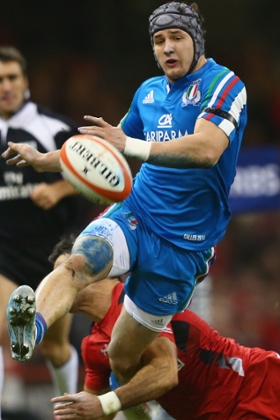
Michele Campagnaro
Age 22
Position Centre
Italy debut v Fiji, Nov 2013
Tries Four
Points 20
When Jacques Brunel admitted: “I don’t know what happened today,” after his Italy side’s 48-7 World Cup warm-up defeat to Scotland in late August, it hardly gave cause for confidence. The French coach’s team are in disarray: they are without an established fly-half, lack creativity, threatened to strike in June, were labelled pensioners by their federation president in April, have lost three on the trot and are reliant on a captain, Sergio Parisse, who may or may not be fit for the tournament and will certainly miss the opening match against France. But that’s not to say they are entirely without hope.
Italy’s two key Pool D fixtures are against France at Twickenham on 19 September and Ireland at the Olympic Stadium just over a fortnight later. The stats do not look good: they have only beaten France three times in 36 attempts, and Ireland four times in 24. However, three of those victories have come in the last few years – twice against France in 2011 and 2013 and once against Ireland in 2013 thanks, in part, to Irish injury and indiscipline. For Italy to emerge from the pool and into the knockout stages for the first time in their World Cup history, they will have to rediscover that 2013 form by relying on traditional power from their pack and hope their talented but mercurial backs can all shine at once.
Their greatest issue is a lack of creativity. Italy’s only established fly-half, Kelly Haimona, was forced to withdraw from the tournament with a broken arm. That has left Tommaso Allan, the former Scotland youth international and nephew of the Scotland hooker John Allan, as the squad’s only established No10. After switching allegiance from Scotland to Italy in 2013, Allan has flickered but was unconvincing when called upon during Italy’s poor Six Nations campaign this year. At 22, with only nine starts under his belt, he is inexperienced and will be grateful to have some knowledge of his French opponents from his time at Perpignan. But fly-half is a clear weakness for Italy and Allan’s understudy has even less experience. Carlo Canna has just three caps to his name, has never started a match, and made his international debut this August.
There is talent in the Italian backs to aid Allan, though, and with ball in hand during the tight 12-16 defeat against Scotland in Turin last month they caused problems. The scrum-half Edoardo Gori has long been a linchpin but sadly Luca Morisi, who has a burgeoning reputation in the centre, was injured and withdrew a week ago. Brunel has named only two specialist wings after Angelo Esposito was forced to pull out with a shoulder injury, but Leonardo Sarto – one of the few to shine for Italy in the Six Nations – and Giovanbattista Venditti are solid performers. The young Exeter Chief’s centre Michele Campagnaro is one to keep an eye on and is both dangerous in attack and solid in defence as Wales discovered in 2014, when he ran in two tries against them in Cardiff and spent the rest of the afternoon delivering clattering tackles. The bones of a useful three-quarters line are there but Italy’s problem will be giving them the platform and space in which to perform.
As ever, the Italian forwards are a powerful unit. But while Mauro Bergamasco, playing in a record-equalling fifth World Cup, and the prop Martin Castrogiovanni bring experience, the pack is old. The average age of the forwards is 30 and the squad features one key flanker, Alessandro Zanni, who had five months out this year following knee surgery and another, Simone Favaro, who was initially left out of the squad with injury concerns.
Their age is one reason why, in the wake of a 2015 Six Nations campaign in which they lost four times and won once, the president of their federation, Alfredo Gavazzi, branded the side “pensioners”. In a bid to resolve their form via the stick rather than the carrot, Gavazzi reportedly attempted to lower the squad’s appearance fees in favour of a win bonus system. The team were furious, first demanding respect then going on strike during a World Cup warm-up camp in June.
A settlement has since been brokered but the incident hardly points to a happy, harmonious squad. That the hooker Leonardo Ghiraldini claimed Italy lacked mental strength after the Six Nations while Castrogiovanni wondered whether they needed a psychologist cannot have much helped.
Of far more concern, however, is the fitness of the captain, Parisse. While Rhys Webb and Leigh Halfpenny’s injuries were the focus of attention following Wales’s warm-up against Italy in Cardiff, Parisse’s own injury in that match was less reported. The No8 is Italy’s only genuine superstar, an inspirational figure to both team and supporters. But he underwent an operation days after the Wales game to reduce swelling and drain fluid from his left thigh and remains a World Cup doubt.
Parisse’s importance to the side has been clear since he broke onto the international circuit in 2002. But during that 23-19 defeat against Wales, it was particularly noticeable. He had been absent with illness from Italy’s first two warm-up defeats against Scotland and was missed in particular during the drubbing at Murrayfield. On his return against Wales, he galvanised the team by injecting order and came close to scoring in the second minute. After the disheartening rout against Scotland, he instigated a performance that Italy could take pride from in their final World Cup warm-up match. His influential presence will be vital if Italy are to overcome France, Ireland, Canada and Romania while keeping any further internal strife at bay.
Italy’s current dowdy world ranking of 14 is misleading – they regularly face far tougher opposition than, say, ninth-placed Fiji or 13th-placed Japan – but it nonetheless suggests they will need to be firing on all cylinders, with Parisse at their heart, forwards at their muscular best and backs living up to potential, if they are to escape Pool D.
Italy’s 31-man World Cup squad
Props Matías Agüero (unattached), Martin Castrogiovanni (Racing 92), Dario Chistolini (Zebre), Lorenzo Cittadini (Wasps), Michele Rizzo (Leicester Tigers).
Hookers Leonardo Ghiraldini (Leicester Tigers), Davide Giazzon (Treviso), Andrea Manici (Zebre).
Locks Valerio Bernabò (Zebre), Joshua Furno (Newcastle Falcons), Marco Fuser (Treviso), Quintin Geldenhuys (Zebre).
Back-rows Mauro Bergamasco (unattached), Francesco Minto (Treviso), Sergio Parisse (Stade Francais, capt), Samuela Vunisa (Saracens), Alessandro Zanni (Treviso), Simone Favaro (Glasgow Warriors).
Scrum-halves Edoardo Gori (Treviso), Guglielmo Palazzani (Zebre), Marcello Violi (Zebre).
Fly-halves Tommaso Allan (Perpignan), Carlo Canna (Zebre).
Centres Tommaso Benvenuti (Bristol), Michele Campagnaro (Exeter), Gonzalo Garcia (Zebre), Enrico Bacchin (Treviso).
Wings Leonardo Sarto (Zebre), Giovanbattista Venditti (Newcastle Falcons).
Full-backs Andrea Masi (Wasps), Luke McLean (Treviso).