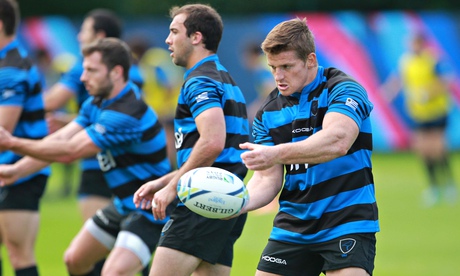
Twenty teams, 13 venues, one winner. The eighth Rugby World Cup dawns, tipped to be the most closely fought yet. All the sides in the top 20 of the world rankings are taking part but the winner will come from six of them, or seven, if France reveal something that has remained hidden since the 2011 final.
The focus is on the regular few: the holders, New Zealand, Australia, South Africa and England, the four countries who have won the Webb Ellis Cup in the past, with Ireland and Wales regarded as outside bets and France a gamble. Some of the others will make the world take notice, if only for a day, and it will be interesting to see how Argentina measure up after their time in the Rugby Championship but for many it will mark an opportunity they only have every four years to play a tier one nation.
England are one of three teams in the top five of the world rankings locked in a group that is the most demanding in the tournament’s history. Throw in Fiji, the Pacific Nations champions with a team made up largely of players from leading professional sides, and there will be little respite for the players involved.
The fifth team in the group, Uruguay, have barely received a mention. It is not bold to predict that a squad comprising mostly of amateur players will return home without a victory in what is the country’s third World Cup; at least in 1999 and 2003, Los Teros had one match in which they could anticipate victory. There have been complaints about seeding teams for the tournament only 13 months after the last World Cup, when Wales had dropped out of the top eight of the rankings momentarily, and running the risk of having a contender exit the tournament at the end of the group stage.
It may be hard on whichever one of England, Australia and Wales fails to make it to the last eight – while Fiji have talent to compare with the three, their fitness levels against teams who aim for a ball-in-play time of more than 40 minutes may undermine them – but it is even harder on Uruguay who in their 67-year history have only played three of the eight foundation unions, England, South Africa and Scotland.
They will play three in the next three weeks and by the time they face England in the final group round, they will already have been tested like never before. Only Namibia, who in 2011 were asked to play their four pool games over a 16-day period and conceded 168 points in the last two when injuries and fatigue overwhelmed them, are below them in the rankings, and with points difference a potential deciding factor in who goes through to the quarter-finals, there will be no relief for them.
At least their matches are spread over 20 days, with World Rugby this time around deciding that player welfare is more important than the wishes of television and ensuring that the top teams play their share of midweek matches but what is the point of exposing amateurs to such a punishing programme if they then return to obscurity for at least another four years?
“It has been called the pool of death but for us it is the group of hope,” said the Uruguay coach, Pablo Lemoine. “We have a unique chance to play three leading teams and we intend to enjoy it. We are really lucky: every group would be difficult for us but the chance to play England, Australia and Wales in one month will never happen for us again.”
Lemoine won 48 caps for Uruguay and played for Bristol and Stade Français but the current squad contains only two players who play outside the country professionally and both are with Pro Division Two clubs in France. As with countries such as Namibia, Georgia, Romania, the USA, Canada and Japan, they need to offset their lack of, or small, exposure to the tier one nations by getting a number of players involved in leading club tournaments but they operate from a small playing base, making those such as Lemoine an exception.
One of the reasons why World Rugby is so aggressive in its commercial approach to a World Cup and demands a substantial guaranteed sum from the hosts is that the tournament provides nearly all its income. This year’s profit will be about £150m, and while the leading nations will be compensated for the income they have forfeited by not having incoming tours and by not being allowed to advertise their sponsors during the tournament, a substantial sum will be invested in the game in the emerging nations, put into development programmes and suchlike.
It is, though, little compared to what the leading countries generate and probably amounts to little more than the annual bill the Rugby Football Union foots for England’s training base in Bagshot. The Six Nations sides have spent the summer preparing hard for the World Cup, one training camp following another with most spending time abroad.
The difference between the best and the rest has grown during the professional era, although the quality of players consistently produced by Fiji, Samoa and Tonga for export has allowed them to remain at least in sight. For every stride taken by Uruguay, the All Blacks have taken a couple of dozen and the chasm between them grows ever wider and deeper.
Rugby union is not advanced enough to justify having 20 teams in the World Cup, a number of whom would be better off in a parallel plate tournament. That, though, would hit the profits and so while it may be argued that this year’s World Cup will be the most closely contested yet, it will also again show a great divide in a sport that is growing upwards rather than outwards.
The established countries are too worried about their own finances to invest in acts of socialism – they could, for example, provide compensation to their clubs to ensure that players of all nationalities are released for the World Cup – and after Uruguay fly home next month following their moment in the sun, no heed will be paid to them until the next World Cup they qualify for. The last time they played England, back in 2003, they conceded 111 points and 17 tries having already been thumped by South Africa and Samoa. A similar fate awaits. Who benefits?
• This is an extract taken from the Breakdown, the Guardian’s weekly rugby union email. To subscribe, just visit this page, find ‘The Breakdown’ and follow the instructions.