England’s 2003 World Cup triumph in Australia seemed to go down quite well, celebrated as dear old rugby had never been celebrated before. What parties might be thrown now the tournament is to be played not on the other side of the world but at home? Or what might happen if England suffer in Pool A for agony? It is a richly uncertain tournament, where as many doubts will be raised on the sporting front as pounds on the commercial. That is, lots.
The last time the Rugby World Cup came to England, 24 years and six versions ago, rugby union was a very different beast. In 1991 it was amateur, no longer so universally resolute in its commitment to remaining so, but still sufficiently attached to its unpaid traditions to make the tournament a cultural rather than a business opportunity. The competition began and ended at Twickenham, but stretched across the territories of the old family of the Five Nations. To reach the final – thanks to defeat by New Zealand in the opening game –– England had to beat France in Paris and Scotland at Murrayfield.
England this time round will move from Twickenham only once, to the Manchester City Stadium for their pool game against the vestige of the amateur world, Uruguay, a team known as Los Teros and made up of players who have jobs in the real world and play for love. England are not expected to lose.
Ten other stadiums in England will be used: three in London – Wembley, the Stadium in Queen Elizabeth Olympic Park and Twickenham – and seven across the land, from Exeter’s Sandy Park to St James’ Park in Newcastle.
Ticket prices range from eye-wateringly to breathtakingly high, a gamble that seems about to pay off. Just as France paid up and turned up to watch in 2007, so it seems the English public are prepared to help fund the global game for the next four years.
Yet there are echoes of the shared past. Wales enjoyed the comforts of home in England’s World Cup of 1991, played a couple of games in Cardiff during France’s in 2007 – and even laid on the quarter-final where the displaced true hosts beat the All Blacks.
Wales were the main hosts themselves in 1999 and – here lies the trick – generously gave Twickenham the semi-finals. In this back-scratching business, you will still find voices in the west expressing disappointment that Wales could not persuade England to play their Pool A match on the second Saturday at the Millennium Stadium.
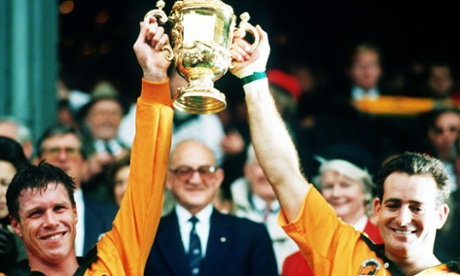
Back in ’91, England were led by Will Carling and powered by one of the great packs of all time. The forwards should have dictated policy – and generally Brian Moore did – but on the eve of the final against Australia a decision was taken (presumably by the backs, behind that of their hooker) to take on the Wallabies with a running game. Australia won 12-6. It was the first example of RWC madness, a now internationally recognised syndrome. It has affected many a team: New Zealand at all tournaments between 1991 and 2011; France and Wales in 2007; France and England alike in 2011. Something goes wrong in the strangeness of the team camp and discipline vanishes. Who will succumb this time? Everyone is vulnerable.
On the loosehead of the England front row 24 years ago was a young Jason Leonard. He is now the president of the Rugby Football Union. No tighter bear hug of welcome will ever be given by a dignitary to his guests. However the RFU managed it, to find themselves with the Barking boy at their head is a stroke of genius. The only word of warning to those who will sit at his high table in the next two months is not to be tempted to go beer for beer with el Presidente. It is a rare chance at this World Cup to say that there can be only one outcome there.
Who may win on the field? New Zealand, captained by the remarkable Richie McCaw, remain the world leaders, despite Australia winning the Rugby Championship. South Africa, the third country to have won the World Cup twice, have entered a period of self-flagellation, based on the old theme of selection by race. They will be, as usual, predominantly white and, as ever, in contention.
Ireland, Wales and Argentina have serious ambitions, but for the moment only two other countries have contested the final. France, who have played in three and are still led by the equally remarkable Thierry Dusautoir, are back in consideration after four bleak years. That leaves the only other country to have won the Webb Ellis Cup – England in 2003, when the 20 participating countries were the same as they are now.
Echoes, repeats, but the past can influence only so much. Sit back if you can; enjoy the ride into the unknown.