Rugby league and its devotion to the international game has always promised big and nearly always under-delivered. If the game truly hopes to grow – as those in charge of the purse strings and the big statements often likes to preach – it must be through establishing, nurturing, promoting and investing in the sport around the world.
Rugby league’s near-disdain for internationals is rare – in only a handful of sports is representing your country not the pinnacle of a career. In league, internationals are an afterthought, an inconvenience, just another event that extends the season, to fit around the premiership and Origin footy and money-grabs like the Auckland Nines.
It wasn’t always this way. An Ashes series was once the most compelling event the sport had to offer, central to the game’s lore, the most fantastic and dramatic and revered for players and fans alike.
The Rorke’s Drift Test, where a brave 10-man Britain held firm. The Chimpy Bush no try, still fiercely debated 84 years on. The Battle of Brisbane, versions I and II. Australia reclaiming a series on home soil after 30 years. The Swinton Massacre, perhaps the most complete individual performance in the storied history of the game from the incomparable Johnny Raper. These are the foundation stones that the game we know today is built on.
And it was not just Australia and England and then eventually New Zealand. Two French tours of Australia in the 1950s set the country ablaze with rugby league fever, Puig Aubert and the talented Les Chanticleers bringing a flair and a fascination rarely seen before or since. Those French teams were packed with extraordinary players, at a time when the 13-man game in France was still reeling from the Vichy blackjacking, but it was the pride in the national jersey combined with the thrill of something different that made those tours so popular and so memorable.
The 1950s and 1960s were heady days for internationals. There was no greater spectacle, no greater honour. The pioneering spirit of the game saw inroads made into South Africa and Papua New Guinea and Wales. A World Cup was established. Attempts were made to spread the Gospel of the Game to the United States. Expansion and the riches it would bring was the dream of rugby league.
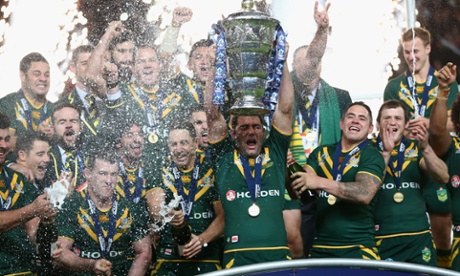
Since then though – as Australia has pulled away from the rest of the world in terms of both on-field talent and off-field power – country against country has been in a severe decline. The long-beloved Kangaroo and Lions Tours were eradicated. Formats for the World Cup were tried and disregarded and ignored, staged whenever and wherever with little rhyme or reason. Marginalisation of the game in Britain and France was ignored. Little money, time or effort was put into bringing along developing nations like Papua New Guinea, Fiji or Samoa. The international schedule became less and less relevant and seemed limited to Australia towelling up England or New Zealand, with the odd exception of a Kiwis win, as in the 2008 World Cup final.
Rugby league would struggle to organise a barbecue in a butcher’s shop and it is the international game that has paid the biggest price for the code’s administrative ineptitude and inertia.
Lip-service is occasionally paid by the game’s powerbrokers (read: the NRL CEO and/or NRL chairman). After the game’s most successful World Cup in 2013, nothing has been done to capitalise on the goodwill generated and the increased support. The success of the United States made the New York Times, while The Wiggles wrote a song about the Tomahawks’ success. Rugby league outposts like Italy and Scotland played some spectacular football. Fiji showed they could become legitimate international competition. French stadiums were filled.
A year on the response – or lack thereof – is as astonishing as it was expected. Player power has been ceded to, leading to the cancellation of a proposed Lions tour in 2015, another kick to the teeth of international footy. There have been mass player withdrawals for the Four Nations, some fair and some not so fair. No Pacific Nations mid-season Test was scheduled.
South Sydney Rabbitohs CEO Shane Richardson said just weeks ago: “I look at the state of international rugby league and it just makes me angry”. It is exasperating for those who see the potential the code has to offer and how well it could translate into new markets. League is a simple game that is captivating to the eye, an easy sell if the time and the money and the effort is invested.
But once again laziness has blown out the small fire for international rugby league the World Cup created.
And as a game, we wonder why the likes of Sam Burgess and Sonny Bill Williams and Israel Folau choose to defect to rugby union (and that’s before we get to Jarryd Hayne). It is doubtful any of them left because they figured the 15-man code was a superior game. They left because of the opportunities the international-landscape of union presents. They left to earn bigger money, to play in a legitimate World Cup, to wear their nation’s jersey often and proudly.
Wallaby Adam Ashley-Cooper made his international debut in 2005 and played his 100th Test last Saturday. To put that in context, an Australian Rugby League player would have had to play in every Australian Test since the third match of the 1992 Ashes Series to reach 100 Tests. That team was captained by Mal Meninga, who hasn’t strapped on his boots in two decades.
International rugby league just isn’t a priority despite its obvious importance to the future of the code. Yet the game’s powerbrokers have the blinkers on, content for NRL to dominate in parts of Australia, play a minor role in the north of England and the suburbs of Auckland and live a monastic virtual non-existence in tiny pockets elsewhere, without organisation or any real hope.
This Four Nations tournament will once again, most likely, be another parade of Australia’s dominance. It is a tournament of generational change for the Kangaroos, yes, and there will be some spectacular football played for the devotees but it will all be for nothing if David Smith and John Grant and the NRL don’t actively take a position to strengthen the international game.
Failure to do so and the exit queue Sam Burgess just walked through will continue to be a pretty popular thoroughfare. And the losers in all that, once again, are fans of the game we like to call the greatest.