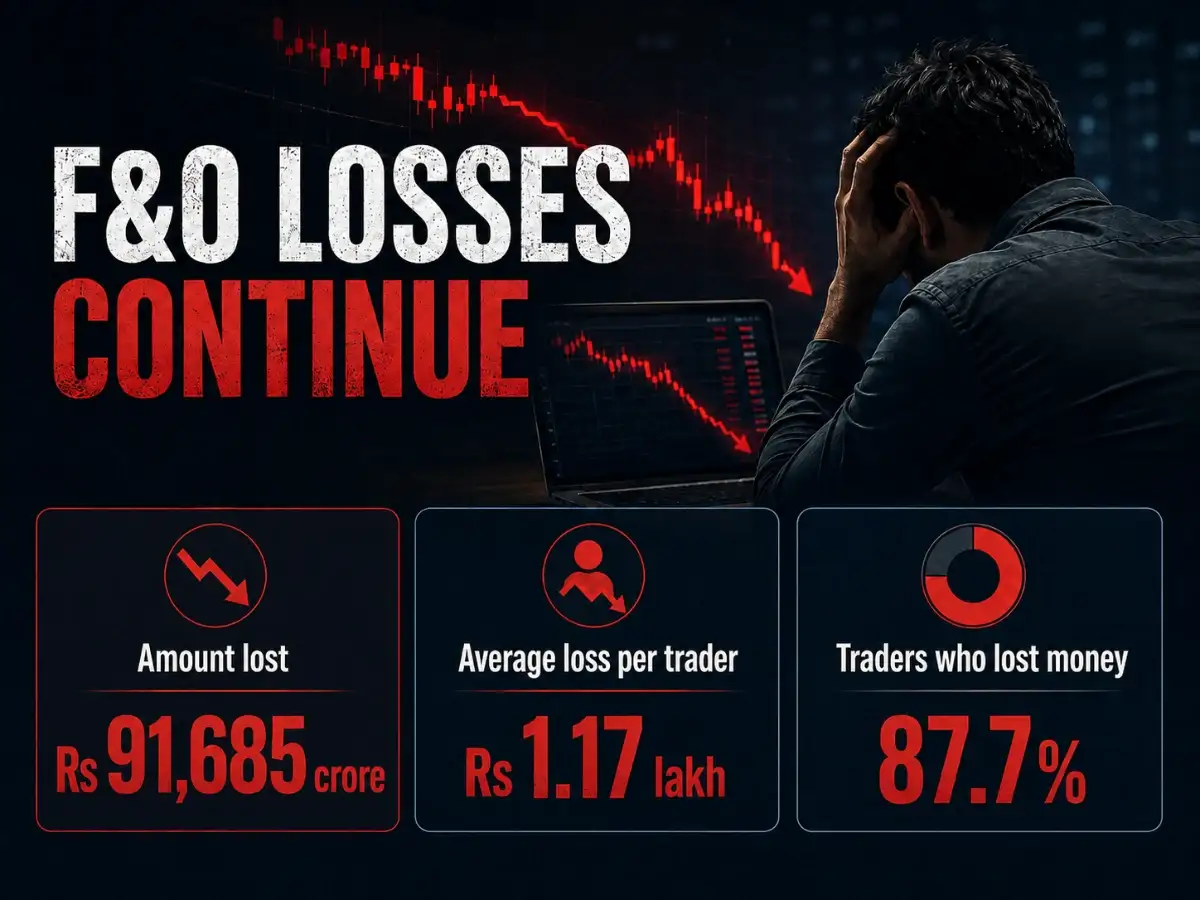
Individual traders continued to lose heavily in India's equity derivatives market in FY26, even as overall retail participation moderated after regulatory tightening and a slowdown in speculative trading. A new Sebi study showed that nearly 88% or 9 out of 10 individual traders still incurred losses in FY26. The share of loss-making individuals declined 3.2 percentage points from 90.9% in FY25.
Sebi study showed individual traders posted aggregate net losses of about Rs 91,685 crore in FY26, compared with about Rs 1.12 lakh crore in FY25. The fall in total losses came mainly because the number of active individual traders declined, not because outcomes improved meaningfully for those who continued trading. Average loss per trader rose marginally to about Rs 1.17 lakh during the year.
Meanwhie, active individual traders declined about 20% to 78.6 lakh in FY26 from 98.1 lakh in FY25, while new entrants dropped about 40%.
The findings are part of two analytical studies released by Sebi’s Department of Economic and Policy Analysis. The first study looked at profitability of individual traders in the equity derivatives segment during FY25 and FY26. The second examined trading behaviour during the same period.
The profitability study is based on data from the top 15 brokers in the equity derivatives segment, covering about 90% of all individual investors in the segment. The trading behaviour study is based mainly on a random sample of 5,000 individual traders, along with profitability data from the top 15 brokers.
Options remained the main source of losses. Sebi said around 92% of aggregate losses incurred by individual traders came from options trading. The share of traders who traded in futures declined marginally to 6.6% from 6.7%.
Transaction costs added to the pressure. Individual traders paid around Rs 25,000 crore in transaction costs in FY26. Over FY22-FY26, cumulative transaction costs paid by individuals stood at around Rs 1 lakh crore. Sebi said even though derivatives premium turnover moderated during FY26, total transaction costs remained broadly unchanged because of the increase in Securities Transaction Tax from October 1, 2024.
The study also showed that losses were heavier among smaller investors. About 35% of individual derivatives traders had no equity holdings, while nearly 78% had equity portfolios below Rs 1 lakh. Traders with equity portfolios below Rs 1 lakh accounted for about 70% of aggregate losses, despite contributing only about half of the turnover.
Loss rates also fell as portfolio size increased. Sebi said 93% of traders with no equity holding made losses, compared with 58% of traders holding more than Rs 10 crore in equity portfolios.
The profit pool, meanwhile, remained tilted towards institutional and professional traders. Proprietary traders recorded the highest gross trading profit at about Rs 44,000 crore, followed by FPIs at Rs 14,000 crore, corporates at Rs 8,000 crore, mutual funds at Rs 3,000 crore and partnership firms or LLPs at Rs 3,000 crore. Sebi said 99% of profits for FPIs and proprietary traders came from algo entities.
Retail trading was also highly concentrated near expiry. Around 59% of index options turnover came from contracts expiring on the same day, known as 0DTE contracts. Around 75% of turnover came from contracts expiring within one day, and 97% came from contracts expiring within one week.
Sebi’s trading behaviour study showed that options buying dominated retail activity. Nearly 97% of traders mainly followed option-buying strategies, while only about 2% were classified as mainly options sellers. Options sellers were the only strategy group to record positive median returns on capital employed in FY26.
The study also found that higher trading intensity was linked to higher loss rates. Younger investors, lower-income groups and traders with small equity portfolios showed much higher trading intensity relative to their financial resources.
Experience did not improve outcomes in a meaningful way. Sebi said traders with several consecutive years of derivatives participation recorded similarly high loss rates. Losses also persisted: among traders who lost money for two straight years and continued trading, around 90% lost money again in the following year.
Quarterly data showed the same pattern. About 85% of trader-quarter observations were loss-making, while only 15% were profitable. Among traders who had both profitable and loss-making quarters, nearly 79% made smaller average gains in profitable quarters than the average losses they suffered in losing quarters.
The study also showed that many traders exit after losses. Between 28% and 40% of traders active in one quarter did not trade in the next quarter. Of those who stopped trading, around 86-89% had incurred losses in the previous quarter.
(Disclaimer: Recommendations, suggestions, views and opinions given by the experts are their own. These do not represent the views of Economic Times)