Pop a piece of dark chocolate in your mouth, says Mark Miodownik, and “for one blissful moment you will be in thrall to the most deliciously engineered material on Earth.” If you resist the urge to bite you’ll notice that as the chocolate melts, your tongue cools, then a combination of sweet and bitter flavours flood your mouth. These will be followed by fruity and nutty sensations, and finally an earthy, muddy taste as the liquid chocolate slides down your throat.
For Miodownik, a materials scientist, stuff is sensual. Not just food but also the stuff of Samurai swords, stainless steel cutlery, reinforced concrete, wrapping paper, china cups, buckyballs and celluloid film. He wants to reawaken our senses to appreciate the wonders of the material world that we have engineered for ourselves in the 7,000 or so years since the first copper was smelted – a world that we usually take completely for granted.
In Stuff Matters, he carefully unpacks everyday materials to reveal how the chemistry of their constituents was orchestrated for a particular purpose. An entire chapter devoted to chocolate describes the process of transforming an unpromising raw material of pale, fibrous, bitter beans into a crystalline matrix of tightly packed triglyceride molecules, cocoa solids and sugar that has a hard, glossy surface, snaps when broken or bitten, and turns from a solid to a liquid only when it reaches body temperature. In other words, it melts in your mouth and not in your hand.
To create such a material involves a greater mastery of physics and chemistry than you might imagine. Indeed, according to Miodownik chocolate is no less remarkable and technically sophisticated than concrete or steels. But the sensual properties that have been so meticulously written into its structure make it much more than that, he argues. “Despite our scientific understanding, words or formulae are not enough to describe it. It is as close as we get, I would say, to a material poem, as complex and beautiful as a sonnet.”
Miodownik’s fascination with materials began with the stainless steel razor blade that sliced clean through his leather jacket and into the flesh of his back during a mugging when he was a schoolboy. He remembers being mesmerised by the blade that sat glinting on the table between him and the policeman who interviewed him afterwards, and later by the staple that neatly bound together the pages of the questionnaire he had to fill out describing the stabbing. Wasn’t that made of steel too?
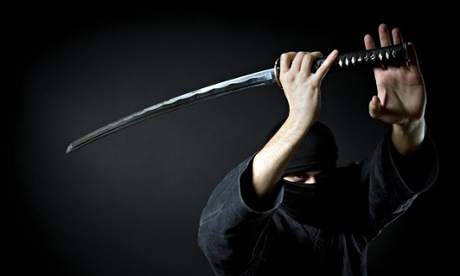
His enthusiasm hasn’t dimmed. It shines through in his description of how 15th century Samurai managed to fashion a sword – with tough, low-carbon, “almost chewy” steel at the centre so it wouldn’t snap, and high-carbon, hard steel at the edges to create an incredibly sharp blade – “that could survive impact with other swords and armour while remaining sharp enough to slice a man’s head off. The best of both worlds.”
In the 21st century, most of us have the good fortune not to live and die by the sword, but we put steel in our mouths every day. If it weren’t for a transparent layer of chromium oxide coating the surface of our cutlery, everything we eat would taste of metal. The invisible patina of chromium oxide on stainless steel prevents your saliva from reacting with the metal, says Miodownik, making ours “one of the first generations who have not had to taste our cutlery”.
What makes this book special is that it celebrates the sensory and social dimension of materials, not just their science. Even apparently humble materials don’t escape Miodownik’s attention. He is not enthusiastic about toilet paper. It blocks toilets and its manufacture entails cutting down 27,000 trees every day. Surely there must be a better way to perform this most important and private of functions?
But he rhapsodises about wrapping paper, which gives a present “a crispness and pristineness that emphasise the newness and value” of the contents. The paper has mechanical properties that lend it to folding and creasing without falling apart, and yet allow it to be torn easily. It is “strong enough to protect the present during transportation but so weak that even a baby can rip it open.”
Like any good popular science book, Stuff Matters is full of stories, such as the one about the gardener who invented reinforced concrete to prevent huge flower pots from cracking under stress, and the one about the blazing row Miodownik had with a materials snob in the foyer of a cinema about the aesthetics of plastic. As a riposte to his antagonist, who bemoaned the fact that sweets were sold in plastic not paper bags as they had been in the good old days, Miodownik pens a screenplay set in the wild west about the development of celluloid.
A good book should also change the way we look at the world. But the human-made, material world has become so sophisticated, so ubiquitous, if we even give it a second thought we dismiss it as mundane and ordinary. Stuff Matters puts the record straight.
Miodownik reminds us that a material doesn’t just have practical and aesthetic value, it can also celebrate certain ideals. Musing on the last surviving cup and saucer from the bone china tea set that his parents received as a wedding present, he tells the story of the invention of porcelain 2,000 years earlier by potters of the Eastern Han dynasty in China. They had found a way to create a ceramic with a delicate, almost flawless surface that was strong enough to be made into bowls, plates, cups and saucers that were almost as thin as paper – translucent, in fact: a material special enough to celebrate a marriage.
We’re reviewing all six books shortlisted for the Royal Society Winton Prize for Science Books. The winner will be announced on Monday 10 November. Click here to enter our competition to win the shortlisted books
Stuff Matters by Mark Miodownik is available on the Guardian bookshop