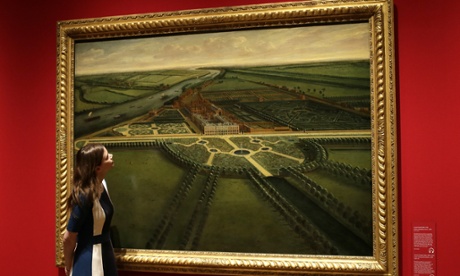
The 14th century gardening manual which warned Henry VIII that his cucumbers would tremble with fear in a thunderstorm, and a spectacular painting showing the beautiful garden he created at his Whitehall Palace, are going on display in an exhibition tracking the gardening passions of generations of royal families.
The painting, done in 1545, shows enticing views out to flower beds and paths from the dark interior where Henry sits with Jane Seymour, and his children, Edward, Mary and Elizabeth. It is the only surviving record of the Great Garden which was destroyed along with the palace in a fire in 1698, and the earliest known painting in British art of a real identifiable garden.
With the gardening manual, which Henry acquired on the death of his chaplain, its previous owner, the painting is among treasures going on display in a new exhibition at the Queen’s Gallery in Buckingham Palace.
Many of the paintings and objects from the royal collection are going on display for the first time, including a watercolour by Queen Victoria’s drawing teacher, William Leighton Leitch, which shows her favourite home, the newly built Osborne House, on the Isle of Wight. The residence, in East Cowes, resembles a giant suburban villa, surrounded by a garden stuffed with geraniums, lobelias and petunias, and bringing to mind a seed catalogue illustration.
Showing a spectacular herbaceous border at Balmoral is a painting, in the exhibition, by Queen Alexandra. And a watercolour depicts the ornamental hermitage at Windsor Home Park, east of Windsor castle, which was designed in the late 18th century by Princess Elizabeth, the daughter of Queen Charlotte. No hermit, however, ever took up the challenge of living decoratively in its moss-lined interior.
The curator of the exhibition, Vanessa Remington, of the Royal Collection Trust, pointed out that royal gardening was often highly political: “Power could be demonstrated and influence spread across Europe by gardening as well as warfare.” She said she thought a lifesize pineapple beneath a magnificent silver table, made for William of Orange when he became king of England, was a blow aimed at Louis XIV.
A painting in the exhibition shows Louis’ vast garden created when he levelled hills and drained marshes to create Versailles. The spectacular painting, copied in scores of prints, shows a hunting scene in front of the lake created by Swiss mercenaries, many of whom died from methane gas that was released from the swamp at the site.
William, keenly interested in gardening, created something more modest at Hampton Court, but by the time his table was made Louis had had to melt down his own silver furniture to help pay for his wars – and William had triumphed in the aim of every royal gardener in Europe, by cultivating the pineapple, then a fabulously exotic fruit.
On display too is Henry VIII’s gardening manual, Ruralia Commoda, which was written in 14th century Italy, in latin. It was the only book of its kind in the king’s library and shows signs of heavy use and annotation.
Apart from the warning over terrified cucumbers, the manual suggests that a royal garden should take up 20 acres or more, and that a good way to grow squash is to plant the seeds in the ashes of human bones.
The book’s gardening tips include advice to have turf seats, shady walks, sweet-scented herbs, high walls to keep out any but invited guests, and a spring of pure water; Henry’s Whitehall garden, indeed, had a massive tiered circular fountain. Such a paradise on earth would not only demonstrate the monarch’s wealth and status but provide a space “where the king will not only take pleasure but after he has performed serious and obligatory business he can be renewed in it”. The advice, the exhibition shows, was followed to the letter by centuries of royals.
Painting Paradise: The Art of the Garden, Queen’s Gallery, Buckingham Palace, 20 March to 11 October, 2015.