
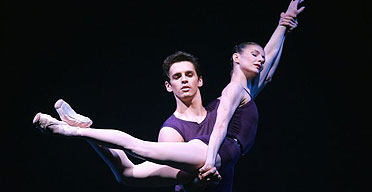
Christopher Wheeldon is a textbook example of why companies should gamble on young choreographers. In 1996, when his work first appeared at Covent Garden, Wheeldon seemed a clever and decorative talent, but very, very safe. Five years later he had produced Polyphonia, a ballet so densely imagined that even now its strategies appear breathtakingly daring, and its imagery shockingly beautiful. Set to 10 piano pieces by Ligeti, this is a work that glitters on a knife edge - tilting between unison and syncopation, transparency and hardness, formality and sex. It also sits triumphantly on the bodies of its eight dancers, especially Alina Cojocaru, swinging wide and steely through her classically styled variation, and Leanne Benjamin, alternately victorious and needy in the pungent eroticism of her final duet.
Polyphonia is a hard act to follow - and it is particularly tough for Matjash Mrozewski, who on Saturday was premiering his first major work for the Royal. Set to music by Arvo Part, Castle Nowhere is arresting, as the curtains open on a scene in which a small bomb appears to have exploded in a drawing room - leaving fragments of mirrors, lamps and clocks suspended in the air.
Beneath this portentous detritus are Zenaida Yanowsky and Edward Watson, costumed in period evening dress, and clearly in the middle of a difficult dance of courtship. The relationship is all delicate, angry yearning on her side, withdrawn self-hatred on his, and the dancers evoke the tension brilliantly. When Yanowsky ends their first duet arched back in a brutal self-exposure and Watson is turned away in fearful denial, the air vibrates with almost murderous suspense.
Yet what is actually going on between them is unclear and even when they are joined by six other dancers, framing their relationship with a chorus of slow balances and finely modulated gestures, the narrative doesn't expand. In Polyphonia, Wheeldon manages to focus a startling emotional subtext within the rich, abstract patterning of his choreography. The trouble with Castle Nowhere is that it is all subtext - with no solid dance or dramatic material to support it.
As the dancers continue circling each other, keeping their secrets tight, it's as if we are watching a teasing trailer from another, larger work. And brutally, when the programme moves on to a revival of Kenneth MacMillan's Requiem, Mrozewsky's is no longer the story of the evening. It is the image of Darcey Bussell, dancing with piercing clarity against Leanne Benjamin's exquisite poignancy that we carry home with us.
· In rep until April 12. Box office: 020-7304 4000.





.jpg?w=600)




