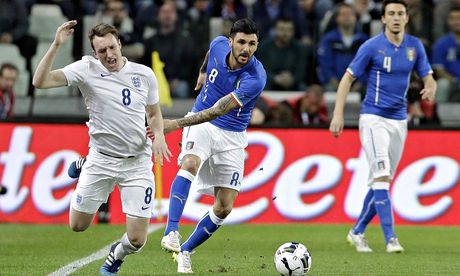
The immediate reaction inspired by Roy Hodgson’s selection for the friendly against Italy was to lower expectations and come to terms with the likelihood it was going to be an evening of the purest English stodge. Phil Jones was going to offer his unique take on a role perfected by Andrea Pirlo, Wayne Rooney was in midfield, Theo Walcott was up front and it was not obvious how England were planning to penetrate a side who were set up to squeeze the space in front of their defence and counterattack swiftly.
All of which meant there could be no surprise about a first half in which England’s flaws – the skittishness in possession, the predictable movement, the lack of imagination – were sorely evident. Italy deservedly led at half-time through Graziano Pellè’s header and England were fortunate it was only 1-0. You could hear the alarm bells ringing in Hodgson’s head. England were sleepwalking towards another kicking. “We were definitely told at half-time that we needed to change that,” Kieran Gibbs said. “We did.”
The healing process actually started a minute before the interval, the removal of the unwell Chris Smalling allowing Jones to drop back into defence and Michael Carrick to bring some poise to the midfield. It continued when the excellent Ross Barkley replaced Walcott after 55 minutes. The improvement was vast and the equaliser had been on the cards by the time Andros Townsend, another substitute, rasped a shot past Gianluigi Buffon from 20 yards with 11 minutes left. The mood changed and the response afterwards was largely positive.
Yet there was also consternation that it had taken Hodgson so long to find that balance. England were far more cohesive and dangerous once Carrick took over from Jones, Rooney joined Harry Kane in attack and Barkley began to roam into the areas where Italy could be hurt. Barkley still needs to fine-tune his decision-making, but it was impossible not to be impressed with his powerful surges and seemingly ceaseless appetite for the ball, while Townsend’s directness offered further encouragement.
England were passing well and attacking with pace and invention by the end, qualities that have tended to be absent when they have faced the top nations in the Hodgson era. In the end it was a step in the right direction, a 1-1 draw on paper but something approaching a moral victory in spirit.
This is England, though, and that sense of optimism had to be accompanied by a few misgivings, unease at how Hodgson eventually stumbled across the right formula, how he thought that Jones was suited to a sitting role at the base of the diamond and that Walcott would be effective through the middle. England had no width or dynamism and were often reduced to hitting hopeful deep crosses to the far post.
Yet perhaps criticism of Hodgson should be kept in perspective. This was a friendly, a chance to try out a few things in a low-pressure environment, and is worth keeping in mind that injuries meant that England were without Jack Wilshere, James Milner, Raheem Sterling, Danny Welbeck, Alex Oxlade-Chamberlain, Adam Lallana, Luke Shaw and Daniel Sturridge. At least three of those would be in Hodgson’s first-choice team and all of them would be in his squad.
Hodgson was right to experiment in that context. The diamond system that was first seen in September’s Euro 2016 qualifying win over Switzerland has been successful and England have looked suited to it, yet it can be a fragile formation, one that requires every player to be comfortable for it to work. What Hodgson learned in the first half is that it will not suit all of his players.
Jones has not disgraced himself as a holding midfielder in the past, most notably when Manchester United held Real Madrid to a 1-1 draw at the Bernabéu two years ago and when England beat Spain in a friendly in 2012, but it has always been as part of a two or a three. Against Italy he was on his own and his limitations on the ball were exposed. Hodgson said there will come a time when Jones will be a useful option for England in midfield but the deepest player in a diamond system needs to be an orchestrator, not a destroyer. If Wilshere is unavailable the position is made for Carrick.
It was a difficult evening, too, for Walcott, who was unconvincing as Kane’s partner or as a No10, his movement failing to stretch Italy. The charge against Walcott, as ever, was that he does not understand the game. Yet he understands it well enough to play for Arsenal and his greatest assets, his speed and finishing, shine brightest when he is used as an inside-right. Walcott may not be as tactically intelligent as Sterling or Lallana, or have as much thrust as Oxlade-Chamberlain, but that does not mean there can be no place for a player who is still regaining his sharpness after returning from the knee injury that kept him out of the World Cup. Just not as a No10.
Now Hodgson knows. And there was no harm in finding out.