Skiiers, usually starved of attention, are offered an opportunity by the Winter Olympics to propel themselves from obscurity into the public consciousness. A career can be transformed, if not in the blink of an eye then at least in the time it takes – not a great deal longer – to slide stylishly down a bit of mountain. In Sochi this was particularly true of the freestyle skiers, enjoying their shot at glory as half-pipe and slopestyle events were included for the first time.
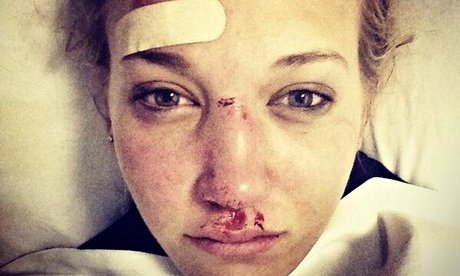
Rowan Cheshire did attract attention because of her performance in Russia, but not at all the way she planned. Instead of beaming with joy, when her face appeared in the newspapers it was a swollen, bloodied mess, after a training accident that was to rule her out of the half-pipe and whose effects she would continue to feel for months.
She had not even been attempting anything particularly difficult. “I’ve been doing it for years,” she says of the trick that undid her. “I’d been doing it in competition all season, so it wasn’t as if it was alien to me or anything. I’d already done it that day, this was the second time trying it. I’d landed it loads of times.
“When you go up the pipe your natural reaction is to jump into a trick, but the pipe in Sochi, the shape of it, when you went up you weren’t supposed to pop at all. But it’s a bit hard to just ride into it. I was supposed to flip sideways but my reaction was to jump into it, and I just popped a bit too much and when I came round the ground wasn’t there. So I just carried on going and landed on my face.”
The blow knocked her unconscious, and she was later taken to hospital for assessment. Of all this, she remembers nothing. “I remember being in the athletes’ lounge before the start, which was in the daytime, and the accident happened at night. Other than that, the only bit I remember that day was when a camera crew stopped to film me, but that was just a few seconds. I remember leaving the athletes’ lounge, and the next thing I remember is waking up in hospital the next day. And your memory tries to include other days as well, push them all together. It gets a bit confusing.”
It turned out that the physical damage was perhaps the least of Cheshire’s problems. “I broke my nose, I got spinal whiplash, spinal concussion, they were really the big issues,” she says. “With therapy they kind of pass, they were painful but only for a while. The head was more of a long-term thing.”
After returning from Sochi, Cheshire would find herself stricken with fear in the most innocuous of situations. “I was discharged from hospital in the late morning. They told me to just take it easy, and I packed a bit, chilled in the house for a while,” she says. “I wasn’t really in the best state. It’s hard to explain, but some things started to really scare me even though I do them all the time. Big social situations, especially, really scared me. The accident did play with my head a little bit.
“When I got home, I struggled with the normal stuff. Getting the train to Manchester on my own – I do that all the time, but at that point, with my head as it was, I was just terrified. I didn’t think I could do it at all, I’d get lost, or I’d get confused or whatever. When I went to the doctor’s in Manchester, which I do every week, I had to get my mum or someone to come with me. It took me a while to get over that.”
Meeting Cheshire at the Ski & Snowboard Show at Earl’s Court, where she and a few other members of Sochi’s Team GB had enjoyed something of a mini-reunion, her face betrays no sign of physical or mental trauma. “Now I feel fine, back to normal,” she insists. “The memory’s not so good, but you know … ”
Though just 18 at the time and still very much an emerging talent, Cheshire had travelled to Sochi with genuine hopes of a medal, having recently become the first British woman to win a World Cup event since Jilly Curry 22 years earlier. The ending to her first full season in senior competition was however to be more nightmare than fairytale.
“I didn’t time it very well,” she says. “Over that season I’d improved massively and my confidence was really high coming into the Games. That season had been just competition after competition and I was very much in that zone. But overall, other than the accident, it was still a really positive trip for me. And even that, well, what you gonna do?”
Having chosen to make a career out of death-defying high-speed deep-frozen acrobatics the chances of remaining accident-free are not good. “When you sign up to do this sport you sign up for injury as well,” she says. “You know it’s going to happen. I’d been quite lucky – I’ve done fingers, thumbs, sprains, bruises, ribs, but I hadn’t really had anything major. I was saving it for a big event.”
Cheshire is now, very gradually, turning her attention towards Pyeongchang, host of the 2018 Winter Olympics. “I’m trying not to think about it too much. I just want to get back into competition and get back to the level I was, so when it all kicks off – and it all kicks off in about two years’ time, really – I’ll be in a good place,” she says.
“There’s no stress this year. Last year was very pressured. In the build-up to the Olympics everyone was fighting to get to the top. This year, it’s about setting your own personal goals. For me, I just want to enjoy it again. I want to go out there, see my friends, and get back to how it was before the Olympics happened.”
Her passion for her sport remains undimmed. After a couple of months’ rehabilitation Cheshire gently eased herself back into skiing. “I went out, without any of my coaches, I stayed at a friend’s house and we just had fun, cruised around, jibbing off things. Just chilling,” she says. “That helped a lot I think. When I got back into the pipe I was really quite scared, but once I’d done it a couple of times I was like, ‘This is OK.’
“You don’t really want to admit it but you do have those little voices saying: ‘You shouldn’t really do that again.’ Your head’s trying to tell you, ‘Why are you throwing yourself around? It’ll happen again.’ But once I got back on that pipe I realised why I love it. For me, it’s the adrenaline. Even if you fall, you get back up and just want to go again. There’s nothing like the rush of it.”