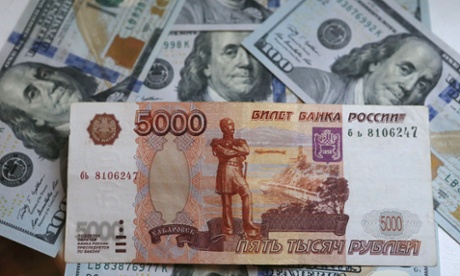
Closing summary: Rouble rallies on Fightback Wednesday
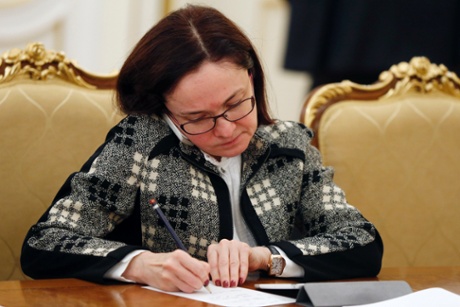
If yesterday was Black Tuesday, then today was Russia’s Fightback Wednesday.
We’ve seen a classic three-pronged attack from Moscow today, as policymakers get to grips with the country’s currency crisis and attempt to rebuild some much needed confidence in its financial system.
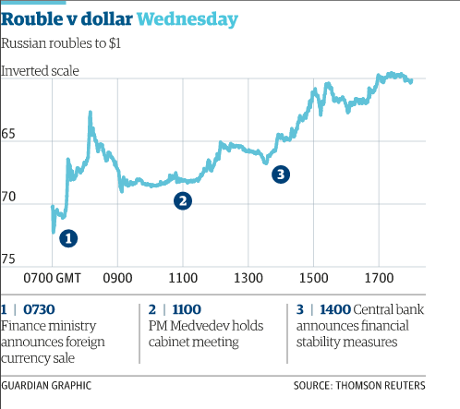
First, at 7am London time, the finance ministry announced it would intervene in the FX markets by throwing $7bn in reserves at the ailing rouble.
At lunchtime in Moscow, prime minister Dmitry Medvedev tried some verbal intervention. He urged calm and promising that Russia’s reserves were deep enough to ride out the crisis.
But it was the third prong that really spurred the rouble; the Central Bank’s announcement of various measures to restore stability. Crucially, this includes the promise that banks could be recapitalised in 2014, and a pledge to make more liquidity available if needed.
Some of these measures look rather dubious, such as allowing banks to ignore losses or used a more favourable rouble rate. But in times of crisis, central banks play by their own rules.
And the rouble has responded, surging around 12% today to around 60 to the $1 tonight.
Now, this does NOT means that Russia’s crisis is over, at all.
The country is still heading into recession, confidence has been badly hit by the events of recent days, interest rates are punishingly high (17%), and the economy is still being stricken by sanctions.
Indeed, data released this afternoon showed there was no meaningful growth in November, while capital expenditure by companies shrank by almost 5%. That’s before this week’s turmoil.
Liza Ermolenko, emerging markets economist at Capital Economics in London, said:
“In general the picture is still of an economy that is stagnating rather than collapsing.”
And who knows how the rouble will fare tomorrow?....
There’s an awful lot of pressure on president Putin tonight, as he puts the finishing touches to his annual press conference tomorrow.
Here’s tonight’s news story on the crisis:
Rouble rise prompts hopes that Russian economic crisis is easing
And that’s all for tonight. Thanks for reading, and for all the comments. GW
Updated
#Ruble is back down to 59 to the dollar as oil prices rise 4%. It's a fickle, fickle thing, this economic crisis
— Alec Luhn (@ASLuhn) December 17, 2014
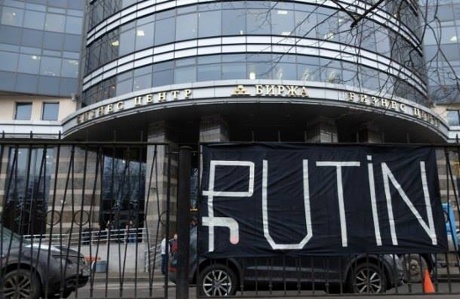
Back to Russia...and this photo from Facebook appears to show a banner outside the St Petersberg stock exchange, blaming president Putin for the rouble crisis (that’s the new rouble symbol)
Greek government loses round 1 of presidential vote
Right, the scores from Athens are in. And the government only managed to get 160 MPs to support it, against a target of 200.
Vote finishes - 160 vote for govt's presidential candidate, 135 vote "present" & 5 are absent #Greece
— Nick Malkoutzis (@NickMalkoutzis) December 17, 2014
That’s not a great result for prime minister Samaras -- he now has to persuade another 20 MPs to back him by the third and final vote on the 29th (when the target falls to 180), or face early elections.
It’s reviving memories of the worst of the eurozone crisis.
#Grexit is back, or something else as bad... Bloomberg breaking news: Greece's Antonis Samaras Fails to Get Votes to Elect President
— Sony Kapoor (@SonyKapoor) December 17, 2014
Updated
That was fast....
*GREECE'S SAMARAS LOSES FIRST OF THREE DEC. VOTES ON PRESIDENT
— World First (@World_First) December 17, 2014
Other in Athens, Greek MPs have begun voting on whether to appoint Stavros Dimas as their next president.
Dimas is expected to fall short of the two-thirds majority needed. That’s not game over, though; two more ballots can be held, and in the end a three-fifths majority - 180 votes - will do. But even that may be beyond the government, which only has a majority of 155.
#Greece begins its (indirect) presidential election today - here are the four things you need to know: http://t.co/4iXDDd3vT4
— GuardianData (@GuardianData) December 17, 2014
Updated
More market excitement, which will cheer Moscow; the oil price has just surged by over 4% in the last few minutes.
Here's oil going wild. pic.twitter.com/zbSosO58qu
— Joseph Weisenthal (@TheStalwart) December 17, 2014
Wow. The Rouble just fell back below the 59-to-the-dollar mark as the rally continues.
Masha Lipman, an independent political analyst in Moscow, says tomorrow’s press conference is “a moment of truth” for Vladimir Putin.
“It’s no longer possible to go on in the same fashion. The economy is tumbling. The time has come for a definitive choice, doing nothing won’t solve the problem.”
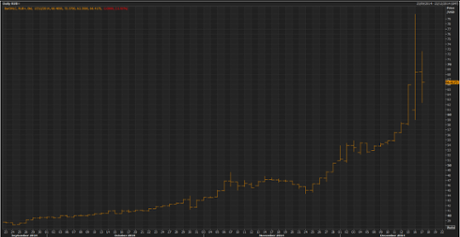
It’s been a truly tumultuous few days for the Russian currency, as this chart shows.
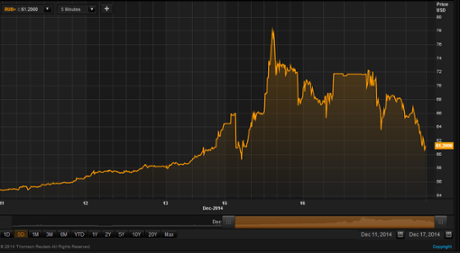
The rouble began Monday morning at a record low of 58 to the dollar, but weakened to 66/$1 by the end of the day.
That triggered the overnight rate hike from the Bank of Russia, to which the markets blew a raspberry on Tuesday, driving the rouble up to 80/$1, before subsiding back to around the 68 mark.
This afternoon’s 10% surge is the biggest one-day rally since 1998, according to the FT. But it still leaves the rouble weaker than at the start of the week.
Updated
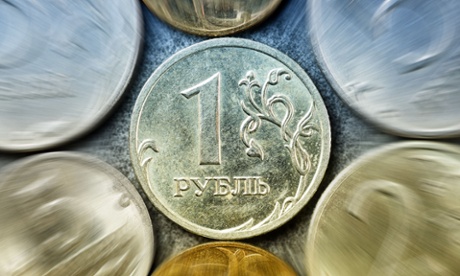
Could the tide be turning for the rouble? John Higgins of Capital Economics reckons it might.
He cites several reasons why the Russian currency could clamber back off the mat:
First, the price of oil could recover. Second, the authorities have made it harder to short the currency by raising interest rates sharply (even though this will come at a cost to the economy). Third, they still have plenty of ammunition in the way of reserves. And fourth, they could continue to take steps to support the currency in other ways if required.
Russia’s situation remains perilous, though, Higgins adds:
Nonetheless, the devastating consequences that the current oil price will have on Russia’s economy and its dollar-debt laden financial system suggest calm may not be fully restored anytime soon.
Here’s Shaun’s latest dispatch from Moscow, explaining how Russia is poised for the president’s annual press conference, tomorrow:
Rouble halts fall but remains volatile as Russia awaits Vladimir Putin speech
Amid the mayhem in Russia, French actor Gerard Depardieu has been launching his new luxury watch.
The timepieces, under the slogan “Proud to be Russian” have been made by Swiss manufacturer Cystos.
Our Moscow correspondent Shaun Walker attended the event, and reports that Depardieu was a little late (!), and shrugged off the rouble crisis.
Here he is!!! He opens with "Dobry utro, dobry den, urghhhhhhh je ne sais quoi... Bon soir" pic.twitter.com/0XM5KFmygj
— Shaun Walker (@shaunwalker7) December 17, 2014
This luxury watch launch is taking place amid awful rouble crisis. And Depadieu is currently ten minutes late. #perfecttimingforawatchlaunch
— Shaun Walker (@shaunwalker7) December 17, 2014
Depardieu at his watch launch: "Luxury doesn't depend on the rouble,it depends on the spiritual strength of the Russian people." Reassuring.
— Shaun Walker (@shaunwalker7) December 17, 2014
The FT flags up that Russian banks are also being allowed to charge more for loans, under the relief measures just announced.
From January 7th, interest rate caps on consumer loans would be temporarily abolished to allow banks and microfinance institutions to reflect their full cost of lending.
The rouble continues to recover, and is now changing hands at ‘just’ 60 to the dollar. A remarkable recovery from yesterday, when it briefly hit the 80 mark.
Russian rouble up 23% from the lows, so is it now in a bull market?
— World First (@World_First) December 17, 2014
The Russian stock market is on an absolute tear this afternoon since the central bank made its announcement. The RTS index has surged by 17%.
Russian stocks, ruble rebound after Bank of Russia relaxes banking regulations to keep its lenders out of trouble for now. Via @kolyandr
— William Mauldin (@willmauldin) December 17, 2014
Financial experts aren’t impressed that Russian banks will be allowed to ignore losses on their assets (if only temporarily):
Russian Central Bk stops revaluing assets for moment to ease pressure on rouble. Yes & if you shut eyes you won't see any problem either
— just urquhartstewart (@ustewart) December 17, 2014
Central Bank of Russia now allowing banks not to mark to market. Because obviously if you don't realize a loss it never happened. Yikes.
— David Rodriguez (@DRodriguezFX) December 17, 2014
Russian central bank First Deputy governor, Ksenia Yudayeva, says some of these new measures are designed to stabilise the rouble on the foreign exchange market.
Reuters has the details:
In an emailed statement, Yudayeva said in order to ease concerns over approaching debt payments by Russian companies, the bank would provide additional foreign currency funds.
“These measures are intended to balance supply and demand on the foreign exchange market, which will help stabilise the rouble rate more quickly.”
Confirmation that the rouble is rallying:
#Russia central bank intervention successfully pushing #USDRUB down pic.twitter.com/ZQGJ4jg9kq
— Open Europe (@OpenEurope) December 17, 2014
Russian central bank announces measures to restore financial stability
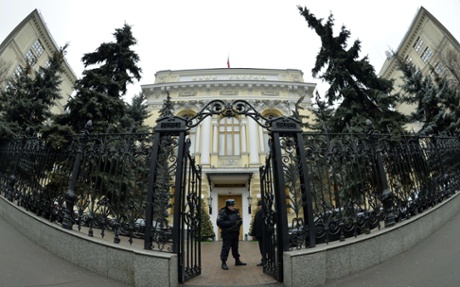
BIG NEWS FROM MOSCOW: The Russian Central Bank has just announced a series of measures to “maintain the stability of the Russian financial sector”.
The news has sent the rouble surging on the foreign exchanges.
The CBR says it is preparing to pump more money into its banks next year. It is also relaxing some banking standards, to effectively allow banks to temporarily ignore losses caused by the currency crisis, and use a more favourable rouble exchange rate.
It’s an attempt to ease the crisis that is gripping Russia, and spooking the global markets. The rouble is rallying hard, up 10% to 61.8 to the dollar as I type.
The details are here, in Russian.
The key measures include:
- A pledge to recapitalise credit institutions next year, in partnership with the Government of the Russian Federation.
- Banks will, temporarily, be freed from having to recognise losses on their securities portfolios, to “reduce the sensitivity of market participants to market risk”.
- The CBR will offer banks more opportunities to buy foreign exchange funds through auctions run by the bank.
- Banks will be allowed to, temporarily, use the rouble exchange rate of the previous quarter when assessing the value of their assets.
- The CBR will offer more support to the Moscow Stock Exchange, to help it distribute liquidity through the markets.
Reaction to follow....
Updated
Brilliant by Larry Elliott: Russia has lost the economic war with the West. http://t.co/4fRXg9YG9M
— Heidi N Moore (@moorehn) December 17, 2014
The clock is ticking over at IKEA”s store on the outskirts of Moscow.
The Swedish furniture giant has said it will raise Russian prices on Thursday, in response to the slump in the rouble’s value.
Associated Press reckons that there are “weekend-like crowds” at the store this afternoon. I’ve dug out some pictures:
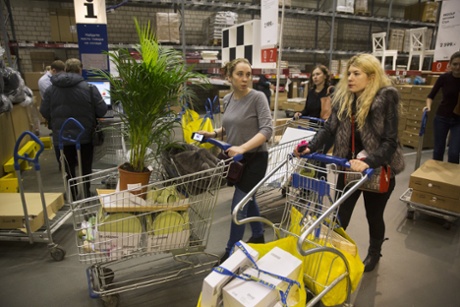
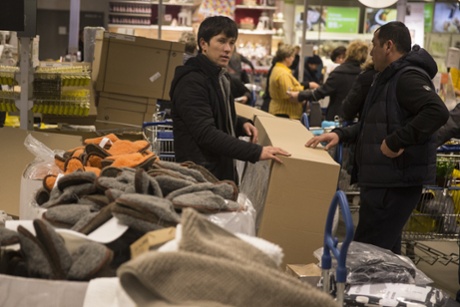
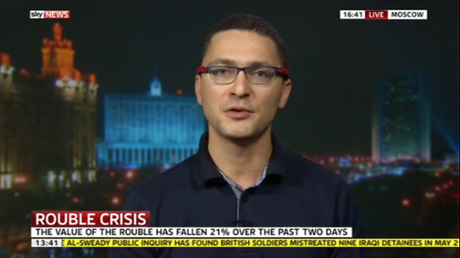
A Russian businessman has warned that the country is facing a ‘perfect storm’ of sanctions and tumbling oil revenues.
Marat Atnashev, a former vice-president of the TNK-BP oil group, told Sky News that simply correcting the exchange rate of the rouble will not fix the Russian economy, as
“There is a full scale economic crisis ahead that will affect all of us.”
The slump in the rouble this year has already forced up the cost of repaying loans in foreign currencies, Atnashev pointed out.
Atnashev also warned that all parts of Russia’s economy - ordinary people, businesses, the elite, will lose something in this crisis, adding:
[Moscow] needs to find the fiscal answer, the economic answer but also the political and social answer….to deliver an economy that is sustainable.
Back to Russia.....and the prime minister’s office has said that Dmitry Medvedev called on Russia’s top exporters on Wednesday to behave “responsibly” during the crisis.
Medvedev urged them to manage their foreign currency revenues in a way that would not boost rouble volatility, during today’s meeting.
Exporters already convert a portion of their export revenues into roubles.
Updated
Over to America briefly... and US inflation has fallen this month as the weak oil price cuts the cost of gasoline.
Consumer prices declined by 0.3% month-on-month, the biggest decline since December 2008 (when the financial crisis was raging).
That pulls the annual US inflation rate down to 1.3%. Something for the Federal Reserve to ponder at their meeting today....
BREAKING: US Consumer Price Index down 0.3% in Nov vs. down 0.1% estimate http://t.co/YSyt97owT6
— CNBC Now (@CNBCnow) December 17, 2014
We’ve pulled together a gallery showing how Russians have been racing to the shops since the currency crisis started:
Rouble collapse triggers Russian spending spree – in pictures
Medvedev urges calm over currency crisis
Russia’s prime minister has attempted to calm the situation by assuring the population that Moscow has the resources to overcome the crisis.
Dmitry Medvedev gave the message at today’s televised cabinet meeting with ministers and top industry leaders, saying:
“All the economic and production goals that you have set yourselves, the country has the currency resources to achieve them.”
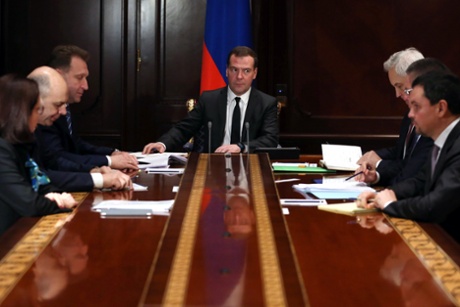
Medvedev’s words appeared designed to prevent panic on the streets, by pledging that Moscow would get things under control.
“It’s in our joint interests to bring order to the currency market as quickly as possible.”
“No one - neither our citizens nor banks nor the real economy - needs such instability.”
And he also claimed that “emotions” had helped to drive yesterday’s market rout, which saw the rouble hit record lows of 80 to the US dollar.
As flagged up earlier, Medvedev also appears to have ruled out implementing capital controls, to Russians taking money of the bank, or out of the country.
He said:
“We act on the basis that our future actions must be based on market mechanisms,
“There is no point in bringing in the extremely harsh regulation in this sphere that there was at one time. It doesn’t lead to anything useful”.
And the message does appear to be working.... the rouble is strengthening to around 65.8 to the dollar, from 68 earlier. But that’s still close to a record low.
Updated
Video: What Russians are saying about the crisis
Here’s the word on the streets of Moscow today:
Some citizens blame their own government for the crisis, others blame the West.
Summary: Rouble under pressure as Medvedev holds meeting
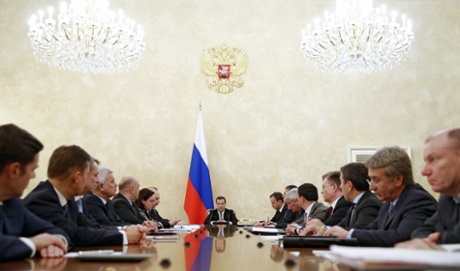
Time for a catch-up, I think.
Russia remains gripped by a currency crisis that threatens to pull the country’s economy deep into recession and could trigger wider economic damage.
The situation in the financial markets is looking a little more stable than yesterday. But Russians are being hurt by the recent slump in the rouble, which has forced Apple to shut its Russian online store.
Apple closes Russian website because of rouble crisis
The Moscow finance ministry made a dramatic bid to help the rouble this morning, announcing that it will deploy $7bn of foreign exchange funds to bolster the currency. Full story.
This sparked an early rally, but some of the bounceback has somewhat fizzled out.
This leaves Russia’s currency hovering around 67 roubles to the US dollar, and 82 to the euro.
The positive way of looking at the #rouble, is more or less flat on the day... in choppy trading pic.twitter.com/YGc2gPznRV
— Global Markets Forum (@ReutersGMF) December 17, 2014
Nicholas Ebisch, currency analyst at Caxton FX, compared the finance ministry’s move to “putting a plaster on the wall of a dam that is about to burst”.
The underlying economic strength of Russia’s economy is still in grave doubt as oil prices slide yet again to a new low of $55 per barrel.”
And analyst Timothy Ash has dismissed the move as rummaging down the sofa for some spare change.
Russia’s prime minister, Dmitry Medvedev, is held meeting with cabinet ministers and top CEOs today to discuss the crisis (see photo above)
Russian PM Medvedev sets emergency meeting with ministers and high profile society representatives to discuss ruble crisis - ANSA #markets
— Michel Santos (@Cibereporter) December 17, 2014
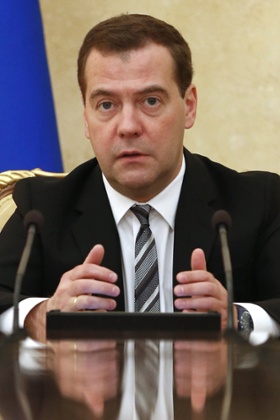
Medvedev tried to talk up the currency, and appeared to rule out introducing capital controls. He said:
“Everyone recognises that the rouble is undervalued. It has become detached from fundamentals and does not reflect the state of the economy,”
“There is no point in introducing extremely strict regulation of this area, such as there has been in previous periods. That does not help anyone.”
RUSSIAN PM MEDVEDEV SAYS ROUBLE OUT OF ZONE COMFORTABLE FOR ECONOMY, SITUATION SHOULD BE BROUGHT UNDER CONTROL - INTERFAX
— Mateusz Walczak (@walczak_mat) December 17, 2014
The Kremlin has been blaming yesterday’s currency turmoil on recklessness and manipulation; one adviser said the “bacchanalia” in the foreign exchange markets must end.
The crisis continues to dominate the worlds of finance and politics.
The main European stock markets are all down today - the FTSE 100 has lost 48 points, or 0.75%, to 6283.
The Moscow stock market is rallying, though, pushing the RTS index up by around 6%.
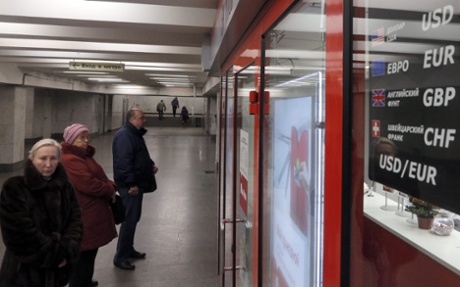
The situation on the streets also appears calm, as Russians face the prospect of sharply rising prices on imported goods.
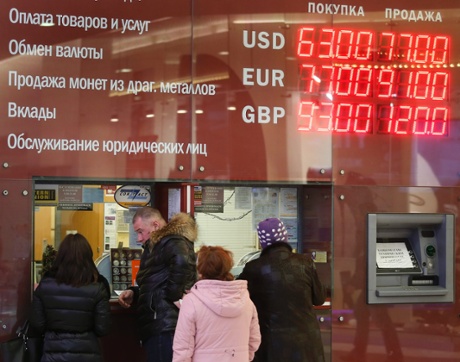
Many Russians have been flocking to stores to buy imported goods before prices are hiked. And currency firms remain open for business, although foreign currency prices are pretty steep.
Looks as if #Russia heading into full scale crisis. Capital controls soon? How long before Putin’s popularity slips? Living stds crashing
— Robin Bew (@RobinBew) December 17, 2014
Updated
Simon Kruse, Moscow correspondent at Danish newspaper Berlingske, reports that prices are changing fast in Moscow as retailers try to keep up.
Supermarket manager tells me they marked up most food items by 5-7 percent this morning.
— Simon Kruse (@crusoes) December 17, 2014
Samsung shop hiked the price of this tablet by 3,200 r around lunchtime. 'We change prices several times a day now' pic.twitter.com/duEVUF4a7q
— Simon Kruse (@crusoes) December 17, 2014
Timothy Ash, an analyst at Standard Bank, is astonished by the news that the Russian finance ministry will deploy around $7bn of ‘spare’ currency reserves to prop up the rouble (as explained earlier)
Ash says the intervention is “unbelievable stuff”:
“Why, if the central bank has $413bn in reserves, is the ministry of finance being called on to put its hand in its pocket for some small change — they are like checking the back of the sofas at this stage”.
The slump in the rouble has astonished Ash:
“I don’t think I have ever seen any currency go through such extreme gyrations in all my time in the industry. The rouble is fast becoming untradable — maybe that is what the central bank wants.”
Updated
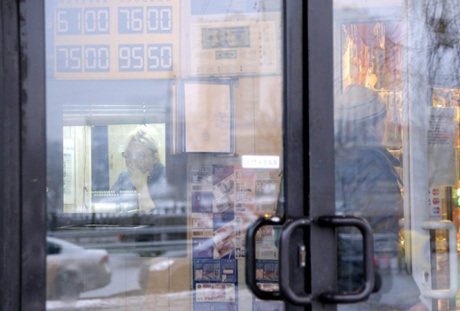
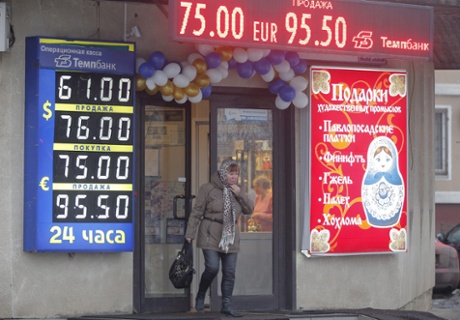
Russia’s currency exchange firms are open again today.
They’ll buy and sell euros and dollars, but the spread between the prices is painfully wide.
One Moscow office will buy a dollar for 61 roubles, but will insist on 76 roubles in return for selling one (compared to this morning’s spot price of 68/$1).
EC: We're watching Russia with concern
The Russian crisis will be high on the agenda when European leaders meet for their final summit of 2014 on Thursday.
Officials in Brussels are watching the crisis in Russia with growing alarm.
Speaking off the record to Reuters, an EC official said:
“We are all watching the economic developments in Russia with concern....No one has an interest in Russia falling into a deep depression.”
Updated
Quotes from prime minister Medvedev are flashing up, via the Interfax agency
- 10:21: RUSSIAN PM MEDVEDEV SAYS ROUBLE OUT OF ZONE COMFORTABLE FOR ECONOMY, SITUATION SHOULD BE BROUGHT UNDER CONTROL - INTERFAX
- 10:22: MEDVEDEV SAYS TOUGH REGULATION OF CURRENCY MARKET NOT NEEDED, ACTIONS SHOULD BE BASED ON MARKET MECHANISMS - INTERFAX
Medvedev to meet with ministers, top CEOs and Bank chief
You can’t accuse Russia’s politicians of sitting on their hands during this crisis.
Prime minister Dmitry Medvedev will hold a meeting of his cabinet today, which will also be attended by the heads of two top energy firms, Rosneft and Gazprom, and the CEOs of major exporters.
Central bank governor Elvira Nabiullina is also attending.
That’s via the RIA Novosti news agency.
Medvedev is holding a meeting this afternoon with ministers, central bank, and CEOs of all major exporters. Capital controls, anyone?
— Jack Farchy (@jfarchy) December 17, 2014
A Kremlin economic aide has told local media that the Russian government and the central bank agreed to take “consolidated actions”, at a meeting yesterday chaired by Dmitry Medvedev.
No further details were given.
The aide, Andrei Belousov, apparently added that Moscow was determined to a halt to the “bacchanalia” in the foreign exchange markets.
RUSSIAN GOVT, CENTRAL BANK WORKING TO STOP `BACCHANALIA': RIA >> Ruble bacchanalia FTW. Is that what they call it these days?
— Katie Martin (@katie_martin_FX) December 17, 2014

It’s s reference to the Roman festivals of Bacchus - known for their boozy, riotous and generally ribald nature.
Not exactly how I’d describe yesterday’s turmoil in the foreign exchange markets.....
Updated
Russia’s fightback continues.... Vladimir Chistyukhin, a deputy governor of the central bank, has said an investigation into possible manipulation on the foreign currency market has been launched.
BANK OF RUSSIA STARTS PROBES ON FX MARKET MANIPULATION
— Jonathan Ferro (@FerroTV) December 17, 2014
Chistyukhina also told reporters in Moscow that the CRB is not discussing introducing a mechanism to suspend trading on the foreign currency market if there were sharp moves in the exchange rate.
Back to Russia.
The rouble is bobbing around at 68 to the $1 after this morning’s rally fizzles out, and analysts are speculating that Moscow may have to introduce capital controls.
Heinz Rüttimann, emerging market Strategist at Julius Baer, says restrictions on money flow would be “the last shoe to drop”, if other measures to shore up the currency fail.
It all depends on the next couple of days and the USD/RUB exchange rate. At risk are funds that invest in the local market and would be hindered to transfer money out of the country.”
If the rouble does not stabilise, Rüttimann argues, then the Russian central bank would face two choices – either hike interest rates again, or restrict the flow of capital in Russia:
“Capital controls are clearly the least preferred option as any investment flows will come to a halt and Russia’s in-vestment-grade rating would be at risk. Capital controls would penalise all foreign investors with exposure to Russia through funds (equities and bonds) that invest in the local market. With capital controls, those funds could not redeem investors’ money so easily anymore. London-listed Russian stocks, however, would still be tradable. The Egyptian experience has shown that investors’ money could be blocked between one to three months.”
Updated
Real wages in UK (wage growth less inflation) rising at fastest rate in 6 yrs. Thanks to lowest inflation in 12 yrs: pic.twitter.com/QGboydvM65
— Jamie McGeever (@ReutersJamie) December 17, 2014
UK jobless data and Bank minutes released
Two pieces of UK news, quickly.
1) The UK unemployment rate was unchanged at 6.0% in the three months to October, dashing hopes of a fall to 5.9%. The unemployment total fell by another 63,000 during the quarter, to 1.958m.
Average earnings are more encouraging – up by 1.4% in the quarter (or 1.6% if you strip out bonuses). That’s higher than CPI inflation, meaning real wages rose (a little).
The squeeze on real incomes really does now seem to have come to an end. Though it’s mainly down to falling inflation pic.twitter.com/FLUitnmsZR
— Ed Conway (@EdConwaySky) December 17, 2014
2) The Bank of England’s monetary policy committee was, again, split 7-2 over interest rates this month.
Minutes of this month’s meeting show that the seven doves were unwilling to raise borrowing costs until wages are growing.....
#BoE voted 7-2 as majority said stronger pay growth needed
— Francine Lacqua (@flacqua) December 17, 2014
Two news stories are being hammered out as I type....
Updated
Volatile Ruble price this morning. Russian govt looks to be trying to support price by intervening in FX market. But it's not working yet.
— Duncan Weldon (@DuncanWeldon) December 17, 2014
The Empire Strikes Back - Russia intervenes but it looks like the impact will be short lived #Russia
— Guy Johnson (@GuyJohnsonTV) December 17, 2014
Updated
That didn’t last long. The rouble is weakening again, heading back towards the 68/$1 mark where it began the day.
Moscow’s foray into the foreign exchange markets an hour ago (details) appears to be fading....
The bit in the circle is Russia pissing its FX reserves up the wall for nothing pic.twitter.com/eZu8eV25nf
— Craig Drake (@csdrake) December 17, 2014
Reuters' take on the Russian government's move
Here’s Reuters’s story on the Russian government’s move into the foreign exchange markets this morning:
Rouble strengthens as finance ministry starts selling FX
The Russian rouble strengthened sharply on Wednesday in volatile trade after the Finance Ministry said it had started selling foreign currency from its leftover stock.
The Russian currency has come under heavy selling pressure this week, forcing the central bank to hike its key interest rate by an unexpected 650 basis points, in an emergency move that did little to buttress the currency.
At 0825 GMT, the rouble was up around 3% against the dollar at 65.52 and was 4.2% stronger versus the euro at 81.50.
Despite Wednesday’s modest recovery, the rouble was still down almost 50 percent against the dollar this year, stirring memories of the 1998 crisis when the currency collapsed within a matter of days.
That poses a major challenge for President Vladimir Putin whose popularity, based partly on providing stability and prosperity, is at risk from the rouble’s decline, which is damaging Russia’s credibility among investors.
Market participants also said exporters could be selling dollars with an eye on the upcoming tax period.
A currency dealer at a large Russian bank said, however, that central bank interventions could not be excluded.
“The strengthening of the rouble looks artificial, so it could be the central bank, though I wouldn’t give you a 100 percent guarantee. This could be an errant exporter, whom authorities have ‘convinced’ to sell forex.”
Russia’s central bank has conducted over $80bn in forex market interventions this year to defend the rouble, which has been dragged lower by falling oil prices, Western sanctions over Ukraine and an increasing sense of market panic.
The bank on Wednesday said it had conducted $1.961 billion worth of forex market interventions on Dec. 15
Russia’s top trade union leader, Mikhail Shmakov, has warned that the slump in the value of the rouble is hurting Russians badly.
Russian trade union leader Mikhail Shmakov tells @ituc about terrible impact on workers of collapsing rouble: huge cut in living standards
— TUCGlobal (@TUCGlobal) December 17, 2014
The weak currency will drive up the price of imported goods, while the massive interest rate hike – from 10.5% to 17% – is going to make credit even more expensive.
Lets put today’s rouble rally (up around 3% today) into some context.
It’s still down around 65% over the last three months, as the tumbling oil price and tougher sanctions over Ukraine have hit Russia hard.
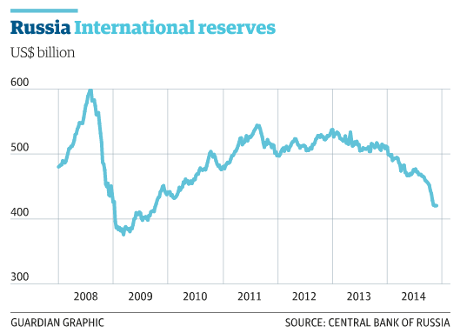
According to Reuters, the Russian finance ministry has around $7bn of spare FX reserves in its ‘leftover stocks’, which are now being used to support the rouble.
Maxim Oreshkin, who runs the ministry’s long-term strategic planning department, says the “market situation” will determine how much is deployed.
Russia Minfin To Sell Fx For As Long As Needed. IFX Better get printing press out then....
— Steve Collins (@TradeDesk_Steve) December 17, 2014
$7bn isn’t enough firepower, on its own, to hold back the tide.
But this is only a small part of Moscow’s overall reserves, which are thought to exceed $420bn.
In early trading the rouble has been up and down like a yo-yo. Russia's Finance Ministry selling foreign currency on the market.
— Steve Rosenberg (@BBCSteveR) December 17, 2014
Wow! RT @CNBCWorld Ruble now back at 65.7550 against dollar after Russia starts selling foreign currency. http://t.co/ugT64Gc7Mr $RUB
— Shaun Richards (@notayesmansecon) December 17, 2014
Bloomberg breaking news: Russia Finance Ministry Starts Selling Foreign-Exchange Reserves on Market
— Opera Capital Mgmt (@Operacm) December 17, 2014
Russian finance minister: We're selling foreign currency reserves
Newsflash from Russia: The finance ministry has announced that it is starting to sell foreign exchanges reserves, and that the rouble is “highly undervalued”.
That means it will be swapping currencies such as the dollar in return for roubles.
And that’s giving the rouble a lift. It has now ‘recovered’ to around 64.6 to the $1, a gain of around 5% today.
- REUTERS: RUSSIAN ROUBLE STRENGTHENING SHARPLY AFTER MINFIN SAYS STARTS SELLING FX
Looks like Russia are selling their USD reserves in order to boost the value of the Rouble. The Rouble is 5% stronger this morning.
— Guy Harding (@GuyHardingSky) December 17, 2014
More Russian intervention-- Interfax: Russ Finance Ministry says started selling foreign currency stock, say #Rouble is highly undervalued
— Louisa Bojesen (@louisabojesen) December 17, 2014
European stock markets have (as forecast) fallen in early trading, reversing yesterday’s gains.
The FTSE 100 dropped 90 points at the open, before settling down 64 points at 6288, a drop of around 1%. The German DAX, French CAC and Italian MIB all fell around 1.3%.
Mike van Dulken, head of research at Accendo Markets, says traders are worrying about the market turmoil in Russia, the weak oil price, tonight’s meeting of the Federal Reserve, and the looming Greek election.
Updated
The slump in the rouble has sent Russians racing to stock up on imported goods, before retailers catch up and hike prices.
tonight in Moscow shops - people convert roubles into goods. Pics from bloggers. pic.twitter.com/BGJyGBtawf
— Gennady Simanovsky (@GennadySimanovs) December 17, 2014
And Apple has suspended sales from its Web store, after watching the rouble fall almost 20% at one stage yesterday.
“Our online store in Russia is currently unavailable while we review pricing,” Alan Hely, a spokesman for the Cupertino, California-based company, wrote in an e-mail today. “We apologize to customers for any inconvenience.”
Rouble dives then recovers in early trading
The rouble is volatile this morning, after yesterday’s tumultuous swings.
Russia’s currency fell by around 5% when trading began at 7am GMT, hitting 72.5 roubles to the US dollar.
But in very choppy trade, it has now dipped back to around 67 against the $1.
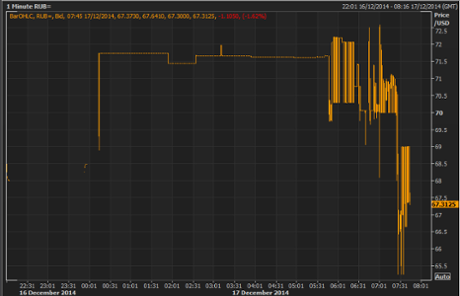
That’s a very slight recovery, and it still leaves the rouble perilously weak.
It’s likely to be another volatile day....
And so the #rouble rollercoaster continues -down 3.5% at opening -I'm beginning to feel a little sick on this ride! Never liked theme parks!
— Katie Pilbeam (@KatiePilbeamRT) December 17, 2014
Updated
Russia is the main story on the financial TV this morning too:
'We don't need a war when we can have a currency war'- guest @sjderrick, Chief Currency Strategist, BNY Mellon #Russia #Rouble @CNBC
— Louisa Bojesen (@louisabojesen) December 17, 2014
And in research notes from the likes of High Frequency Economics (HFE):
HFE on #Ruble collapse: Currency collapse does not happen in isolation, but is always accompanied by financial and economic collapse #Russia
— Holger Zschaepitz (@Schuldensuehner) December 17, 2014
European stock markets are expected to drop this morning, as the Russian crisis and tonight’s Greek presidential vote worry traders.
Jasper Lawler, analyst at CMC Markets, explains:
Having avoided contagion from oil and emerging markets in the previous session, things now appear to be catching up to European markets that look weak heading towards the open on Wednesday before data that could confirm the Eurozone fell into deflation during November.
Multiple major money-centre banks appear to no longer be pricing USD/RUB because of the crashing ruble, cutting Russian companies and individuals off from global financing. As a major trading partner, Russia’s funding problems are expected to start hitting home in Europe.
Equity market calls
- FTSE 100 is expected to open 68 points lower at 6,263
- DAX is expected to open 121 points lower at 9,442
- CAC 40 is expected to open 68 points lower at 4,025
The agenda: UK unemployment, Bank minutes, Fed meeting
Good morning, and welcome to our rolling coverage of the financial market, the world economy, the eurozone and business.
There’s no let-up from the news today. We’ll be tracking:
Russia’s currency crisis, as the tumbling rouble threatens to trigger a major financial crisis.
The latest UK unemployment figures, due at 9.30am GMT. They could show another fall in the jobless rate, from 6% to 5.9%. The data could also show wages picking up, in a pre-election boost for the government.
The minutes of the Bank of England’s monetary policy committee meeting, two weeks ago, also at 9.30am GMT.
Then at 10am, we should get confirmation that the eurozone’s inflation rate was a meagre 0.3% in November.
Greek politics: MPs hold their first vote to elect (or reject) the government’s candidate for president tonight, from 5pm (although the vote may be later).
The Athens parliament is expected to reject Stavros Dimas – so we’ll be looking to see how many votes the government gets. The third and final vote is on the 29th...
The financial markets, which are being spooked by events in Moscow and Athens.
Traders are also nervous ahead of the US Federal Reserve’s monthly meeting tonight, from 7pm GMT . The Fed may change its forward guidance, and drop the pledge to keep interest rates near zero for a “considerable time”.
I’ll be tracking all the main events through the day.....
Updated