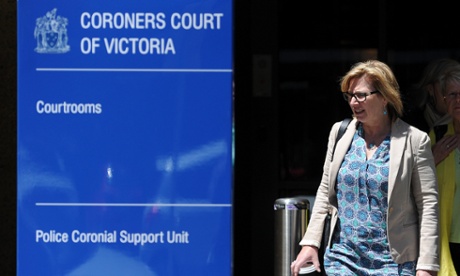
In the months before Rosie Batty’s ex-partner killed their 11-year-old son Luke, she phoned a child protection officer and said she felt fearful for her safety and “completely overwhelmed”, the coronial inquest into Luke’s death has heard.
Batty made the call to Tracie Portelli, an advanced child protection practitioner, after coming out of court last September where Luke’s father, Greg Anderson, had disputed an intervention order.
Portelli’s notes from that conversation were read out to coroner Ian Gray in court on Thursday.
“Mother was crying on telephone,” they read. “Mother is fearful of her safety, feeling completely overwhelmed. Mother was not supported when she attended to court. Mother feels there is no end to all this.”
The notes also said Batty told the magistrate that she felt like throwing herself under a bus.
Batty asked Portelli during the phone call when child protection would be issuing a protective order, which would require the department to monitor and support her and Luke more closely. But Portelli told Batty her situation did not warrant such an order.
“Child protection would take out an intervention application only when there is no protective parent, or if that parent is not in a position to ensure the ongoing safety of that child,” Portelli told the inquest.
“[Batty] was acting protectively, had professional supports such as art therapy and counselling [for Luke] in place, and an active intervention order in place.”
Portelli told the inquest she did not believe during her phone conversation with Batty that Luke was at risk of harm, and that Batty’s frustration was to do with the high cost of the legal system and the fact that she was not eligible for legal aid while Anderson was.
“Anderson would request that there was a variation to the [intervention] order, then wouldn’t turn up to court,” Portelli said. “And every time it went to court, she [Batty] was having to pay for it.”
But Batty had not directly told her during that call that she felt incapable of protecting and supporting Luke, Portelli said. Portelli closed Luke’s case in October last year.
Batty’s legal counsel, Rachel Doyle, challenged Portelli’s conclusion that overall, Batty was fine.
“Your case notes would seem to be at odds with her being fine,” Doyle said. “Surely the substance of that phone call was a call for help?”
Portelli responded she did not believe her notes provided a fair representation of the phone call, because they were not verbatim and only recorded Batty’s side of the conversation.
“The overall impression that these case notes give is of a woman who was asking you for help,” Doyle said.
“I disagree,” Portelli responded.
During her evidence, Portelli said in hindsight it may have been useful, during her investigation of Luke’s case, to call a meeting of all the professionals, including police, involved with the Batty family to get a stronger understanding of the overall situation.
“While doing so is best practice, it’s not standard practice,” Portelli said.
Anderson killed Luke in February on a cricket field in Tyabb, Victoria, with a cricket bat and a knife. There were four warrants out for his arrest at the time and he was facing 11 criminal charges, mostly related to family violence.
During her evidence, Batty’s psychologist, Dr Janet Heath, said Batty had previously told her she felt “very much at risk”.
“At the time she was going through the legal process and wasn’t feeling supported by the courts,” Heath said. “She rang me one day from the courts very distressed because she felt so unsupported.”
The inquest had previously heard Anderson was frequently granted bail, and often did not show up to court hearings.
The inquest continues.