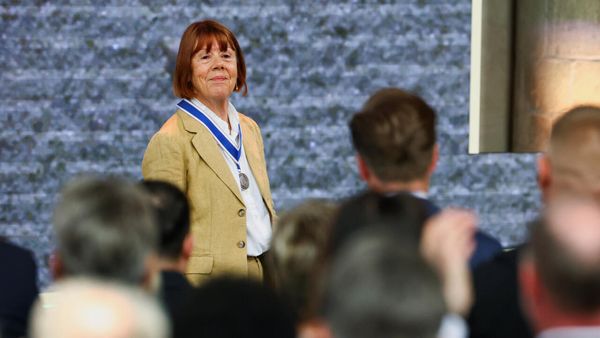
Australian of the year Rosie Batty wants a royal commission into the family courts’ treatment of survivors of domestic violence, labelling the institution her “biggest area of concern”.
Batty spoke via telephone link to senators during an inquiry into domestic violence on Thursday. She was named Australian of the year for 2015 after shining a spotlight on family violence following the horrific murder of her son Luke at the hands of his father.
Batty advocated for specialised training in the family law court system, saying the institution is her “biggest area of concern”.
“I’ve never known anyone, put it that way, to speak out positively about the family law courts,” she told the inquiry, saying initiating a royal commission would “be a very strategic decision”.
Of particular concern is the inability for media to report on family law court cases, even when victims or survivors give permission.
“It’s an area that’s beyond investigation, beyond reproach,” Batty said.
She spoke of survivors being treated badly and the need for specialised training within the family law court system.
“There is a total disregard or a total ignorance of family violence being an issue,” she said. “You’re viewed in court as likely to be lying to manipulate the system.”
She said there is a view with the court system that women victims particularly “coach” their children into “greater fear and anxiety”.
Batty welcomed the push to track high-risk offenders with GPS tracking devices, similar to how some states and territories currently monitor sexual offenders, but said it needed to be part of a broader strategy.
“It wouldn’t work in isolation, obviously other factors are needed,” she said. “We really need to be looking at, how do we change the behaviour of the perpetrators?”
Cate McKenzie from the Department of Social Services said all states and territories were keen to look at how to harness new technology like tracking devices to stop recidivism. “This is a very live issue,” she said.
The Council of Australian Governments (Coag) will consider a proposal to put GPS ankle bracelets on high-risk offenders of domestic violence.
Premiers and chief ministers agreed in April to implement a national domestic violence order scheme, to come into force within 12 months.
The federal Attorney General’s Department told Thursday’s Senate inquiry that a few issues with the scheme, such as how to retroactively change existing state-based laws and how to notify jurisdictions of victims’ and perpetrators’ movements, were still being ironed out.
But representative Michael Pahlow said the department was “well and truly down the track” of creating the national scheme.