The Soyuz TMA-14M spacecraft, above, approaches the International Space Station, carrying Expedition 41 Soyuz commander Alexander Samokutyaev, Nasa flight engineer Barry Wilmore and Russian flight engineer Elena Serova.
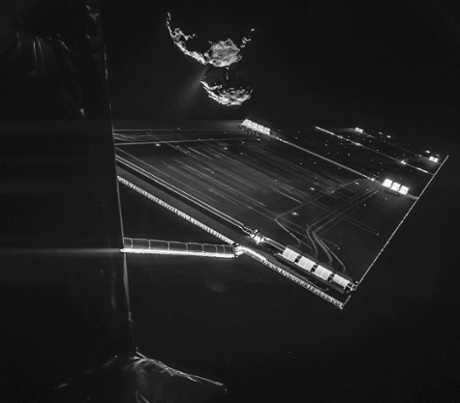
In November, a 10-year-journey through space – the Rosetta mission – will culminate in landing a craft called Philae on a comet – 67P/Churyumov-Gerasimenko (67P/C-G) – to study it and also possibly unlock the secrets of the universe. Above, is a selfie taken from about 10 miles from the comet’s surface by the landing craft. It shows one of its 14-metre-long solar arrays, with the comet in the background. Gas and dust jets extending from the comet’s ‘neck’ region are clearly visible. The primary landing site, currently known as site J, can also be seen on the smaller lobe of the comet.
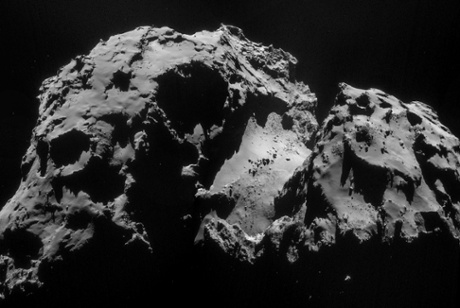
A closeup mosaic of the comet shows large boulders, several metres across, lying in the smooth ‘neck’ region. Boulders are also seen at the base of exposed cliff faces, towards the top left in this image, and on the ‘head’ of the comet. A crater-like depression is located on the larger lobe (or the ‘body’), to the far-left centre of the image. Scientists have announced the landing site for Rosetta mission, but the topography of the comet makes success far from guaranteed.
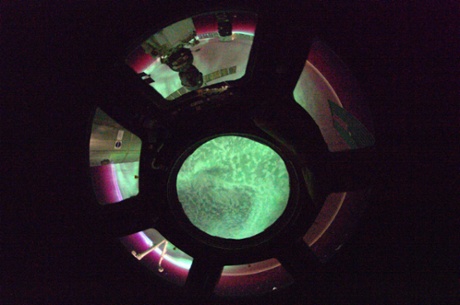
Northern lights, Aurora Borealis, as seen from the ISS. The northern lights are caused by collisions between fast-moving particles, electrons, from space and the oxygen and nitrogen gas in our atmosphere. These electrons originate in the magnetosphere, the region of space controlled by Earth’s magnetic field. As they rain into the atmosphere, the electrons impart energy to oxygen and nitrogen molecules, making them excited. When the molecules return to their normal state, they release photons, small bursts of energy in the form of light.
![This image was obtained with the wide-field view of the Mosaic camera on the KPNO 0.9m-meter telescope at Kitt Peak National Observatory. NGC 7000, also known as the North America Nebula, is a giant emission nebula in the constellation of Cygnus. This image shows only the southern tip of the nebula (the Mexico part of the nebula). The nebula is being energized by the light from stars embedded within. The image was generated with observations in Hydrogen alpha (red), Oxygen [OIII] (green) and Sulfur [SII] (blue) filters. In this image, North is up, East is to the left.](http://static.guim.co.uk/sys-images/Guardian/Pix/pictures/2014/10/29/1414592784344/0d67766b-662d-4ba6-9b4f-29de831cafb4-460x422.jpeg)
This is the North America Nebula (NGC 7,000), a giant emission nebula in the constellation of Cygnus. The image, taken by the Mosaic camera fitted on the telescope at Kitt Peak National Observatory, shows only the southern tip (the Mexico part of the nebula). The nebula is lit and energised by stars within it. An image of the eastern part of the nebula is also available here.
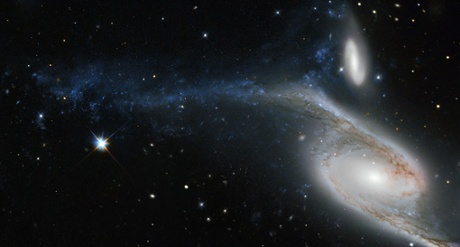
This is the second largest spiral galaxy discovered by Hubble Space Telescope, measuring over 500,000 light-years across from tip to tip. It’s known as NGC 6872 and sits in the costellation of Pavo (the Peacock). Its unusual shape is caused by its interactions with the smaller galaxy seen above it, called IC 4970. They both lie roughly 300 million light-years away from Earth. In size it is beaten only by NGC 262, a galaxy that measures a mind-boggling 1.3 million light-years in diameter. The Milky Way, measures between 100,000 and 120,000 light-years across. The upper left spiral arm of NGC 6872 is distorted and populated by star-forming regions, appearing blue on this image. This may have been be caused by IC 4970 recently passing through this arm although here, recent means 130 million years ago!
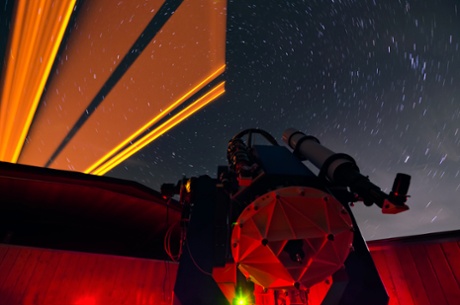
This seemingly disco-lit rooftop keeps an eye on the Northern Celestial Pole from the Allgäu Public Observatory in Ottobeuren, Germany. Seen here is the facility’s 0.6-metre Cassegrain reflector telescope, which was installed in 1996. The yellow laser beam, fanning out, is ESO’s Wendelstein laser guide star unit, used to create a bright spot in the sky as an artificial reference star, allowing astronomers to measure how the real stars blur or twinkle. The measurements are then used to correct blurring and enable sharper images to be taken – the process is known as adaptive optics.
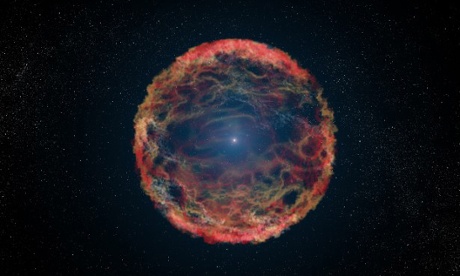
An artist’s impression of supernova 1993J, which exploded in the galaxy M81. Using the Hubble Space Telescope, astronomers have identified the blue helium-burning companion star, seen at the centre of the expanding nebula of debris from the supernova. The discovery confirms a long-held theory that the supernova occurred inside what is called a binary system, where two interacting stars caused a cosmic explosion.
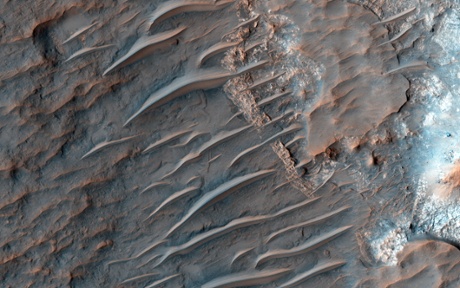
The tropics of Mars are littered with small bright ripples shaped by the wind. Called ‘transverse aeolian ridges’, or Tars, they are six meters tall and spaced a few meters apart and often found in channels and craters. Their internal structure remains a msytery, making it difficult to know how they were formed. Sarah Mattson of the University of Arizona discovered these rare banded Tars in Iapygia, south of Syrtis Major. They resemble Tars elsewhere on Mars, except that they show bands or layers on the northwest side but fewer or none on the southeast. One possible interpretation is that these Tars are made up of wedge-shaped layers. If correct, it implies that the ripples grew vertically over time, as material accreted at the crests of the ridges. It also suggests that the banded slopes faced upwind.
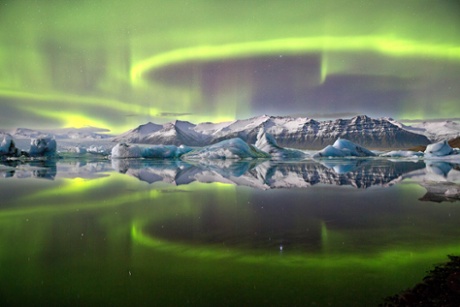
A vivid aurora over Iceland’s Vatnajökull national park bathes the glacier lagoon in a ring of green glow. This image by British photographer James Woodend, captures stunning, mirror image effect, brought on by the utter stillness of water in absence of wind and current. It won the Astronomy Photographer of the Year 2014 award.
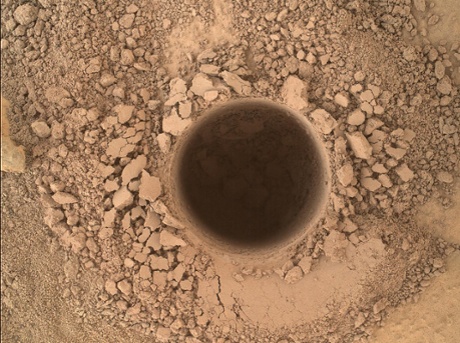
Nasa’s Curiosity Mars rover has collected its first sample of Mount Sharp. It drilled 2.6 inches deep into a basal-layer outcrop on the layered mountain and collected a powdered-rock sample. Data and images confirmed success of this operation. The powder collected by the drilling is temporarily held within the sample-handling mechanism on the rover’s arm. The rock is softer than any of the previous three targets where Curiosity has collected a drilled sample for analysis.
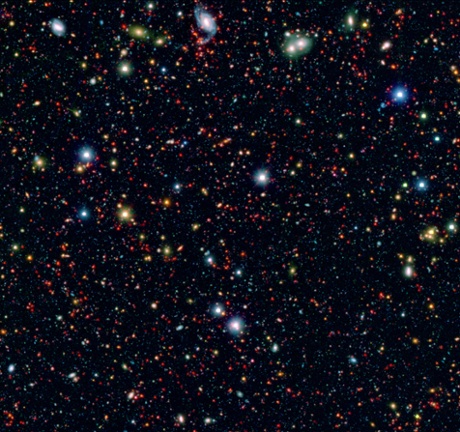
Millions of galaxies fill the patch of sky known as the Cosmos field, short for Cosmic Evolution Survey, a portion of which is shown here. Even the smallest dots in this image are galaxies, some up to 12 billion light-years away. The square region in the centre of bright objects is where the telescope was blinded by bright light. However, even these brightest objects in the field are more than 10,000 times fainter than what you can see with the naked eye. The picture was composed using a combination of infrared and visible-light data from Japan’s Subaru telescope atop Mauna Kea in Hawaii.
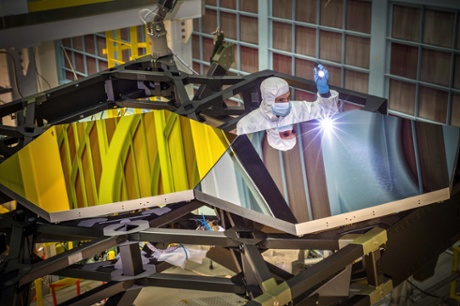
Inside Nasa’s Goddard Space Flight Centre’s giant clean room in Greenbelt, Maryland, US, optical engineer Larkin Carey from Ball Aerospace examines two test mirror segments recently placed on a black composite structure called the James Webb Space Telescope’s ‘Pathfinder’. It acts as a spine supporting the telescope’s primary mirror segments. The Pathfinder is a non-flight prototype. The JWST is the successor to the Hubble Space Telescope. It will be the most powerful space telescope ever built. Webb is an international project led by Nasa with its partners, the European Space Agency and the Canadian Space Agency.
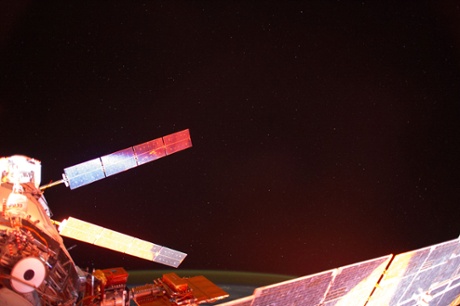
This is one of a number of images featuring the European Space Agency’s Automated Transfer Vehicle (ATV-5 or Georges Lemaître) docked with the International Space Station.
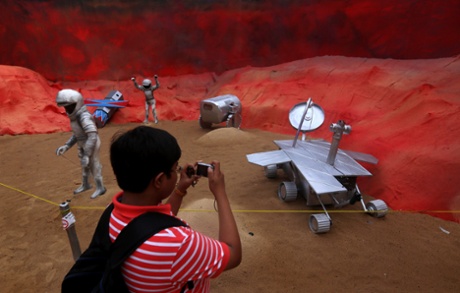
A boy takes picture of a pandal art installation entitled ‘Mars Mission’ with a replica of the Mars Pathfinder and astronauts figures during the Durga Puja festival in Calcutta, India. The Indian Space Research Organisation (Isro) successfully sent an orbiter spacecraft to Mars in September. India’s Mars success was hailed as a major scientific acheivement for the country, making it the first in Asia to do so, and putting it ahead of China.
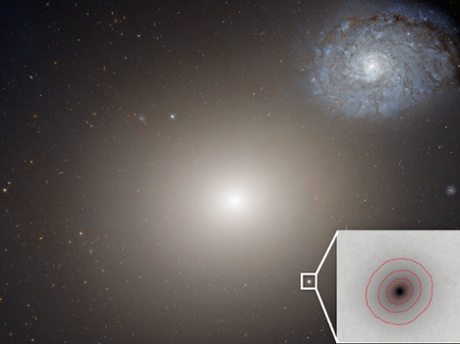
This Hubble Space Telescope image shows the gargantuan galaxy M60 in the centre, and the ultracompact dwarf galaxy M60-UCD1 below it and to the right, and also enlarged as an inset. A new international study led by University of Utah astronomer Anil Seth and published in the journal Nature found that M60-UCD1 is the smallest known galaxy with a supermassive black hole at its centre, suggesting the dwarf galaxy originally was much larger but was stripped of its outer layers by gravity from galaxy M60 over billions of years. M60’s gravity is also pulling galaxy NGC4647, upper right, and the two eventually will collide.
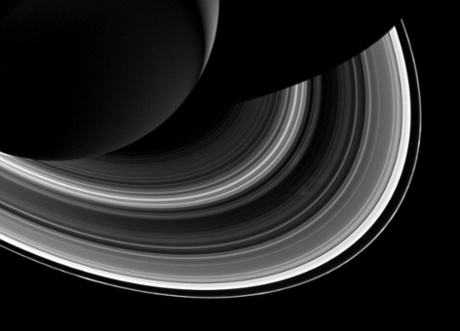
Mimas, one of Saturn’s moon, appears in the lower-right corner of the image. It orbits Saturn as a set of the ever-intriguing spokes appear in the B ring (just to the right of centre). Spokes are ghostly features that stretch across B ring, and usually have a long, finger-like or wedge-shaped appearance. They form in minutes and last an hour or two before disappearing again. Scientists expect that spokes will soon cease to form as Saturn approaches northern equinox. The exact mechanism of spoke formation is still the subject of debate, but ring scientists do know that spokes no longer appear when the sun is higher in Saturn’s sky. It is believed that this has to do with the ability of micron-sized ring grains to maintain an electrical charge and levitate above the rings, forming spokes. Thus, these may be some of the last spokes ever seen by Cassini.
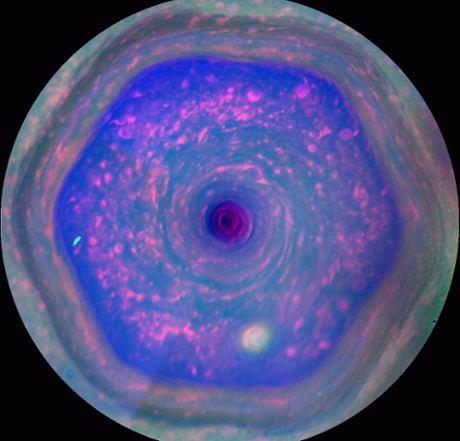
Saturn is mostly a gigantic ball of rotating gas. But it has one thing in common with Earth: weather. It’s among the most bizarre in our solar system, such as the swirling storm shown in this Cassini view. Known as ‘the hexagon’, this features an intense, six-sided jet stream at Saturn’s north pole. Spanning some 18,640 miles across, it hosts howling 199miles/h winds that spiral around a massive storm rotating anticlockwise at the heart of the region. Numerous small vortices rotate in the opposite direction to the central storm and are dragged around with the jet stream, creating a terrifically turbulent region. While a hurricane on Earth may last a week or more, the hexagon has been raging for decades, and shows no signs of letting up.
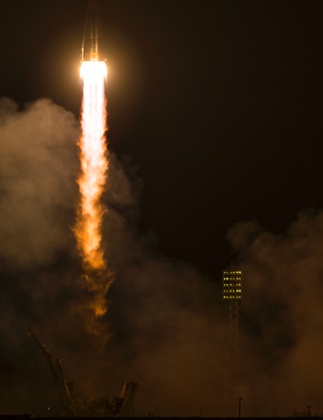
The Soyuz TMA-14M rocket is launched on 26 September at the Baikonur Cosmodrome in Kazakhstan. It’s three-member crew will spend the next five and a half months aboard the International Space Station.
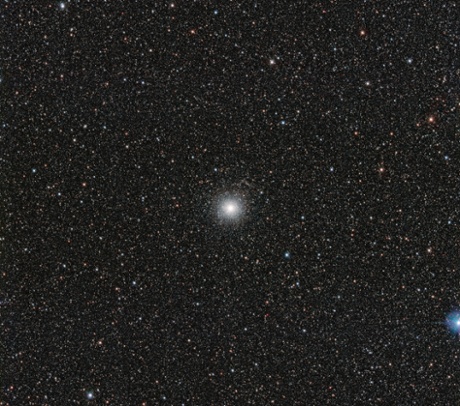
This image from the Very Large Telescope (VLT) survey at ESO’s Paranal Observatory in northern Chile shows the globular cluster Messier 54. This cluster looks very similar to many others, but it doesn t belong to the Milky Way, and is part of a small satellite galaxy, the Sagittarius Dwarf Galaxy. This unusual parentage has allowed astronomers to use the VLT to test whether unexpectedly low levels of the element lithium in stars are also found in stars outside the Milky Way. Astronomers can calculate accurately how much lithium they expect to find in the early universe, and from this work out how much they should see in old stars. But the numbers don’t match — there is about three times less lithium in stars than expected. This mystery remains, despite several decades of work.