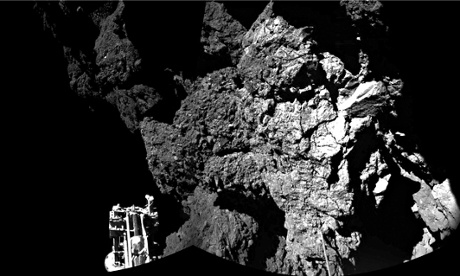
That’s it for today. The Philae mission looks almost certain to be coming to an end. Tomorrow we will know one way or the other whether it has survived the night.
It has been an extraordinary rollercoaster. Amid all the anxiety about the lander’s limited lifetime, behind the scenes, the science teams have been working. We are promised many fascinating results but the analysis will take time.
Even if the “hop” does not succeed and Philae ends tonight, there is no way that it can be seen as anything other than a success. History has been made. Science has been advanced. And we have taken a step closer towards understanding our cosmic origins.
The extraordinary amount of interest in this blog has shown that an overwhelming number of you think the same. Let us always remember the day that Philae landed.
I thank you all.
Stuart
Stuart has published his final news story of the day about the lander’s plight:
Scientists controlling the Philae lander on Comet 67P/Churyumov–Gerasimenko are preparing to make a last ditch attempt to “hop” the robotic probe into a sunnier spot on the comet’s surface.
If they fail, the lander will go into hibernation. Without sufficient sunlight on its solar panels, its mission will be over.
The lander’s legs have a built-in spring action that can be commanded to fire. These commands will be uploaded tonight during an expected communications window that opens at around 21:00 GMT. There is no guarantee of success.
Read the rest of his story here.
Updated
Scientists will order dying lander to 'hop'
Rosetta scientists will order the dying Philae lander to “hop”. The order will be sent to Philae’s legs this evening in a bid to bounce the comet lander into a sunnier position to recharge its batteries. Read the full report here.
Updated
The MUPUS scientists seem very happy.
We have got a lot of data from all our thermal sensors in PEN, TEM and ANC-T. It is amazingly cold up there.
— MUPUS on Philae (@Philae_MUPUS) November 14, 2014
Philae’s exact location remains unknown. And here’s another space-age mystery …
#CometLanding I love Rosetta and Philae's tweets! But they left earth 2 years before Twitter was invented. Signed up on a mobile device?
— Michael Cox (@mikecalcox) November 14, 2014
Summary
- Simulations suggest battery power will last long enough for tonight’s data transmission from Philae between 21:00 and 23:00 GMT.
- Esa is considering whether to spin Philae’s flywheel (designed to keep the craft upright during flight) to ‘bounce’ the lander into a new position where its solar arrays will get more sunlight to recharge its batteries.
- 80-90% of the intended science will have been carried out, but there’s some doubt over whether all the data will be uploaded before the lander loses all power.
- All the lander’s instruments are working well. MUPUS and APXS instruments were used last night and the drill was activated. Esa will know this evening whether drill samples have been taken successfully. There will be more CONSERT radar data tonight, which will be used to try to locate Philae.
- As the comet reaches its closest approach to the sun next year, there may be enough power from Philae’s solar panels to wake up the lander.
- 84 images of the comet are being awaited from Rosetta, which will be used to try to locate the lander. There will also be descent and touchdown images relayed from Philae to Rosetta.
- A manoeuvre command has been sent to Rosetta to keep the Philae landing area in sight over the coming days.
Updated
Apologies to Valentina Lommatsch, DLR. I consistently missed the last few letters from her name during the hangout.
Watch a replay of the ESA hangout.
Updated
The briefing has ended. The wait begins for tonight’s communications attempt. Signals should be released received sometime between 21:00-23:00 GMT if Philae is still alive.
Updated
Taylor: congratulates the ESA comms team.
“Hear, hear,” I say.
Updated
Ulamec: The message for Philae is to keep your fingers crossed. Let’s hope we get news from “hell” to use Holger’s term.
Updated
Accomazzo: I want Philae to be live tonight.
Taylor: We are on the cusp of the big science results. They are coming.
Sireks: The CIVA image of the comet’s leg on the surface of the comet is “the image of my life”.
Updated
Sierks: Next August the comet will be “active as hell”. This is because the sun’s heat will vaporise the comet’s ices.
Updated
Sierks: We will continue to search for the lander and watch for activity on the comet.
Lommats: cross your fingers, or your thumbs if you’re German, that the lander may come back during closest approach.
Updated
Lommats: Lander operations are extremely happy. Every instrument has had the chance to collect data.
Gaudon: It is the role of the scientists to announce the results now.
Gaudon: We are very satisfied with all the Philae instruments. There will be good science.
Ulamec: nuclear batteries not possible because of safety and political reasons. Europe has not developed such batteries.
Ulamec: We will know that the battery is flat when Philae fails to make scheduled contact.
Taylor: 8km comet flybys are planned.
Accomazzo: Rosetta will orbit the comet at 20km in December.
Accomazzo: Not possible to angle Rosetta so that sunlight bounces off its huge solar panels to fall on Philae and charge its batteries.
Accomazzo: Not possible to place Rosetta in a “synchronous” orbit to “hover” above the Philae landing site.
Updated
Gordon Johnston: Nasa is “shadowing” what Esa is doing with Rosetta to apply to its own missions.
Updated
Gaudon: Instruments were designed 15 years ago.
Updated
Gaudon: Philae is a very big success. Each of the instruments is working well. Very proud of the science from the lander.
Lommats: At closest approach to the sun, we may get enough power on the panels to wake up Philae. But this is not certain: “it looks a bit bad, but we can hope.”
Updated
Lommats: Lander needs 5.1 watts to boot up. The secondary batteries have about 3 watts. So, doesn’t look good.
Updated
Accomazzo: It is a strange feeling when you get contact with Philae. It is live streaming from the comet.
Taylor: We move on now. Now we have the lander down, we can do the science [with the Rosetta orbiter].
Ulamec: The landing gear was successfully designed to damp the majority of the kinetic energy, otherwise the bounce would have been much higher.
Sierks: Thinks that the final resting spot should be called Agilkia.
Sierks: the truth is the comet is not very colourful. Some areas have been colour-mapped.
Ulamec: Science return is 80-90% what was hoped for.
Ulamec: COSAC requires less energy than the PTOLEMY instrument. Hence it gets first chance at samples from the drill.
Updated
Ulamec: the principal concept for Philae has been valid.
Ulamec for Philae: A larger battery.
If you could launch Rosetta again, what would you upgrade?
Accomazzo: I would like to fly the same spacecraft.
Ulamec: The harpoons are not likely to fire accidentally.
Gaudon: Hopes that all science data can be retrieved before loss of battery power.
Ulamec: The flywheel could be spun up to try to kick Philae “out of the hole”.
Lommats: Not sure yet whether the drill has penetrated the ground or not.
Lommats: Philae is surrounded by rocks.
Lommats: confirms that they are thinking about trying to bounce the lander.
Valentina Lommats, DLR: battery simulations make tonight’s communications slot possible. But really close.
Ulamec: It they got contact later, they plan to rotate the body of the lander to try to get a bit more illumination onto the solar panels.
Ulamec: battery may be gone before this evening’s contact.
Taylor: “Stay tuned. It’s beyond words.” Lots of results to come.
Taylor: We are on the cutting edge of science. We’ve already got fantastic data.
Rosetta Project scientist Matt Taylor emotionally appologising for #shirtgate
Nasa representatives talking now. Seem to be using the opportunity as an advert for their planned OSIRIS-REx mission.
Updated
Sierks says his inclination is that Philae bounced in the opposite direction to that inferred by CONSERT.
Sierks: The final resting point, as inferred from CONSERT data, is not in the pre-programmed OSIRIS commands. New commands must be uploaded to search there
Sierks: OSIRIS should have seen the initial landing, and the bounces.
Sierks: Expecting 84 images to downlink. Will continue searching for Philae. It will appear in the images as a 3x3 or 4x4 pixel block.
Holger Sierks, OSIRIS Principle Investigator: No more news from the camera. Still awaiting descent images and touchdown images to be downlinked. [Presumably they must be stored on Rosetta]
Updated
Gaudon: Drill has gone down 25cm from the baseplate of Philae.
Phillipe Gaudon, CNES, says that data from APX and MUPIS is looking good. Science data still arriving.
Accomazzo: link to Philae is very stable once it is established.
Andrea Accomazzo, Rosetta flight director, says that a manoeuvre has been sent to Rosetta to keep the Philae landing area in sight over the coming days.
Ulamec confirms that the drill has been activated. We will know this evening if the drill samples have been placed into the experiments.
Stephan Ulamec, lander manager, speaking now. MUPUS and APX instrument used last night. More data from radar received to try to locate Philae.
ESA Hangout beginning right now.
Philae drills into the comet
It seems that the Philae drill has reached 200 millimetres into the comet.
Everything nominal so far. Current position 200 mm. We are reaching the comet soil. Link lost now, next window tonight at 22.00. Stay tuned.
— Rosetta SD2 (@RosettaSD2) November 14, 2014
Updated
Eric Hand has written a piece for Science this morning. He has this to say about efforts to locate the lander:
On Thursday, Holger Sierks, the principal investigator for the Rosetta orbiter’s main science camera, had hoped to find the lander in an image about 1 kilometer away from the target site (before coming to a rest, Philae bounced in a big way). But as of Friday morning, Ferri [Paolo Ferri, the head of mission operations at ESA’s command center in Darmstadt, Germany] did not think that that effort had been fruitful. Part of the problem is that Rosetta has retreated to a 50-kilometers orbit – much too far to spot the lander in current passes overhead. Sierks says Philae would just be a 1 pixel dot at that distance. So instead he is combing pictures taken just after the landing, when the lander would be more of a 3x3 pixel smudge. Better results have been coming from the CONSERT instruments, says Ferri. These instruments, one on the orbiter and one on the lander, exchange radio signals to make a tomograph of the comet’s interior (when the comet lies between the lander and the orbiter). But the instruments can also be used like a radar, when the orbiter is directly over the lander. Ferri says scientists already have collected one sounding, which traces out a circle of probable location. Two more soundings would pinpoint the lander.
Nasa will be represented at the hangout, scheduled for 13:00 GMT.
We're joining @ESA this morning for the #ESAHangout on #CometLanding results at 8am ET: http://t.co/XCx2VLOBVN pic.twitter.com/BsQHLKja7d
— NASA (@NASA) November 14, 2014
A concise summary of the landing – and those two slow-motion bunny hops – has been published on Esa’s blog. It concludes with this sobering assessment:
The primary battery enabling the core science goals of the lander may run out some time in the next 24 hours. As for the secondary battery, charged by solar panels on Philae, with only 1.5 hours of sunlight available to the lander each day, there is an impact on the energy budget to conduct science for a longer period of time. The original landing site offered nearly seven hours of illumination per 12.4 hour comet day.
Esa is staging a live hangout at 13:00 GMT when the Rosetta and Philae teams will provide an update on the mission.
If anyone tells you the Rosetta mission is a waste of money that could have been spent on something else, show them this from @scienceogram
How much does it cost to land on a comet? (now with minor update!) http://t.co/t4Hqbxiuk2 @ESA_Rosetta #CometLanding pic.twitter.com/11p4PJkXtv
— Scienceogram (@scienceogram) November 12, 2014
Updated
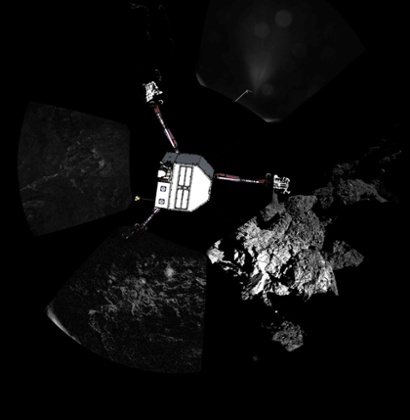
If you were slightly mystified by the image (above) released yesterday of the panoramic views around Philae, here’s a video from Esa illustrating how the instrument that took the pictures works.
The video does tend to bring home disappointment at the lander’s current predicament, seeing this shiny Philae in an upright position, anchored on smooth, level open ground.
Updated
MUPUS is a suite of instruments designed to investigate the nature of the surface where Philae has come to rest. The penetrator was scheduled to be deployed last night. It will measure the temperature of the subsurface and the strength of the material that Philae is resting on.
The penetrator is on the end of an arm that can extend up to 1.2 metres away from Philae. It hammers the instrument into the ground. The recoil from each hammering could move Philae. Yesterday Philae scientist Jean-Pierre Bibring told me that any movement that did occur was likely to be favourable.
If the mission is to last longer than the weekend, Philae must move further into the light. It is currently sitting in the shadow of a cliff wall, or large boulder.
Updated
In the UK, the Royal Mail is celebrating the historic landing with a special postmark.
Thank you @RoyalMail we love your @ESA_Rosetta @Philae2014 #cometlanding postmark today! http://t.co/4C6DK6mLe6 pic.twitter.com/luFNoeW6ov
— ESA (@esa) November 14, 2014
Updated
The APXS (Alpha Proton X-ray Spectrometer) instrument determines the chemical composition of the Philae landing site. These have become standard instruments on recent Mars rovers.
Philae’s APXS fires alpha particles (each one the nucleus of a helium atom) at the surface of the comet and catches what bounces back, including X-rays. Different chemicals react in different ways and so the composition can be determined.
The recoil from the alpha particles is not enough to move Philae.
Updated
Last night MUPUS hammered the penetrator into the ground. APXS also got to work! My team is currently checking how they did #CometLanding
— Philae Lander (@Philae2014) November 14, 2014
Philae reports home
Just confirmed: Philae is talking to Earth (through Rosetta). Telemetry data downlinking first, then science data. Telemetry tells the engineers the condition of Philae. From that we will know if Philae has shifted position.
Updated
It appears that contact has been re-established.
Good morning @Philae2014 nice to talk to you again #CometLanding
— MUPUS on Philae (@Philae_MUPUS) November 14, 2014
Updated
Day three begins
Good morning and welcome to day three of the Philae lander on comet Churyumov-Gerasimenko. Overnight mission operations have continued. A communications window to the lander is open now, and we await confirmation that contact has been re-established.
Today may be the day that we have to face up to the fact that Philae has a limited lifetime, perhaps less than 24 hours left of power in its primary battery.
Mission operators will have to decide whether to try deploying mechanical instruments on the lander in an attempt to move it into sunlight.
Updated




.jpg?w=600)