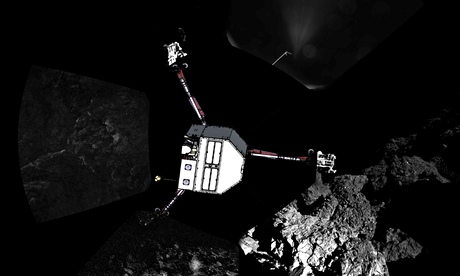
The earthbound examples of human endeavour in your editorial (A triumph for human imagination and ingenuity, 13 November) did not mention the programme of manned moon landings, which took place more than 40 years ago. With hindsight, this was perhaps the last hurrah for the idea that the conquest of space was simply an extension of terrestrial exploration. Space is too big, the distances too far, the journey times too long and the costs of maintaining a human-friendly habitat too vast for the human exploration of space. What the Rosetta mission has so successfully done is to put the final nail in the coffin of the idea that only human explorers can offer a feasible solution to the problem of making future extraterrestrial discoveries.
Ray Perham
Ilford, Essex
• We have landers on Mars and now on a comet, all adverts for the amazing power of science and technology. Yet some of us in the scientific community are disappointed that these landers are not actually looking for life. The world’s space agencies have become fixated on searching for the “building blocks of life”. What the public (ie taxpayers) really wants to now is – does life itself exist in space? Like Nasa, the European Space Agency has presented us with an amazing achievement and at the same time an incredible missed opportunity.
Milton Wainwright
Professor of astrobiology, Sheffield University
• Your editorial salutes the human imagination and ingenuity of the Rosetta mission scientists, which is undoubtedly a great achievement. The vocabulary you use, however, startled me. Was the landing of a bit of high tech on a rock on a “heroic scale”? Can that bit of high tech be heroic? It isn’t human, like Magellan or Edmund Hilary. Do the scientists have “courage” in “thinking the unthinkable”, or perhaps delusional fantasy? The commander of the International Space Station tweeted that the lander was “poised to rewrite what we know about ourselves” (Report, 13 November). Will it really? I am frankly alarmed at such hyperbolic nonsense.
It seems to me that, as with Richard Branson’s narcissistic space-tourism project, the shades of Icarus and Ozymandias might give us pause. In The Advancement of Learning, Francis Bacon hoped that new inventions would be applied to relieving mankind’s misery and needs.
What a waste of intellectual, scientific and technological expertise this space thing is. Science has lost its purpose and its way, and all we can do is gawp at it.
Frank Grace
Ipswich, Suffolk
• Not only is the Rosetta mission a superb scientific achievement, but its leading scientist, Jean-Pierre Bibring, has given us two comments worth bearing in mind for more mundane day-to-day living back on Earth (One giant heartstopper, 14 November). Referring to Philae’s present precarious position on the comet, he says: “What’s really impressive here is not the degree of failure but the degree of success,” and “We are running against the clock. Don’t put the emphasis on failure – it is gorgeous where we are.”
Norah Wagon
Langport, Somerset
• A small step for mankind, and a very large step for the European community. No US help, no Russian help, just a combined effort by the 20 member states of the European Space Agency. What a symbol! United, we’re a force. Divided, we’re a bunch of petty, squabbling children. Let the word go out: a united Europe matters.
Bernard Besserglik
Pantin, France
• “We are there ... we are on the comet” (Report, 13 November), but we are also here, on the planet, where £1bn could have been so much better spent, combating climate change, so that the human race could continue to live here.
David Bradnack
Oxford
• The European Space Agency has spent £1bn to learn something about how we got here in the first place. Well, we are here, we’ve been here a while, and we have some pretty pressing problems. Over the past week, debate has taken place in your pages about the aetiology, treatment and reporting of serious mental disorder, and if nothing else has reflected the scandalous underfunding of research – especially the necessary interdisciplinary research – in this area. Right next to the story of the Philae lander, you report that the Treasury has gained a £1.1bn windfall from fines imposed on banks for rigging the foreign currency markets (Report, 13 November), but hasn’t decided how to spend it yet. I have a suggestion – and it ain’t rocket science.
Professor David C Sanders
Durham
• In your otherwise excellent account and photographs of the Philae landing, you failed to mention the comet’s size. I am forced to guess. The size of Wales? Half of Wales? Just a little bit of Wales? Wales and some more?
Barbara Kirby
Hoylake, Merseyside