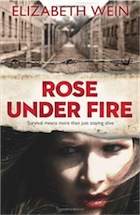
Rose Under Fire is a grippingly truthful story about survival and hope in a harsh world. The majority of the plot takes place in a German prison camp during 1945. From the start I loved the fairly sparse prose, which is interspersed with poems, the determined and feisty characters, and the author's brutal honesty in dealing with confronting subject matter. The historical facts were in no way forced on the reader but gently revealed over the course of the story.
For me, what made the story so compelling was the prose, uncrowded by excessive description but still pulling the reader into the story. Rose (the narrator's) poems were a beautiful touch, as she struggles to understand the atrocities she sees through the power of the written word. The poems eventually become one of few sources of hope for the characters, relating to their stories in a slightly abstract way.
Rose is a delivery pilot for the Royal Air Force, taxiing pilots and delivering planes in need of repair to airfields across Britain. Despite the frequent air-raids, the fighting is far away and Rose isn't even allowed to fly to France, an adventure which she longs to have. When Rose is taken prisoner by the Germans, her family and friends are convinced that she is dead, vanished like so many others.
At Ravensbrück, a real prison camp for political prisoners during WWII, Rose fights for her survival in appalling conditions but also forms incredible bonds with other women also imprisoned there, some of whom have been crippled because of being illegally experimented on by Nazi doctors. While this aspect of the novel may be considered rather grim and gruesome by some, I was glad that the book didn't romanticise the prison camp and the outlook is amazingly positive, given the circumstances. As Rose writes in one of her poems:
Hope waits stubbornly,
Watching the sky
for turmoil, feeding on
things that fly…
Even when some of the characters get out of the prison camp, leaving many of their friends to die, the real world is almost scarier than Ravensbrück to them, especially when they are forced to "tell the world" about the ordeals they went through. I found this aspect of the plot particularly moving and heart-rending.
I was absolutely delighted to discover that some of the characters from Elizabeth Wein's other novel, Code Name Verity, featured in this book too. Out of purely selfish reasons I would have liked to have heard a bit more about them but I understand that this book is Rose's story and that their stories did conclude in Code Name Verity. It was fun to find all the links between the two stories and to compare them, since this is a must-read for fans of Code Name Verity, although the order you read them in doesn't particularly matter.
All historical fiction requires extensive research, of course, and I have never read a better example of a well-researched novel. I later found out that the author actually spent a week at the real Ravensbrück camp! While some facts have been simplified to help the story flow, the horrific ordeals that the women experienced were real. I think that it takes a skilled author to write a novel so historically accurate that doesn't cram the reader's head with facts and figures.
Rose Under Fire is a beautiful, captivating novel that manages to bring hope to a sad story and brings the terror of war to life. It will certainly stay vivid in readers' minds long after they have closed the book. Young adult literature needs more historical fiction like this! I would highly recommend it to anyone ages 12 and up.
• Buy this book at the Guardian Bookshop.
Want to tell the world about a book you've read? Join the site and send us your review!